


AI agents in business have crossed the line from experiment to operating standard in 2026. The proof sits in the numbers. Gartner forecasts that 40 percent of enterprise applications will embed task-specific AI agents by the end of 2026, up from under 5 percent in 2025. Surveys back this up: roughly 79 percent of companies now report adopting AI agents in some form, and 88 percent of executives plan to grow their AI budgets in the next twelve months because of agentic AI.
The money follows the momentum. Analysts size the global AI agents market at around 10.9 billion dollars in 2026, up from about 7.6 billion in 2025, and they project it past 50 billion dollars by 2030 at a growth rate near 45 percent a year. Returns are real too. Independent surveys put the median payback period near 5 months, and customer service deployments often turn positive inside 4 months. These figures explain why AI-powered business automation now dominates boardroom agendas worldwide.
This guide breaks down what AI agents actually do, how businesses use AI agents in 2026 to replace manual work, the measurable benefits, real company examples, the best categories of AI agents for business automation, and how AI agents will change workplaces. It also covers how US business leaders read this shift, because America still drives the largest slice of global spending.
What Are AI Agents in Business?
An AI agent is software that pursues a goal on its own. It plans the steps, calls the tools it needs, makes decisions, and finishes multi-step work with little human input. A chatbot waits for a question and answers it. An agent takes a goal and gets the job done.
Think of the gap this way. You ask a chatbot to draft an email and it writes one. An agent reads your inbox, spots the leads that need a reply, drafts each message in your voice, logs the activity in your CRM, and flags the few cases that need your judgment. The model underneath can be the same. The category of output is completely different.
Every working agent shares four parts:
- A reasoning model that plans and decides, the brain of the system.
- Memory that lets it remember context across steps and sessions.
- Tools and integrations that connect it to your CRM, ERP, email, and databases.
- A runtime that executes the steps, verifies results, and escalates when unsure.
Why AI Automation in Business Is Exploding in 2026
For years AI mostly gave advice. It summarized data and suggested next steps while people did the actual work. In 2026 agents do the work. This jump from insight to action is the reason AI for business operations moved from a nice extra to a core investment.
Three forces drive the surge:
- Reasoning models got good enough to handle real workflows, not just answer trivia.
- Companies connected agents to live systems, so an agent can update a record or process an invoice instead of only describing one.
- The economics turned clear. Teams measure hours saved per worker each week, and many report 30 to 50 percent cost cuts in the functions they automate first.
The shift also marks the end of older automation for many use cases. Traditional scripted automation followed fixed rules and broke the moment an input changed. Agents read context, reason through exceptions, and keep going. That single difference is why so many businesses now move from rigid scripts to agentic systems.
How AI Agents Are Replacing Manual Work
Below are the functions where AI assistants for businesses already replace hours of repetitive effort. Each one follows the same pattern. The agent handles the routine flow end to end while people review the exceptions.
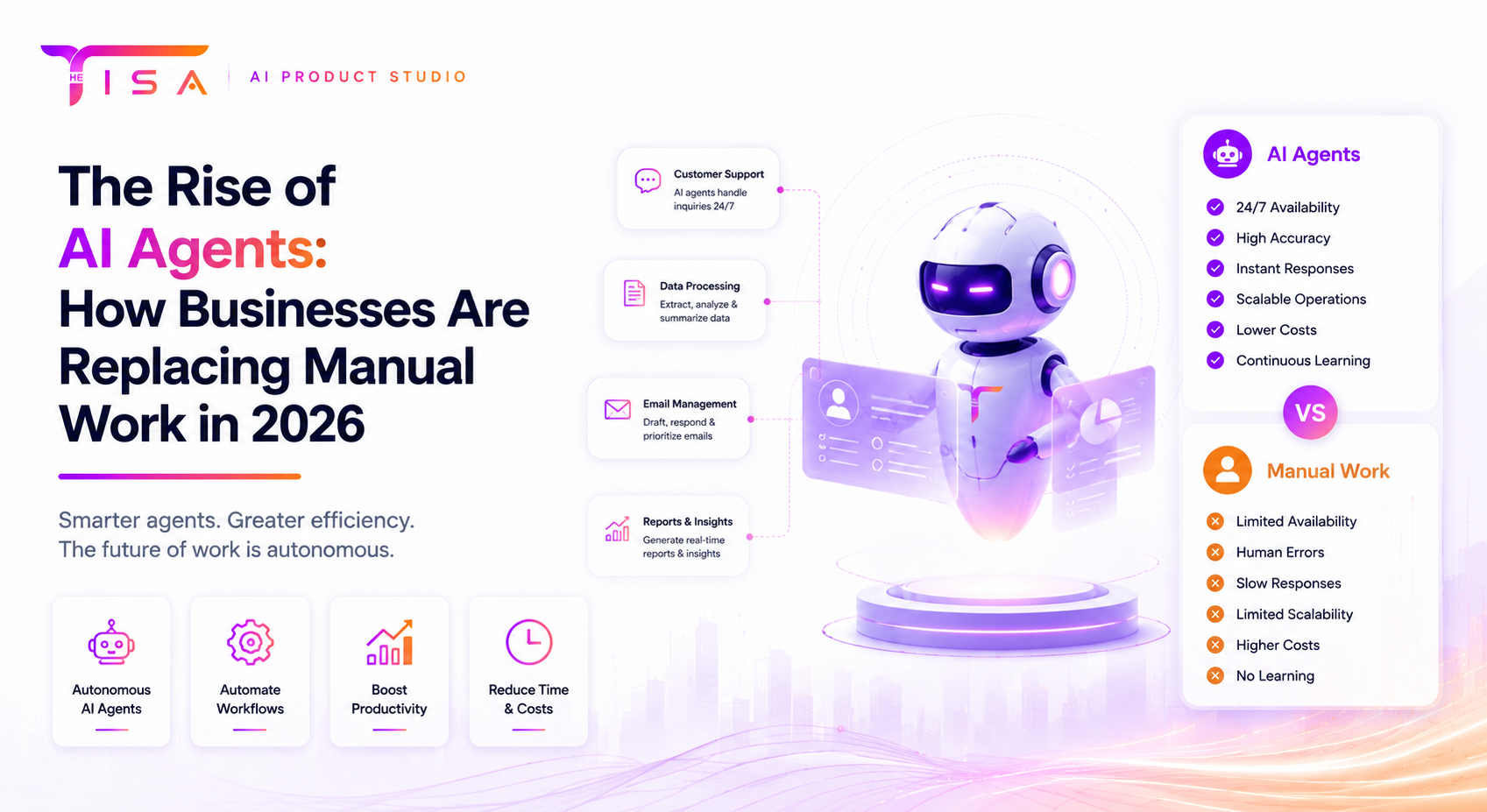
Customer support. AI agents resolve tier-one tickets on their own. They pull answers from manuals and past cases, respond in seconds at any hour, and hand off complex issues to humans with full context attached. Customer service usually delivers the fastest payback of any function.
Sales and lead operations. Agents score the whole pipeline, draft personalized outreach, update CRM records after every interaction, and trigger follow-ups. Teams report sharp lifts in qualified pipeline and reply rates without adding headcount.
Finance and accounting. Agents read invoices, extract the fields, match them against purchase orders, and write the result into the accounting system. They also flag unusual transactions for review. Manual data entry shrinks by most of its old volume.
Human resources. Agents screen resumes, schedule interviews, send onboarding paperwork, and answer routine policy questions. Work that took recruiters days now takes minutes.
Operations and supply chain. Agents track shipments, predict demand, reorder stock, and warn the right team about delays before they hit customers. Companies report faster response to disruptions and far fewer manual interventions.
IT and engineering. Agents review system alerts, open incident tickets, read pull requests, run tests, and suggest fixes. Software work has become one of the highest-value agent categories.
Benefits of AI Agents for Businesses
- Lower costs. Companies cut operating costs by 30 to 50 percent in the first functions they automate.
- Faster work. Agents process data and act in seconds, so leads get instant replies and approvals stop waiting in queues.
- Fewer errors. Agents follow the same verified steps every time, which removes the slips that come with manual entry.
- Real scale. One agent handles volume that once needed several assistants, so teams grow output without growing headcount.
- Better focus. People hand off the boring repetitive work and spend their time on strategy, creativity, and relationships.
- Round-the-clock coverage. Agents work nights, weekends, and holidays, so service never sleeps.
Examples of AI Agents in Companies
Real deployments show the range. A retail business-development team used agents to automate brand tracking, funding research, identity checks, and email drafting. The system saved about 75 percent of manual admin time, lifted outreach capacity several times over, and improved reply rates while growing a qualified pipeline without new hires.
In customer support, AI service agents now join nearly every conversation at some companies and resolve the majority of cases end to end. In supply chains, large consumer brands report forecast accuracy climbing from the high sixties to the low nineties after adopting predictive agents, which cut hundreds of millions in excess inventory. These are not lab demos. They are production systems with measured results.
Best AI Agents for Business Automation by Category
There is no single best agent. The right choice depends on the workflow you automate. Pick by category:
- Customer service agents. Best starting point because the ROI is clearest and the payback is fastest.
- Sales and outreach agents. Strong for lead qualification, enrichment, and follow-up at scale.
- Finance and document agents. Ideal for invoice processing, expense matching, and reporting.
- Marketing agents. Useful for content production, campaign drafting, and research.
- Operations and IT agents. Built for monitoring, ticketing, and supply-chain coordination.
One rule holds across every category. A general-purpose agent rarely beats a focused one. An agent that knows your market, your data, and your rules wins. That is why so many companies now build custom agents around how their business already works rather than forcing the business to fit a generic tool.
How US Business Leaders View the Rise of AI Agents
North America leads the global market on spending, cloud maturity, and the density of its AI vendor ecosystem. The US enterprise agentic AI market alone was valued near 770 million dollars in 2024 and keeps growing above 43 percent a year. American executives treat agents as a competitive race, not a science project.
Their optimism comes with discipline. US leaders now ask harder questions. They want to know which workflow to automate first, what governance to put in place, and when the investment pays back. The reason is sobering. Only about a quarter of AI initiatives have delivered the returns leaders expected, and Gartner warns that more than 40 percent of agentic projects risk cancellation by 2027 when teams skip governance and clear value. So US buyers increasingly start with one high-volume workflow, prove the numbers, then scale what works.
Globally the pattern differs by region. Europe prioritizes auditability and compliance under GDPR and new AI rules. Markets like India, Singapore, and Japan push fast experimentation in ecommerce and support, driven by cost efficiency and scale. The direction is the same everywhere. Agents are becoming a foundational layer of business software.
How AI Agents Will Change Workplaces
Agents will not empty the office. They will reshape what people do inside it. The clearest signal comes from developers. Gartner expects that by the end of 2026 most engineers will spend more time orchestrating and reviewing AI work than writing every line themselves.
Expect three changes. Routine execution moves to agents. People move up to judgment, strategy, and exception handling. And new roles appear, from agent orchestrators to people who govern what agents are allowed to do. The workforce study from the World Economic Forum frames the bigger picture. Automation displaces some roles while creating a larger number of new ones over the rest of the decade.
The winners will treat agents as digital teammates, not magic buttons. They will train their people to work alongside agents, set clear guardrails, and keep humans in the loop on the decisions that carry risk.
How to Start With AI Agents in 2026
- Pick your biggest bottleneck. Choose the workflow that costs the most time and money first.
- Clean your data. Agents perform only as well as the data they reach, so connect and tidy your systems first.
- Build a focused pilot. Run one workflow with one team for 60 to 90 days and track real metrics.
- Set governance early. Define what the agent does on its own, what needs human review, and how every action gets logged.
- Scale what works. Expand the wins across teams and keep refining as your needs change.
At “The TISA“ we build custom AI agents designed around how your business actually works. We help you choose the right first workflow, connect it to your systems, and scale it with the governance that turns a pilot into a deal-closing engine.
Frequently Asked Questions
Q.1 What are AI agents in business?
AI agents in business are software systems that pursue a goal on their own. They plan the steps, use your tools, make decisions, and finish multi-step tasks with little human input. Unlike a chatbot that only answers questions, an agent completes the job. Learn more from Google Cloud on agentic AI.
Q.2 How are AI agents different from chatbots and RPA?
A chatbot answers a question and old-style robotic automation follows a fixed script that breaks when inputs change. An agent reasons through variable conditions and adapts to exceptions. See IBM on AI agents for a deeper explainer.
Q.3 How big is the AI agents market in 2026?
Analysts size the global AI agents market near 10.9 billion dollars in 2026 and project it past 50 billion by 2030 at roughly 45 percent annual growth. The full breakdown is in Grand View Research.
Q.4 What ROI can businesses expect from AI agents?
Independent surveys put the median payback period near 5 months, with customer service often turning positive inside 4 months. Returns vary widely, so governance and data quality decide who captures the gains. See the McKinsey State of AI for benchmarks.
Q.5 Which business function should adopt AI agents first?
Customer service is the most common starting point because it has the clearest ROI and the shortest payback. Sales operations and finance usually follow. Background reading is available from Gartner on agentic AI.
Q.6 Will AI agents replace jobs?
Agents replace repetitive tasks more than whole jobs. They shift people toward strategy, judgment, and exception handling and create new roles in orchestration and governance. The World Economic Forum Future of Jobs report covers the workforce outlook.