


US hospitals and physician practices rarely lose revenue because care wasn’t delivered. They lose it after the visit: a coverage change nobody caught, a prior authorization that expired, a code the documentation didn’t support, a denial nobody had time to appeal. Each of these is a small administrative miss. Together they slow cash, inflate the cost of collecting it, and tie up billing staff in rework.
That’s where AI in healthcare claims and revenue cycle management (RCM) earns its place. RCM covers every step from scheduling and eligibility through coding, claims, payment posting and collections. Most of those steps are repetitive, rule-heavy and document-heavy, which is the work AI handles well when people stay in charge of the judgment calls.
This guide examines how AI fits across the revenue cycle, connects with electronic health record (EHR) and billing systems, and addresses the 2026 federal and state regulations that shape implementation. It also covers protected health information (PHI) security, the KPIs used to measure results and a phased implementation approach for healthcare organizations.
For teams planning a build, AI software development for healthcare provides relevant context on the technical side of healthcare software.

Key Takeaways
- Start where rules are clear and volume is high. Eligibility, claim scrubbing, denial triage and electronic remittance advice (ERA) analysis pay back fastest and carry the least clinical risk.
- Prior authorization is now on a federal clock. Under the Centers for Medicare & Medicaid Services (CMS) Interoperability and Prior Authorization Final Rule (CMS-0057-F), impacted payers must decide most standard requests for medical items and services within 7 calendar days and expedited ones within 72 hours. They must also offer a Fast Healthcare Interoperability Resources (FHIR) Prior Authorization API by January 1, 2027.
- AI drafts; licensed people decide. Code selection on complex encounters, medical-necessity arguments and appeal letters need a human approver.
- Every vendor that handles PHI needs a Business Associate Agreement (BAA), minimum-necessary access and an audit trail.
- Define your KPIs before you automate. Without a baseline that uses consistent formulas, you can’t prove return on investment (ROI).
Why revenue cycle teams are turning to AI now
Denials are common and rarely appealed. KFF’s analysis of federal transparency data found that HealthCare.gov insurers denied nearly 1 in 5 in-network claims in 2023 (19%). Rates ranged from 1% to 54% across insurers, and about 1% of denials were appealed. Where reasons were reported, administrative issues (18%) and missing prior authorization or referral (9%) were cited more often than medical necessity (6%). Those are process failures, and process is what automation can fix. These figures cover one market segment, so treat them as an indicator, not your baseline.
Prior authorization consumes whole jobs. In the American Medical Association’s (AMA) late-2024 survey of 1,000 physicians, practices completed an average of 39 prior authorizations per physician per week, taking about 13 hours of physician and staff time. 40% of physicians had staff who worked only on prior authorization.
Manual transactions still cost billions. The CAQH Index estimates more than $20 billion a year in further savings if remaining manual and partly manual administrative transactions moved to electronic workflows. CAQH also reports that more than half of health plans now use AI in administrative workflows, compared with about a quarter of provider organizations.
Payers are automating faster than the providers who bill them. An RCM AI program doesn’t replace your billing team. It gives the same team enough capacity to work every denial and catch errors before claims go out.
Where AI fits in healthcare claims and revenue cycle management
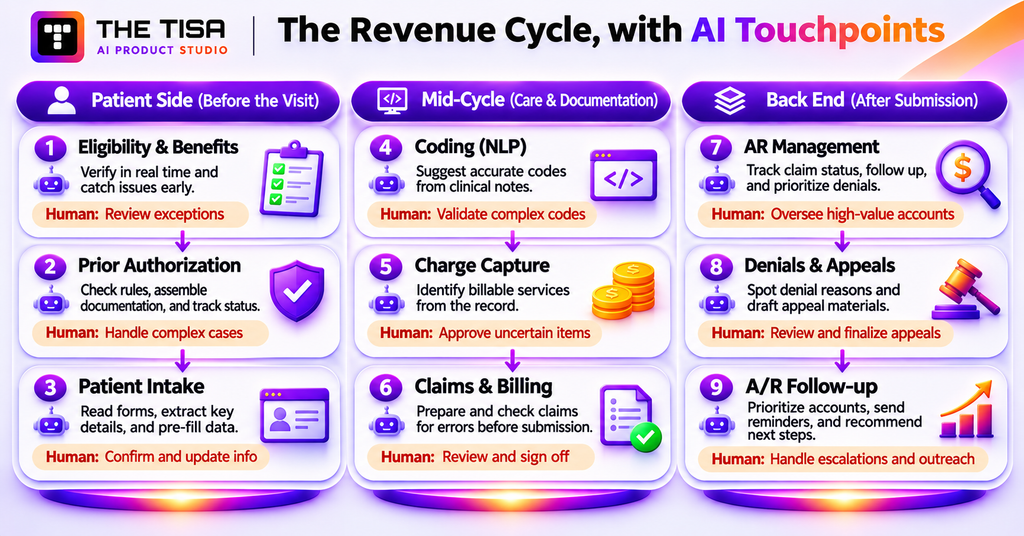
The revenue cycle has three phases: the front end (before the visit), mid-cycle (documentation to claim) and the back end (after submission). Most of the data moves through standard X12 electronic data interchange (EDI) transactions:
- 270/271: eligibility inquiry and response
- 278: prior authorization
- 837: claim
- 276/277: claim status
- 835: remittance, also called the ERA
| Stage | What AI does | Data and transactions | Who approves |
|---|---|---|---|
| Eligibility and benefits | Runs checks before and on the day of service; flags inactive coverage, coordination-of-benefits issues and high patient responsibility | X12 270/271, payer portals | Front-desk or patient access staff |
| Prior authorization | Detects when an order needs authorization, assembles documentation, submits and tracks status | X12 278, HL7 Da Vinci FHIR APIs, portals | Clinician signs the medical-necessity narrative |
| Coding | Natural language processing (NLP) suggests diagnosis and procedure codes, with evidence highlighted | EHR notes, orders, problem lists | Certified coder |
| Charge capture | Compares documented services with charges | EHR orders, chargemaster, charge lines | Charge-integrity analyst |
| Claim scrubbing and denial prediction | Applies payer rules and National Correct Coding Initiative (NCCI) edits, then scores each claim’s denial risk | X12 837, payer rules, past 835 outcomes | Biller fixes high-risk claims |
| Remittance and underpayments | Groups denials by Claim Adjustment Reason Code (CARC) and Remittance Advice Remark Code (RARC); compares payments with contract rates | X12 835, payer contracts | Analyst approves variance disputes |
| Denials and appeals | Routes denials by type; drafts appeals from cited records | 835, EHR, payer policies | Staff or clinician edit and sign |
| Accounts receivable (A/R) follow-up | Ranks open claims by expected value; automates status checks | X12 276/277, A/R aging | Collectors work the ranked queue |
| Patient financial experience | Prepares cost estimates, plain-language statements and payment-plan options | Eligibility, fee schedules | Staff handle financial-assistance cases |
1. Eligibility and benefits verification
Eligibility errors are the cheapest denials to prevent. An AI agent can run batch 270/271 checks two or three days before appointments, re-check on the day of service, and read the free-text parts of 271 responses that rules engines often miss: a behavioral-health carve-out, a plan that ended last month, a secondary payer the patient didn’t mention. The output is an exception queue, so staff call only the patients who need a call. This is a natural first project for AI workflow automation.
2. Prior authorization
Prior authorization is where AI saves the most staff time. A well-designed prior-auth agent works in four steps:
- It checks the payer’s rules to see whether an order needs authorization, using the payer’s Coverage Requirements Discovery (CRD) API as payers launch them.
- It pulls the relevant notes, imaging and lab results from the EHR, limited to what the payer’s documentation rules require.
- It drafts the medical-necessity summary for a clinician to approve.
- It submits through the payer’s API, the X12 278 transaction or a portal, then tracks status and escalates before the decision deadline or the authorization’s expiry.
The clinician’s approval matters because the request is a clinical statement made on the provider’s behalf. Our AI agent development work builds this kind of tool-using agent with approval steps built in.
3. Clinical documentation and AI medical coding
NLP and large language models can read a clinical note and suggest ICD-10-CM diagnosis codes and CPT or HCPCS procedure codes, highlighting the sentence that supports each one. For high-volume, lower-complexity encounters, coders review instead of starting from scratch. For complex inpatient stays, surgery and risk-adjustment coding, the model only suggests and a certified coder decides.
Two safeguards matter more than raw model accuracy. First, every suggested code must link to evidence in the record. Second, track coder overrides by code family. A suggestion that coders often reject points to a model or documentation problem you want to find early.
4. Charge capture
A missed charge never becomes a denial. It simply never becomes revenue. AI can reconcile documented procedures, supplies, infusions and timed services against what was charged, then flag likely gaps for a charge-integrity analyst.
5. Claim scrubbing and denial prediction
Traditional scrubbers apply fixed edits: missing modifiers, invalid code pairs under CMS’s National Correct Coding Initiative, and mismatched demographics. Machine learning adds a second layer. A model trained on your own 837 claims and 835 outcomes predicts which clean-looking claims a specific payer is still likely to deny, and why. A biller then fixes the highest-risk claims before they go out. The model is only as good as your remittance history, so consistent 835 posting comes first.
6. Remittance analysis and underpayment detection
Every 835 explains what the payer paid and why, using standard CARC and RARC codes. Healthcare claims analytics can turn thousands of these into a root-cause view by payer, location, provider and code, and compare each payment with your contracted rate. Underpayments are often small per claim but large in total, and few teams have time to chase them by hand.
7. AI denial management and appeals
Once a denial arrives, AI can classify it (eligibility, authorization, coding, medical necessity, timely filing or duplicate), route it to the right person, and draft an appeal. Drafting is useful, but it’s also where unsupervised AI is riskiest. An appeal that invents a clinical fact or misquotes a policy is worse than no appeal. Retrieval-augmented generation (RAG) limits the model to drafting from documents it can cite, and a person still edits and signs the appeal. Figure 3 shows the full workflow.
8. A/R prioritization and claim status
Instead of working A/R oldest-first, rank open claims by expected recoverable value and likelihood of payment. Automated 276/277 status checks remove most “just checking” calls and portal visits, so collectors spend their time on claims that need negotiation.
9. Patient financial experience
AI can produce good-faith cost estimates from eligibility and fee-schedule data, explain bills in plain language and offer payment plans. Financial-assistance and hardship decisions stay with people, because they carry legal and reputational weight.
The 2026 rules that shape RCM AI design
Regulatory information, not legal advice. This section summarizes federal and state rules as of November 3, 2026, for educational purposes. Rules, guidance and enforcement change. Confirm current requirements with qualified counsel before you make compliance decisions.
| Rule | Who it applies to | What it requires, and when | What it means for AI design |
|---|---|---|---|
| CMS Interoperability and Prior Authorization Final Rule (CMS-0057-F) | Medicare Advantage organizations; state Medicaid and Children’s Health Insurance Program (CHIP) fee-for-service programs; Medicaid managed care plans and CHIP managed care entities; qualified health plan (QHP) issuers on the Federally Facilitated Exchanges | Since January 1, 2026: Decisions on prior authorization for medical items and services within 72 hours (expedited) and 7 calendar days (standard), plus a specific reason for every denial. QHP issuers on the Federally Facilitated Exchanges are excluded from the decision timeframes. Drugs are excluded from these provisions. Program rules still allow extensions in limited circumstances, such as when more information is needed. Payers posted their first annual prior-authorization metrics by March 31, 2026. By January 1, 2027: a FHIR Prior Authorization API, Provider Access API and Payer-to-Payer API | Submit complete requests the first time, capture specific denial reasons as structured data, and plan to submit through payer FHIR APIs as each payer launches them |
| HIPAA transaction enforcement discretion | HIPAA covered entities implementing the CMS-0057-F Prior Authorization API | HHS won’t take enforcement action against covered entities that use an all-FHIR Prior Authorization API instead of the X12 278 standard. The X12 278 alone can’t meet CMS-0057-F’s API requirements. | Support both FHIR and X12 278 routes, because payers will move at different speeds |
| CMS WISeR Model | Providers billing Original Medicare (not Medicare Advantage) in Arizona, New Jersey, Ohio, Oklahoma, Texas and Washington, for a defined list of services | Runs January 1, 2026 through December 31, 2031. Technology vendors use AI-assisted review of prior authorization requests, and clinicians review denials. In April 2026, CMS delayed two of the original 15 services. | Check whether your services and states are in scope, and track WISeR decisions separately from your commercial and Medicare Advantage prior-auth work |
| 42 CFR § 422.101(c) and CMS’s February 2024 Medicare Advantage FAQs | Medicare Advantage organizations making basic-benefit coverage and medical-necessity determinations | Plans may use algorithms or AI to assist, but the determination must rest on the individual patient’s circumstances, not on a larger dataset alone. | Expect payer decisions to cite patient-specific facts. Make sure your submissions include them. |
| California SB 1120 (“Physicians Make Decisions Act”) | California health care service plans and disability insurers, and the entities they contract with for utilization review (UR) or utilization management | Since January 1, 2025: AI used in these reviews must rely on the individual’s clinical information. Only a licensed physician or qualified health professional may make the medical-necessity decision, and the tools are subject to audit. | A guide to where regulators are heading on AI-assisted coverage decisions. It doesn’t apply directly to provider billing. |
| HIPAA Security Rule and the proposed update (NPRM) | Covered entities and business associates | The current Security Rule applies today. The notice of proposed rulemaking (NPRM) from January 2025 is only a proposal, not law. HHS’s 2026 regulatory agenda lists final action no earlier than July 2027. | Meet the current rule. You can treat the proposal’s controls (asset inventory, multifactor authentication, encryption) as good practice, not as a legal requirement. |
Status of WISeR. As of late October 2026, WISeR was still operating. A Columbus Dispatch report republished by Becker’s described early delays in Ohio, and CMS said the problems had been resolved. A Senate resolution to overturn the model, S.J.Res.192, was placed on the Senate calendar in June 2026. We found no record of it passing as of November 3, 2026. Check congress.gov before you rely on this.
Why provider teams should care. Most of these rules bind payers, but they change your side of the workflow. Faster deadlines only help if requests arrive complete. Specific denial reasons only help if you capture them as data. And as payers automate their reviews, providers still working by fax and portal fall further behind. Payer-side teams can see how we approach claims operations on our AI solutions for insurance workflows page.
HIPAA, BAAs and third-party risk
AI in RCM handles PHI at almost every step, so HIPAA applies to the whole pipeline, not only the model.
- Business Associate Agreements. Any vendor that creates, receives, maintains or transmits PHI on your behalf is a business associate and needs a BAA. That includes the AI platform, the model provider if PHI reaches it, the cloud host and the clearinghouse. HHS’s cloud computing guidance says a cloud provider storing encrypted PHI is still a business associate, even without the encryption key.
- Minimum necessary. A prior-auth agent doesn’t need the whole chart. Limit each agent to the fields and documents its task requires, following HHS’s minimum necessary standard.
- Access control and audit logging. The Security Rule requires access controls and audit controls for systems that hold electronic PHI. In practice, log which person or agent accessed which record, what the model suggested, who approved it and what was submitted.
- Clearinghouse resilience. In February 2024, a ransomware attack on Change Healthcare, a clearinghouse that processes claims for hundreds of thousands of providers, disrupted claims processing for months (see HHS’s Change Healthcare FAQ). It ultimately affected about 192.7 million people. Design your automation to route claims through a second clearinghouse, and test that failover.
For general HIPAA requirements for AI products, see HIPAA-compliant AI use cases in healthcare. Our approach to security and data protection explains how we handle client data.
A secure reference architecture for AI claims processing
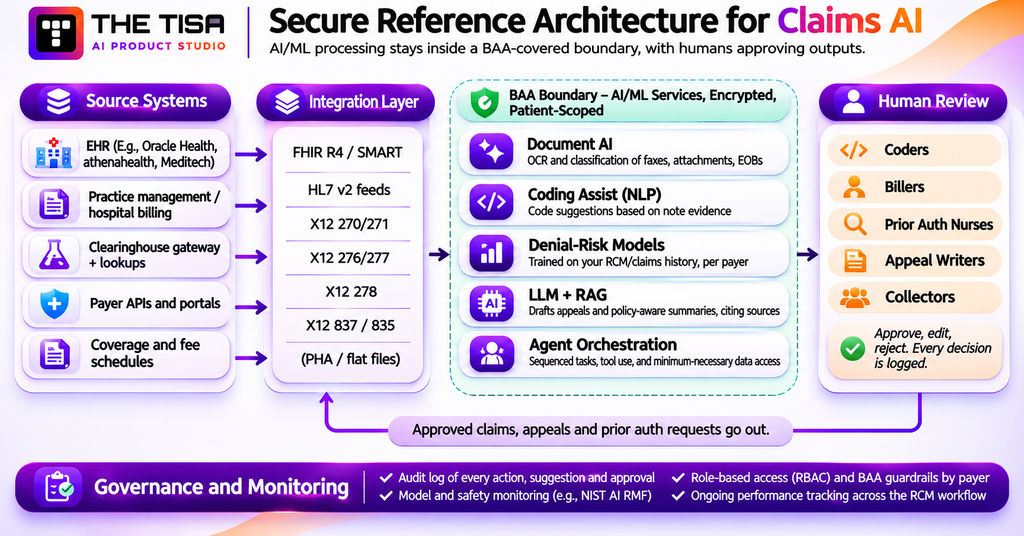
A production RCM AI system usually has five layers:
- Source systems. The EHR (for example Epic, Oracle Health, athenahealth or NextGen), practice management or hospital billing, primary and backup clearinghouses, payer APIs and portals, and contract management.
- Integration layer. HL7 (Health Level Seven) FHIR R4 and SMART on FHIR where the EHR supports them, HL7 v2 feeds, and X12 EDI through the clearinghouse. Robotic process automation (RPA) for portals is a last resort, and it’s monitored. Our comparison of AI agents vs. traditional automation explains when each fits. For older billing platforms, see integrating AI with legacy systems.
- AI services inside the PHI boundary. These include document AI for faxes and attachments, NLP coding suggestions, denial-risk models, and a large language model with RAG over payer policies and your appeal history. All of it runs in a BAA-covered environment with encryption, private networking and no training on your data without permission.
- Human review queues. Coders, billers, prior-auth nurses and appeal writers see each AI suggestion beside its evidence and approve, edit or reject it. Every decision is recorded.
- Governance and monitoring. Audit logs, role-based access, model performance dashboards by payer and code family, drift alerts and an incident runbook. The NIST AI Risk Management Framework and our generative AI governance guide give this layer a structure.
If AI suggestions will appear inside a certified EHR as decision support, ask your EHR vendor how it meets ONC’s HTI-1 decision support intervention transparency requirements. (ONC is the Office of the National Coordinator for Health Information Technology.) Those requirements apply to certified health IT developers, but they shape what clinicians expect to see.
Augment, don’t replace: keeping humans in the loop
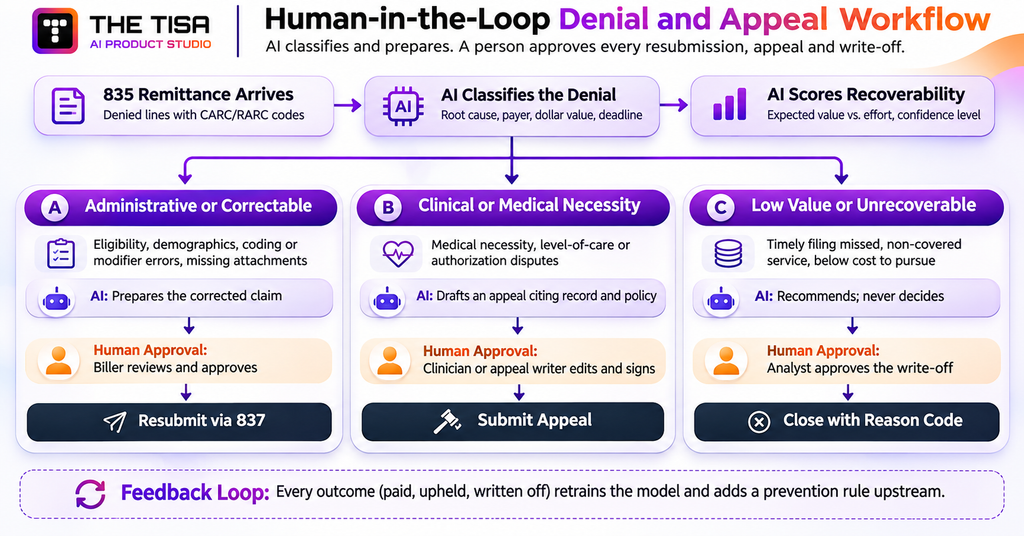
The best RCM AI programs follow one rule: automate the work, not the judgment. A practical way to apply it is to give each task one of three autonomy levels.
| Level | AI does | A person does | Good fits |
|---|---|---|---|
| Automated with audit | Completes the task and logs it | Reviews a sample of results each week | Eligibility re-checks, claim-status checks, posting clean payments, non-clinical scrubber edits |
| Suggest and approve | Prepares the work with evidence | Approves, edits or rejects every item | Coding suggestions, prior-auth packets, corrected claims, underpayment disputes, A/R ranking |
| Assist only | Summarizes and retrieves | Makes the decision and writes the final output | Medical-necessity arguments, complex inpatient coding, clinical appeals, write-offs, financial assistance |
Move a task up a level only when the data shows it’s ready. For example, coders might accept the suggestions for one stable encounter type unchanged more than 98% of the time for three months. Move it back down when accuracy drops or a payer changes its rules.
KPIs that prove RCM AI is working
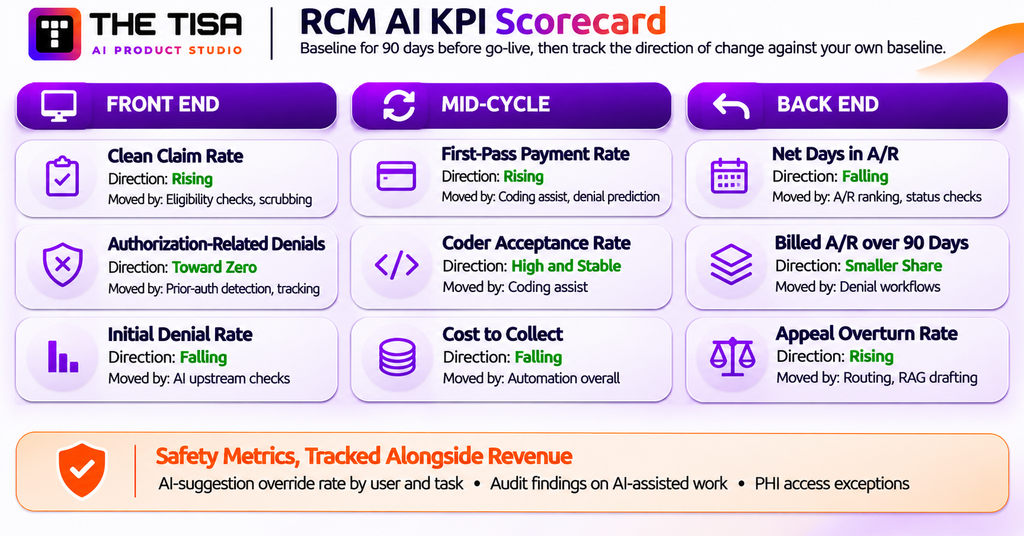
A KPI is only useful if everyone calculates it the same way. The definitions below follow the HFMA MAP Keys where a MAP Key exists. Baseline each KPI for at least 90 days before go-live, then report it monthly by payer and location using the same formula.
| KPI | How to calculate it | Measurement notes | AI use case that moves it |
|---|---|---|---|
| Clean claim rate | Claims that pass all edits with no manual intervention ÷ claims accepted into the claims-processing tool (HFMA CL-1) | Count each claim once, at its first scrub. If you measure at clearinghouse or payer acceptance instead, say so and keep that point fixed. | Eligibility checks, payer-specific scrubbing |
| First-pass payment rate | Claims paid as expected on first submission, with no correction, resubmission or appeal ÷ claims adjudicated in the period | Separate from clean claim rate: a claim can be clean and still be denied or underpaid. | Coding assist, denial prediction |
| Initial denial rate | Claims denied on first adjudication ÷ claims adjudicated | State whether you count claims or claim lines. HFMA’s remittance denial rate (AR-5) also counts denials on appeal, so don’t compare the two directly. Track the final denial rate (denials written off after all appeals) separately. | All front-end and mid-cycle use cases |
| Authorization-related denials | Denials with authorization-related CARCs (for example 15 and 197) ÷ claims adjudicated | Report by payer and service line. | Prior-auth detection and tracking |
| Net days in A/R | Net patient A/R ÷ average daily net patient service revenue (HFMA FM-1) | Uses the net receivable on the balance sheet, after expected contractual adjustments; state the averaging period (often three months). | A/R ranking, automated status checks, appeals |
| Billed A/R over 90 days | Billed A/R older than 90 days ÷ total outstanding billed A/R (HFMA AR-1 aging buckets 91–120 and over 120 days) | The denominator is outstanding billed A/R, not claims submitted. Age from the date of service or discharge, consistently. | Denial workflows, A/R prioritization |
| Cost to collect | Total revenue cycle cost ÷ total patient service cash collected (HFMA FM-6) | Include vendor and AI platform costs in revenue cycle cost. | Automation across the cycle |
| Net collection rate | Payments ÷ (charges − contractual adjustments) for the same date-of-service cohort | Contractual adjustments are the difference between charges and the payer’s contracted allowed amount. Measure a cohort once its claims are at least 120 days old. HFMA’s cash collection measure (FM-2) is a related trend indicator. | Whole program, especially underpayment recovery |
| Appeal overturn rate | Appeals resulting in payment ÷ appeals resolved | Track alongside appeal volume. A rising rate on falling volume can hide missed revenue. | Denial routing, RAG appeal drafting |
| Coder acceptance rate | AI code suggestions accepted unchanged ÷ suggestions reviewed | Report by code family and encounter type. | Coding assist |
| Automation rate | Two separate measures: fully automated (tasks completed with no human touch ÷ all tasks) and AI-assisted (tasks AI prepared and a person approved ÷ all tasks) | Never combine them. Most clinical and financial tasks should stay AI-assisted. | All use cases |
About benchmarks. We don’t publish universal target numbers, because results depend on specialty, payer mix, claim complexity and how mature your current processes are. A behavioral-health group and a hospital outpatient department can both be well run with very different days in A/R. Set targets from your own baseline, and use peer benchmarks (such as those in HFMA’s MAP App) only when they’re calculated the same way.
Track two safety metrics beside the financial ones: the AI-suggestion override rate by user and task, and audit findings on AI-assisted work. If revenue rises while overrides and audit findings also rise, you have a compliance problem, not a success.


A phased roadmap you can run
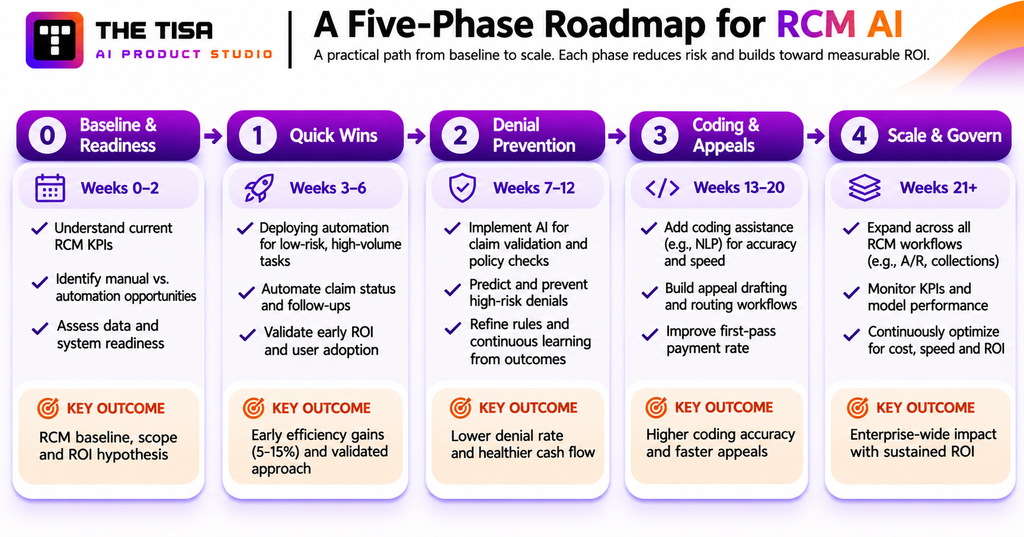
| Phase | Typical timing | What you do | Exit test |
|---|---|---|---|
| 0. Baseline and readiness | Weeks 0–4 | Pull 12–24 months of 837/835 data, map denials by CARC and payer, sign BAAs, name approvers | KPI baseline signed off; top five denial causes known by dollar value |
| 1. Quick wins | Weeks 4–10 | Eligibility exception queue, automated claim status, 835 root-cause dashboard | Measurable staff time saved; no PHI incidents |
| 2. Denial prevention | Months 3–5 | Payer-specific scrub rules, denial-risk scoring, prior-auth detection and tracking | Initial and authorization-related denial rates falling against baseline |
| 3. Coding and appeals assist | Months 5–9 | NLP coding suggestions for selected encounter types; RAG appeal drafting with human sign-off | Stable coder acceptance; appeal volume and overturn rate up |
| 4. Scale and govern | Month 9 onward | Payer FHIR prior-auth APIs as they launch (deadline January 1, 2027), more specialties, drift monitoring, quarterly model reviews | KPIs sustained; documentation ready for audit |
Timelines depend heavily on data access. Approvals for EHR and clearinghouse connectivity often take longer than building the models.
Build, buy or combine?
| Option | Best when | Watch out for |
|---|---|---|
| Buy AI-powered RCM software | Your workflows are standard and a vendor’s roadmap matches your priorities | Limited control over models, data use and payer-specific logic; another BAA to manage |
| Build custom | You’re an RCM company or software vendor where automation is your product, or your specialty and payer mix are unusual | You own monitoring, security and maintenance |
| Combine | You keep your core billing system and add custom agents for your biggest gaps, often denials, prior authorization or underpayments | Integration quality decides the outcome; agree who owns each workflow |
Most provider organizations combine the two. For budgeting, see our guide to AI agent development costs.
Seven mistakes that sink RCM AI projects
- Automating before measuring. Without a baseline, nobody can prove the project worked, and it loses funding at the next budget review.
- Training on inconsistent remittance data. If 835 posting varies by person, a denial model learns your posting habits instead of payer behavior.
- Letting AI submit clinical statements unsupervised. Prior-auth narratives and appeals are statements made for clinicians, so keep a human signature on them.
- Sending PHI to tools without a BAA. This includes staff pasting claim details into public chatbots. Provide an approved tool and block the rest.
- Relying on screen-scraping alone. Portal bots break whenever a payer changes a page. Use APIs and X12 first, and monitor any RPA closely.
- Ignoring payer-specific rules. A model with no payer-level tuning misses the patterns behind most denials.
- Treating go-live as the finish line. Payer policies, code sets and contracts change every year. Budget for monitoring and retraining from the start.
Example: what a 2-point denial reduction is worth
Assume a multi-specialty group submits 20,000 claims a month with an average expected payment of $180, and its initial denial rate is 10% (claims, first adjudication). That’s 2,000 denied claims and about $360,000 in delayed payments each month.
Suppose eligibility checks, payer-specific scrubbing and prior-auth tracking bring the initial denial rate down to 8%. Then:
- 400 fewer claims a month need rework.
- At an assumed $25 of staff time per reworked claim, that’s about $10,000 a month in avoided rework, or $120,000 a year.
- About $72,000 a month in payments arrives on first submission instead of weeks later. Claims that would never have been appealed are no longer at risk of write-off; KFF found only about 1% of denials were appealed in its data.
The bigger effect is often indirect. Staff who stop reworking preventable denials have time for the complex denials and underpayments that used to age out.
How THE TISA helps with healthcare revenue cycle automation
THE TISA is an AI and software development company. We design and build custom AI agents, workflow automation and integrations that work inside existing systems, with security and human review planned from the start. For healthcare claims and RCM, that typically means:
- Agents for high-volume RCM tasks: eligibility exceptions, prior-auth packet assembly and tracking, denial triage and appeal drafting, each with an approval step.
- Integration with EHRs, practice-management systems and clearinghouses over FHIR, HL7 v2 and X12, without replacing your system of record.
- Policy-grounded drafting with RAG, so appeals and prior-auth summaries cite the payer policy and the patient record.
- Governance built in: BAAs wherever PHI is handled, role-scoped access, encryption, audit logging and KPI dashboards.
Some limits we state up front. Software supports HIPAA compliance but doesn’t certify it; your compliance program remains responsible. We haven’t yet published a healthcare RCM case study. For examples of how we deliver AI inside operational workflows, see OpsPilot, an AI-powered admin portal, and Clove, an AI integration for a SaaS product. Both are outside healthcare. Our development process page explains how we scope, build and hand over projects.
Conclusion
The case for AI in healthcare claims and revenue cycle management rests on three numbers you already own: your denial rate, your cost to collect and your days in A/R.
- Denials are mostly preventable process failures. Automated eligibility checks, payer-specific scrubbing and prior-auth tracking reduce them before claims go out.
- Cost to collect falls as routine work moves to AI. The same team can then work every denial and underpayment.
- Cash arrives sooner when more claims pay first time, and when A/R is worked by value rather than by age.
The rules raise the stakes. Payers face federal prior-auth deadlines and a January 1, 2027 API requirement. Regulators are also signaling that AI may assist coverage decisions but licensed people must make them.
The organizations that benefit most will start with a measured baseline, pick the two or three stages that cost them the most, keep people in charge of clinical and financial judgment, and expand only when the KPIs show results.
Frequently Asked Questions
Q1. How is AI used in healthcare revenue cycle management?
Ans. AI checks eligibility, detects and assembles prior authorizations, suggests medical codes from clinical notes, scrubs claims and predicts denials before submission, analyzes 835 remittances for denial causes and underpayments, drafts appeals and prioritizes A/R follow-up. In each case it prepares work for people to approve, especially where clinical or financial judgment is involved.
Q2. Can AI reduce claim denials?
Ans. It can reduce avoidable ones. In KFF’s analysis of 2023 HealthCare.gov plan data, administrative issues and missing prior authorization or referral were cited more often than medical necessity as reasons for in-network denials. Eligibility checks, payer-specific scrubbing and prior-auth tracking target those causes. How much your rate falls depends on your denial mix, so measure a baseline first.
Q3. Will AI replace medical coders and billers?
Ans. No. AI handles high-volume, rules-based steps and drafts suggestions with evidence. Certified coders still approve codes, especially for complex encounters, and billing staff spend less time on rework and more on complex denials and underpayments.
Q4. What does the CMS prior authorization rule (CMS-0057-F) require?
Ans. For prior authorization of medical items and services (not drugs), impacted payers must decide expedited requests within 72 hours and standard requests within 7 calendar days, and give a specific reason for denials, starting January 1, 2026. Impacted payers are Medicare Advantage, Medicaid and CHIP programs and plans, and QHP issuers on the Federally Facilitated Exchanges. QHP issuers are excluded from the decision timeframes, and program rules allow extensions in limited cases. Payers must also offer a FHIR Prior Authorization API by January 1, 2027.
Q5. Is AI in medical billing HIPAA compliant?
Ans. It can be, but compliance depends on how the system is built and run, not on the AI itself. You need a BAA with every vendor that handles PHI, minimum-necessary access, access and audit controls, encryption and an updated risk analysis. Don’t send PHI to a public AI tool that won’t sign a BAA.
Q6. Can AI make medical necessity decisions?
Ans. AI can summarize records and compare them with criteria, but a licensed professional should make the decision. For California health plans, disability insurers and their utilization review vendors, SB 1120 requires that. For Medicare Advantage coverage determinations, CMS requires decisions based on the individual patient’s circumstances.
Q7. What’s the difference between clean claim rate and first-pass payment rate?
Ans. Clean claim rate measures claims that pass all edits without manual intervention before or at submission. First-pass payment rate measures claims that are paid as expected on the first submission, with no correction, resubmission or appeal. A claim can be clean and still be denied, so track both.
Q8. Does AI for RCM work with Epic, athenahealth and other EHRs?
Ans. Usually, yes, through HL7 FHIR R4, SMART on FHIR, HL7 v2 feeds and X12 transactions through your clearinghouse. The exact route depends on what your EHR vendor exposes, your contract and app-registration approvals, which often take longer than the build.
Q9. How long does it take to implement AI in revenue cycle management?
Ans. A focused first use case, such as an eligibility exception queue or 835 denial analytics, can often go live in 6-10 weeks once data access is approved. A broader program covering denial prediction, prior authorization, coding assist and appeals typically runs 6-12 months in phases.
Improve Healthcare Claims and Revenue Cycle Workflows with AI
Add AI to your existing healthcare billing and revenue cycle systems to reduce manual work, identify claim issues earlier, and improve denial management. Talk to THE TISA about building AI solutions that integrate with your existing EHR, billing software, and healthcare workflows.
Discuss Your Healthcare AI Project →