


B2B marketing has a timing problem. Your best prospects are researching on their own, often with AI assistants, and most of them would rather not talk to a salesperson until they’re close to a decision. By the time they fill out a form, they may have a shortlist. Meanwhile, generic outreach gets ignored, and your team spends hours on lists, follow-ups and reports instead of strategy.
AI-powered digital marketing helps with this in three ways:
- It spots buying signals earlier. AI reads intent data, website behavior and firmographic changes that a person would miss.
- It personalizes at scale. It helps tailor messages to each account without adding headcount.
- It handles routine work. Enrichment, scoring, routing and first drafts move to AI, so your team can focus on the conversations that close deals.
This guide is for B2B marketing leaders, demand-gen and revenue operations (RevOps) teams, and founders at SaaS, tech and professional-services companies. It covers:
- the AI tools worth using, grouped by the job they do
- five tactics, with steps you can follow
- how to connect the tools into one system
- the KPIs that prove it’s working
- the email, privacy and platform rules that keep you out of trouble
- a 90-day plan to get started

Key Takeaways
- Buyers research alone, so signals matter more than forms. In a 2025 Gartner survey, 61% of B2B buyers said they prefer a rep-free buying experience.
- Relevance beats volume. In the same survey, 73% said they actively avoid suppliers who send irrelevant outreach. AI should make messages more relevant, not more frequent.
- Tools are the easy part. Most results come from clean CRM data, clear scoring rules and a fast handoff to sales.
- Keep people in charge of judgment. Let AI draft, score and route. People approve messaging, pricing, claims and anything sent under a real person’s name.
- Follow the rules. CAN-SPAM, the Gmail and Yahoo sender requirements, state privacy laws, LinkedIn’s terms and Google’s spam policies all apply to AI-generated marketing.
Why B2B marketing teams are adopting AI now
Buyers are using AI too. Gartner’s 2026 buyer survey of 645 B2B buyers found that:
- 45% used generative AI (GenAI) in their purchase research.
- 69% still wanted to check AI-generated insights with a sales rep.
- Buyers used an average of seven information sources during a recent purchase.
Your content, reviews and website all feed the AI answers your buyers read, and your sales team still needs to be ready when they reach out.
Buying groups are big. Forrester’s State of Business Buying, 2026 found that an average of 13 internal stakeholders and nine external participants influence a B2B purchase. No team can personalize for that many people by hand across hundreds of target accounts.
Marketing is where companies use GenAI most. McKinsey’s 2024 Global Survey found that marketing and sales was the business function using generative AI most, at 42% of respondents. Your competitors are probably already using it.
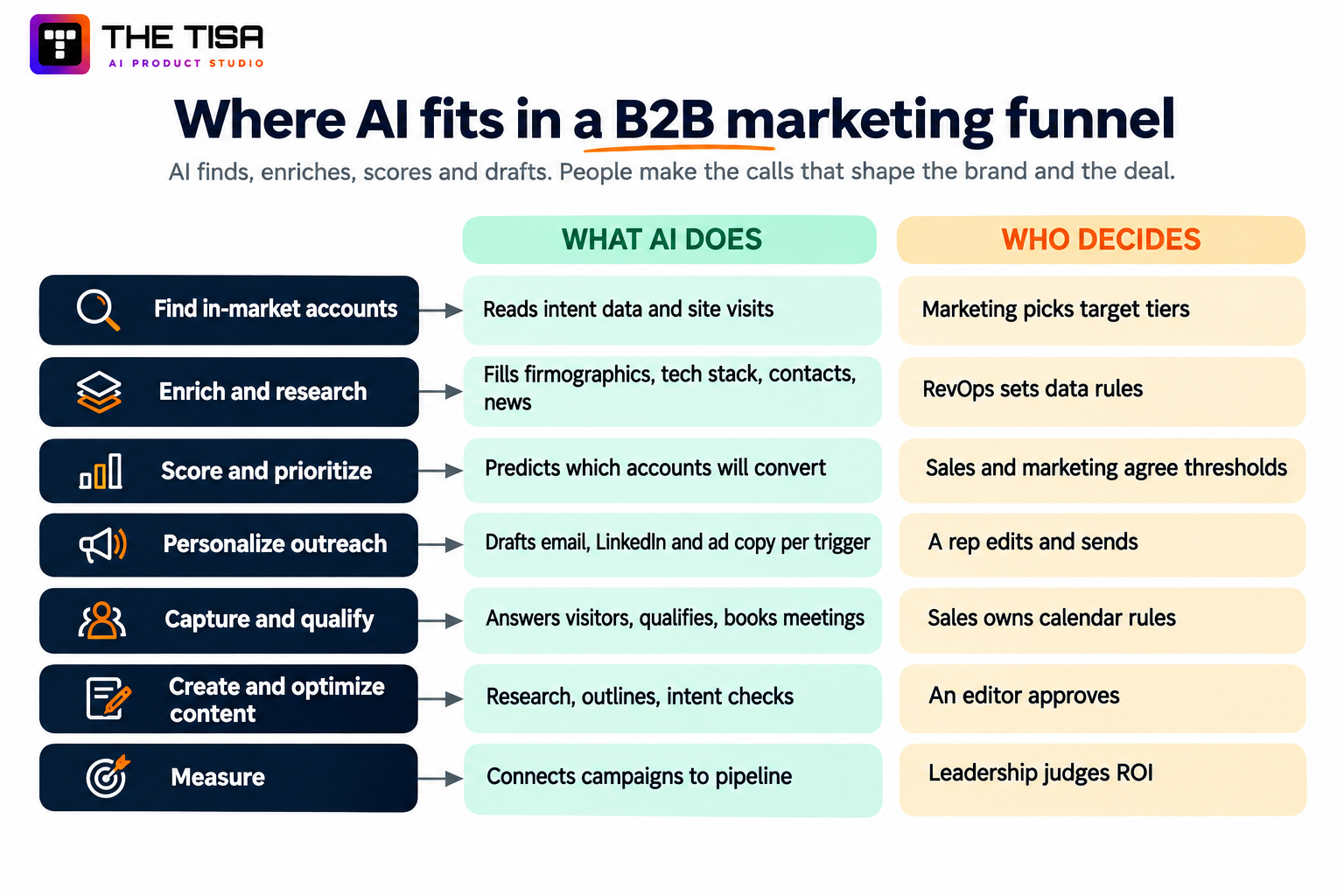
Where AI fits in a B2B marketing funnel
| Funnel stage | What AI does | Example tools | Who decides |
|---|---|---|---|
| Find in-market accounts | Reads intent data and website visits to show which accounts are researching your category | 6sense, Demandbase, ZoomInfo | Marketing picks target accounts and tiers |
| Enrich and research | Fills in firmographics, technology used, contacts and recent company news | Clay, Apollo, Lusha, Breeze Intelligence | RevOps sets data rules |
| Score and prioritize | Predicts which accounts and leads are most likely to convert | HubSpot Breeze, Salesforce Einstein | Marketing and sales agree on thresholds |
| Personalize outreach | Drafts emails, LinkedIn messages and ad copy by industry, role and trigger | Lavender, Reply.io, Claude, ChatGPT | A rep edits and sends |
| Capture and qualify | Answers website visitors’ questions, qualifies them and books meetings | Intercom Fin, Tidio Lyro, HubSpot chatbot | Sales owns the calendar rules |
| Create and optimize content | Researches, outlines and checks content against search intent | Jasper, Claude, Surfer SEO, Clearscope | An editor or subject expert approves |
| Measure | Connects campaigns to pipeline and flags what’s working | CRM reporting, attribution tools | Leadership judges ROI |
The best AI marketing tools for B2B, grouped by the job they do
It’s easy to buy too many AI tools. A better approach is to name the job first, then pick one tool per job that connects cleanly to your CRM. The tools below are common, well-established examples, not endorsements. Features and product names change often, so check current details with each vendor before you buy.
1. Intent data and account-based marketing (ABM)
Tools: 6sense, Demandbase, ZoomInfo.
What they do: These platforms combine third-party research signals (which companies are reading about topics like yours across the web) with your own website and engagement data. The result is a list of accounts that appear to be in-market, often before anyone fills out a form. Most also run account-targeted display ads and alert sales when an account’s activity spikes.
Keep in mind: Intent data is a probability, not a promise. Before you trust a platform’s “in-market” label, compare it with your last 6–12 months of closed-won deals and see how often the signal actually showed up first.
2. Sales intelligence and data enrichment
Tools: Apollo, ZoomInfo, Clay, Lusha, and Breeze Intelligence (formerly Clearbit, now part of HubSpot).
What they do: They fill in missing details on accounts and contacts: company size, industry, technology used, funding, job changes and verified contact details. Apollo pairs a large contact database with built-in sequences and an AI assistant. Clay works as a flexible enrichment workbench that pulls from many data providers and can run AI research steps on each row, such as summarizing a company’s recent news.
Keep in mind: B2B contact data goes stale as people change jobs. Re-verify emails before every campaign, and make sure the provider tells you where its data comes from and how it handles opt-out requests.
3. CRM intelligence and predictive lead scoring
Tools: HubSpot (Breeze AI) and Salesforce (Einstein and Agentforce).
What they do: Built into the CRM, these features score leads and accounts from your own history: who converted, how they engaged and what they looked like. They can also summarize records, suggest next steps and draft follow-ups.
Keep in mind: Predictive scoring needs enough closed deals and consistent data to learn from. If your lifecycle stages are messy or reps don’t log activity, fix that first. A model trained on bad data just automates bad guesses.
4. AI email and LinkedIn personalization
Tools: Lavender for email coaching and personalization, and Reply.io for multichannel sequences with AI writing.
What they do: They help reps write shorter, more relevant messages, suggest personalization from each prospect’s role and company news, and score drafts for clarity and tone before sending.
Keep in mind: Use AI to draft, and let a person send. LinkedIn’s User Agreement prohibits bots and unauthorized automation on its platform, and accounts that use them risk restriction. For email, high volume with weak targeting damages your sender reputation quickly (see the guardrails section below).
5. Conversational marketing and website chat
Tools: Intercom (Fin AI agent), Tidio (Lyro), and the chat tools built into HubSpot and other CRMs.
What they do: AI chat agents answer visitors’ product and pricing questions from your own help content, qualify them with a few questions, and book meetings straight onto a rep’s calendar, at any hour.
Keep in mind: Drift, long a leader in this category, is being retired. After the Clari–Salesloft merger, the company announced Drift’s sunset in March 2026 and named a successor product for existing customers. If you use Drift today, plan your migration. If you’re choosing a tool now, evaluate the alternatives instead.
6. Content creation and SEO optimization
Tools: Jasper for brand-voice marketing content, Claude and ChatGPT for research, outlining and long-form drafting, and Surfer SEO and Clearscope for optimizing content against search intent.
What they do: They speed up research, briefs, first drafts and repurposing, and show which topics and questions a page should cover to compete in search.
Keep in mind: Google allows AI-assisted content, but it warns that generating many pages without adding value can violate its scaled content abuse policy. Original expertise, real data and a human editor are what make content rank and get cited. For a deeper look at search in 2026, see our guide to AI in SEO and content marketing.
7. Custom AI agents, when off-the-shelf tools aren’t enough
Sometimes the gap is the space between tools. Common examples are a research agent that reads your CRM and a prospect’s website to prepare a call brief, or an assistant that answers questions from your own case studies and pricing rules. These usually need a small custom build using AI agent development or retrieval-augmented generation (RAG). RAG grounds the AI’s answers in your own approved documents.
How to choose between tools
| Question to ask | Why it matters |
|---|---|
| Does it sync both ways with our CRM? | Insights that stay in a separate dashboard rarely get used |
| Where does its data come from, and how fresh is it? | Stale or unexplained data leads to bad targeting and compliance risk |
| How does it handle consent, opt-outs and data deletion requests? | US state privacy laws give people rights over their data |
| Can we control what the AI writes and who approves it? | You need brand, legal and accuracy guardrails |
| What does it cost at our real volume, and can we export our data if we leave? | Seat- and credit-based pricing adds up, and lock-in is expensive |
Five AI marketing tactics that drive B2B growth
Tactic 1: Predictive lead scoring and fast routing
Static scoring rules (for example, +10 points for downloading an ebook) miss how buyers actually behave. Predictive scoring learns from your own wins and losses and weighs signals such as pricing-page visits, repeat visits from the same company, job changes and research spikes.
How to set it up:
- Define the outcome you’re predicting. Use a sales-accepted opportunity, not a form fill, so the model learns what turns into revenue.
- Clean the inputs. Remove duplicates, standardize lifecycle stages and make sure reps log meetings and outcomes.
- Score accounts as well as people. In B2B, one engaged person matters less than three engaged people from the same company.
- Route by score, with a time limit. Send high-scoring leads to a named rep, and agree on how fast they must follow up. Speed matters most when a buyer has just shown intent.
- Review the scores every month. Compare them with actual outcomes, and retrain or adjust when the model drifts.
Tactic 2: Account-based marketing powered by intent data
ABM focuses your budget on a defined list of high-value accounts. Intent data tells you which of them are in-market right now.
How to run it:
- Tier your accounts. For example, Tier 1 gets one-to-one plays, Tier 2 gets plays by industry, and Tier 3 gets programmatic ads.
- Map the buying group. For each Tier 1 account, identify likely roles such as economic buyer, technical evaluator, end user and procurement. AI enrichment can suggest names, and reps confirm them.
- Write plays that start from a signal. For example: when a Tier 1 account researches your category and visits pricing, start account-targeted ads, alert the account owner, and send a short, relevant note within a day.
- Coordinate the channels. Ads, email, sales outreach and events should tell one story to the same account.
- Measure at the account level. Track engaged accounts, meetings, opportunities and pipeline per account, not just lead counts.
Tactic 3: Personalized outreach at scale, with a human in the loop
Gartner found that 73% of B2B buyers actively avoid suppliers who send irrelevant outreach. AI can fix relevance, or it can multiply spam. The difference is in the workflow.
How to do it well:
- Start from a trigger, not a list. Good triggers include a funding round, a new executive, a job posting that signals a project, a tool switch or a research spike.
- Enrich only what you’ll use. Role, company size, industry, the trigger and one relevant detail are usually enough.
- Let AI draft and a rep edit. Ask for a short message that names the trigger, offers one useful idea and makes one low-pressure ask. The rep checks the facts and the tone.
- Send at a human pace. Use multiple steps across email and LinkedIn, but send LinkedIn messages by hand.
- Protect deliverability.
- Authenticate your sending domains.
- Honor unsubscribes quickly.
- Watch spam complaint rates.
- Stop sequences that get no replies.
Tactic 4: Conversational lead capture on high-intent pages
Visitors on pricing, demo, integration and comparison pages are often ready for a conversation, but not always at 2 p.m. on a Tuesday.
How to set it up:
- Start where intent is highest. Put the AI chat agent on pricing, demo-request and product pages first, not every page.
- Train it only on approved content. Use your help center, product docs, pricing rules and case studies. Tell it to say “I don’t know” and offer a human when it’s unsure.
- Qualify lightly. Two to four questions are enough, such as role, company size, use case and timeline. Then offer a meeting or a resource.
- Hand off cleanly. Book directly into the right rep’s calendar, and pass the chat transcript into the CRM.
- Be upfront. Tell visitors they’re chatting with an AI assistant, and give them an easy way to reach a person.
Tactic 5: Faster content without falling into scaled-content traps
AI can cut the time it takes to research, outline, draft and refresh content. It can’t supply the original expertise that makes B2B content credible.
How to scale responsibly:
- Plan topic clusters around buyer questions. Group content around the problems your buyers research at each stage.
- Use AI for the heavy lifting. That includes research summaries, outlines, first drafts, repurposing a webinar into posts, and optimization checks in tools like Surfer SEO or Clearscope.
- Add what only you have. Include customer examples, your own data, expert quotes and clear opinions.
- Edit and fact-check every piece. Google’s guidance asks publishers to review AI-generated content for accuracy, including titles, meta descriptions and structured data.
- Be careful with programmatic pages. Pages generated from templates (for example, one per industry or integration) are fine when each one has unique, useful information. Hundreds of near-identical pages are exactly what Google’s scaled content abuse policy targets.


Example: TISA-TECH, from search traffic to booked demos
TISA-TECH is THE TISA’s own IT training and career development platform, built for a training institute in India. It’s a learner-facing product rather than a B2B one, but the growth problem is the same one B2B teams face: turn search visitors into qualified inquiries, then into conversations.
What we built
- SEO from day one: clean URL structure, SEO-friendly page architecture, optimized metadata, a proper heading hierarchy, internal linking, schema markup, image optimization, and fast, mobile-friendly pages.
- High-intent conversion points: demo class booking, callback requests, and course inquiry forms, kept short and validated.
- Content that answers buyer questions: detailed course pages, learning paths, live project information and student success stories.
Results
These are verified project metrics from the TISA-TECH case study.
| Metric | Result |
|---|---|
| Monthly website visitors | 18,500+ |
| Monthly inquiries | 1,250+ |
| Demo class bookings | 480+ |
| Inquiry conversion rate | 8.4% |
| Mobile users | 74% |
| Average page load time | 2.1 seconds |
The next step: adding AI to the inquiry funnel
With steady inquiry volume in place, the next gain comes from responding faster and more relevantly, not from more traffic. The TISA-TECH roadmap already lists AI-powered career recommendations and an admin analytics dashboard as future additions. Here’s how the five tactics in this guide map onto its funnel:
| Step | Trigger | Tools | Who approves | KPI |
|---|---|---|---|---|
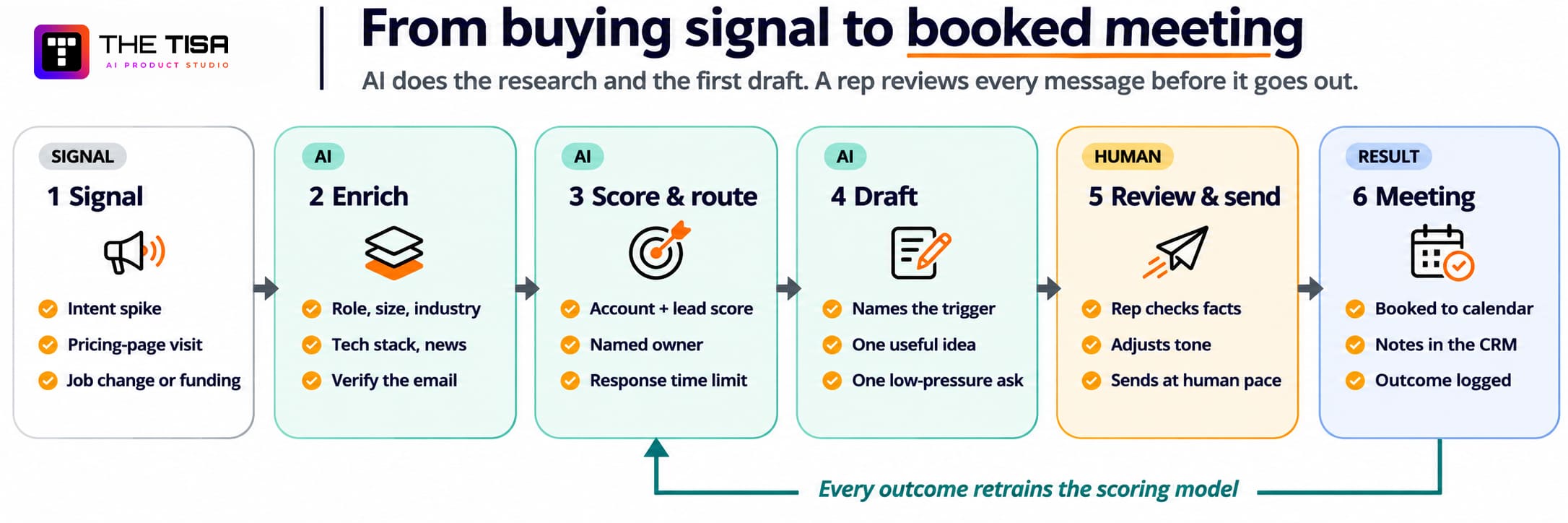
| 1. Spot intent | A visitor views the same program’s curriculum and fees pages more than once in a week | Website analytics events sent to the CRM | Marketing defines which pages count as high intent | High-intent visits per week |
| 2. Score | The visitor submits an inquiry; the CRM combines form answers with page behavior | CRM lead scoring | The admissions team agrees on score thresholds | Inquiry-to-demo rate |
| 3. Route | High-scoring inquiries go to a named counselor with a response-time target | CRM workflow automation | The admissions lead owns the routing rules | Speed to lead |
| 4. Prepare a brief | An AI assistant summarizes the pages viewed, the program of interest and the learner’s stated background | LLM with RAG over the approved course catalog | The counselor checks the brief before calling | Counselor prep time |
| 5. Follow up | The counselor calls or sends a personal message that references the right program | Phone, email, WhatsApp | The counselor decides what to say | Demo booking rate |
| 6. Record and learn | The demo, attendance and enrollment outcomes are logged | CRM | The admissions lead reviews scores monthly | Inquiry-to-enrollment rate |
For a B2B company, the workflow is the same with three swaps:
- pricing, integration and comparison pages instead of course and fee pages
- account-level intent data and buying-group enrichment instead of individual inquiries
- SDRs instead of counselors
The principle doesn’t change. AI spots the signal and prepares the brief, and a person makes the contact.
A reference AI marketing stack
You don’t need every tool. You need these layers working together, with the CRM at the center:
- Data sources: your website and product analytics, first-party engagement such as email, events and webinars, third-party intent data, and enrichment providers.
- System of record: the CRM (for example HubSpot or Salesforce) holds the single, clean view of each account and contact. Everything else reads from it and writes back to it.
- Intelligence: scoring models, enrichment workflows, AI research agents and content assistants.
- Human review: marketers, SDRs and editors approve messages, content and target lists before anything goes out.
- Activation: email sequences, ads, website chat, sales alerts and content publishing.
- Measurement: pipeline and revenue reporting tied back to campaigns and accounts.
The weak point in most stacks is the connection between layers, not the AI itself. If your tools don’t share data cleanly, our AI integration services and AI workflow automation teams can connect them.
Need your marketing tools to work as one system? We design and build CRM-centered AI workflows for scoring, enrichment, routing and outreach, with approval steps built in. Talk to our team →
Guardrails: the rules AI-driven marketing must follow
This section is general information for US marketers, not legal advice. Confirm your obligations with counsel.
- CAN-SPAM applies to B2B email. The FTC’s CAN-SPAM compliance guide says the law covers all commercial email, including business-to-business messages. Your emails need:
- accurate headers and subject lines
- your physical postal address
- a working opt-out, honored within 10 business days
You’re also responsible for what vendors send for you, and penalties apply per email.
- Gmail and Yahoo sender requirements. Gmail’s sender guidelines and Yahoo’s apply to anyone sending in volume. Bulk senders (Gmail defines this as about 5,000 messages a day to its users) must authenticate with SPF, DKIM and DMARC, offer one-click unsubscribe and keep spam complaint rates below 0.3%. AI-written emails sent too fast to poorly targeted lists break these limits quickly.
- State privacy laws. About two dozen US states now have comprehensive privacy laws, according to the IAPP’s state tracker. Many give people the right to opt out of targeted advertising and the sale of their data, and some require you to honor browser signals such as Global Privacy Control. Check how your intent and enrichment vendors comply.
- No fake reviews or testimonials. The FTC’s rule banning fake reviews took effect in October 2024. It explicitly covers AI-generated reviews and testimonials from people who don’t exist. Never use AI to invent customer quotes or case studies.
- Platform terms. LinkedIn’s User Agreement prohibits bots and unauthorized automated activity. Google’s spam policies apply to AI-generated pages.
- Your own data. Don’t paste customer lists, contracts or deal notes into consumer AI tools. Use business accounts whose terms say your data isn’t used for training, and limit who can connect AI tools to the CRM. Our generative AI governance guide covers how to set these policies.
KPIs that prove AI marketing is working
Pick a few KPIs, define them once and baseline them before you change anything. Results vary widely by deal size, sales cycle and market, so set targets from your own baseline rather than from generic benchmarks.
| KPI | How to calculate it | Why it matters |
|---|---|---|
| Engaged target accounts | Target accounts with meaningful engagement (for example, three or more actions by two or more people) in the last 30 days ÷ all target accounts | Shows whether ABM and intent plays reach the right companies |
| Speed to lead | Median time from a high-intent action (demo request, pricing chat) to a first human response | Fast follow-up is one of the simplest ways to lift conversion |
| Lead-to-opportunity rate | Sales-accepted opportunities ÷ marketing-qualified leads (or accounts) in the same period | Tests whether scoring sends sales the right people |
| Positive reply rate | Positive replies ÷ emails delivered | Measures relevance better than open rates, which privacy features distort |
| Spam complaint rate | Spam complaints ÷ emails delivered (from Google Postmaster Tools) | Keep it below Gmail’s 0.3% limit, or your emails stop reaching inboxes |
| Marketing-sourced and influenced pipeline | Dollar value of opportunities where marketing was the first touch (sourced) or engaged before creation (influenced), using one written attribution rule | Connects marketing work to revenue |
| Win rate and sales cycle length | Won ÷ closed opportunities, and median days to close, for AI-assisted vs. other deals | Shows whether better targeting improves deal quality |
| Cost per opportunity | Marketing program and tool costs ÷ sales-accepted opportunities | Keeps tool spending honest |
For content, also track organic conversions, branded search and how often your pages are cited in AI answers. Clicks alone understate impact.
A 90-day plan to get started
| Phase | What you do | Checkpoint |
|---|---|---|
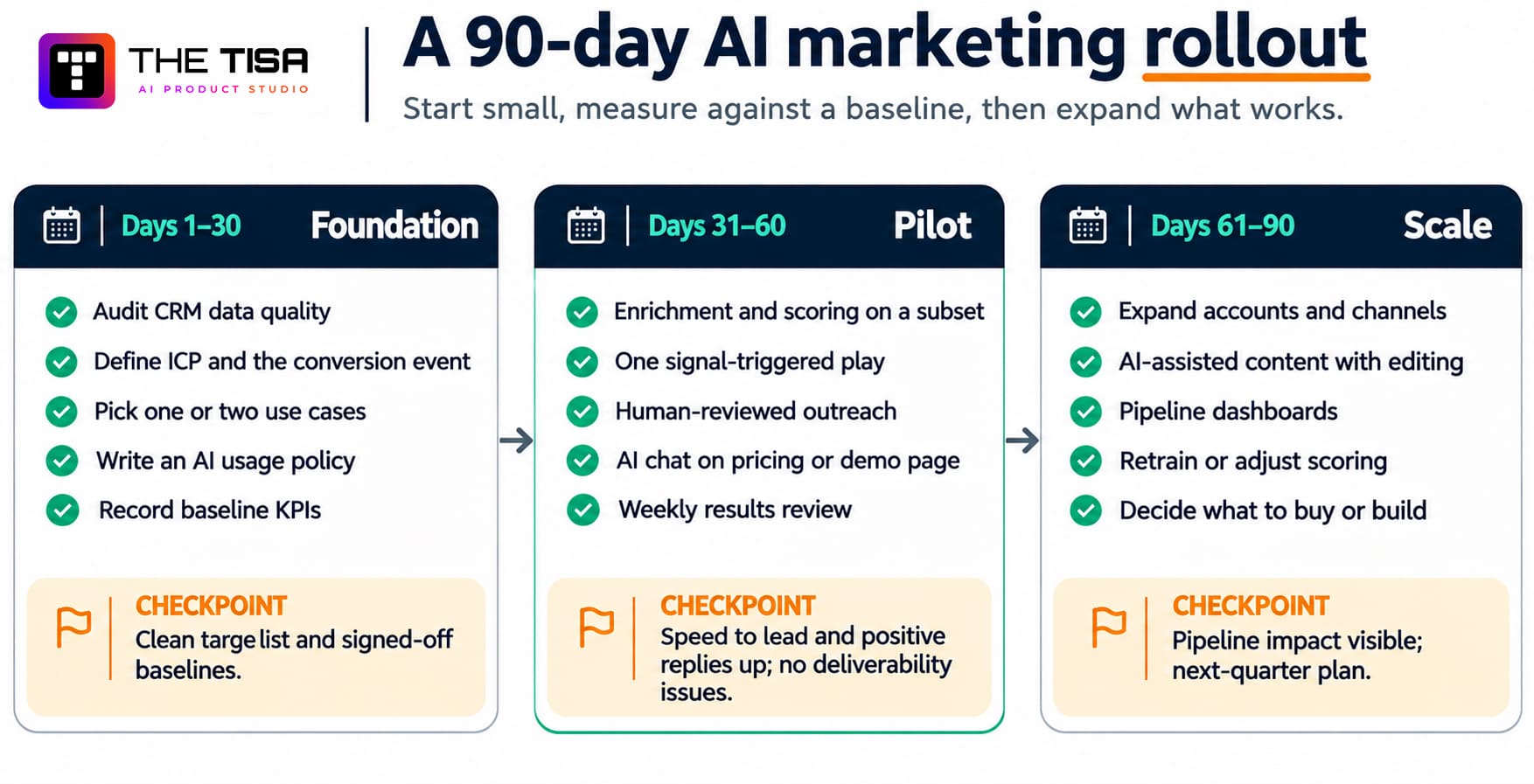
| Days 1-30: Foundation | Audit CRM data quality. Define your ideal customer profile (ICP) and the conversion event you’ll predict. Pick one or two use cases. Write an AI usage policy. Record baseline KPIs. | Clean target account list; baselines signed off |
| Days 31-60: Pilot | Turn on enrichment and scoring for a subset of target accounts. Launch one signal-triggered play with human-reviewed outreach. Add an AI chat agent to your pricing or demo page. Review results weekly. | Speed to lead and positive reply rate improving; no deliverability problems |
| Days 61-90: Scale | Expand to more accounts and channels. Add an AI-assisted content workflow with editorial review. Build pipeline dashboards. Retrain or adjust scoring. Decide what to buy and what to build. | Pipeline impact visible against baseline; a plan for the next quarter |
Six mistakes to avoid
- Buying tools before fixing data. AI on top of a messy CRM produces confident, wrong answers.
- Automating volume instead of relevance. More emails to the wrong people hurt your domain reputation and your brand.
- Letting AI send under a person’s name without review. One invented fact or off-tone message can cost a deal.
- Treating intent data as certainty. Validate signals against your own closed-won history.
- Publishing AI content without expertise. Thin, generic pages don’t rank, don’t get cited and don’t convince buyers.
- Measuring activity instead of pipeline. Opens, clicks and MQL counts can rise while revenue stays flat.
How THE TISA helps B2B teams use AI in marketing
THE TISA brings together a digital marketing team (SEO, content, social, paid media and email) and an AI software development team. That means we can plan your campaigns and also build the custom pieces that off-the-shelf tools don’t cover:
- CRM-connected scoring, enrichment and routing workflows
- AI research and drafting agents with human approval steps
- Website AI assistants that answer from your own approved content
- Dashboards that tie campaigns to pipeline
For examples of our AI builds, see NovaMind AI, a multilingual voice and text assistant, and our multilingual RAG chatbot case study. If you’re a software company, our SaaS and technology page shows how we work with product teams.
Conclusion
AI-powered digital marketing gives B2B teams three advantages: they see buying signals earlier, they make outreach relevant at scale, and they spend less time on routine work. The tools are widely available. The difference comes from how you use them:
- clean CRM data at the center
- clear scoring and routing rules
- people approving anything that represents your brand
- respect for email, privacy and platform rules
- KPIs tied to pipeline instead of activity
Start small with one or two use cases, measure against a baseline, and expand what works.
Frequently Asked Question
Q1. What is AI-powered digital marketing?
Ans. AI-powered digital marketing uses machine learning and generative AI to find in-market buyers, enrich and score leads, personalize outreach, answer website visitors, create and optimize content, and measure results. In B2B, its main value is spotting buying signals earlier and making outreach more relevant without adding headcount.
Q2. What are the best AI tools for B2B marketing?
Ans. It depends on the job. Common choices include 6sense, Demandbase or ZoomInfo for intent data and ABM; Apollo, Clay or Lusha for enrichment; HubSpot Breeze or Salesforce Einstein for predictive scoring; Lavender or Reply.io for outreach; Intercom or Tidio for website chat; and Jasper, Claude, ChatGPT, Surfer SEO or Clearscope for content. Choose one tool per job that syncs cleanly with your CRM.
Q3. How does AI improve B2B lead generation?
Ans. AI improves lead generation by identifying accounts that are researching your category, scoring leads by their likelihood to convert, routing hot leads to sales quickly, and drafting personalized messages tied to a real trigger. The biggest gains usually come from better targeting and faster follow-up, not from sending more messages.
Q4. Is AI-written cold email legal in the US?
Ans. Commercial email, including B2B email, must follow CAN-SPAM: accurate headers and subject lines, a physical postal address, and a working opt-out honored within 10 business days. Bulk senders also need to meet Gmail and Yahoo requirements, such as authentication and one-click unsubscribe. Who wrote the email doesn’t change these rules.
Q5. Does Google penalize AI-generated content?
Ans. Google doesn’t ban AI-assisted content, but its spam policies prohibit generating many pages without adding value for users, which it calls scaled content abuse. Content that shows real expertise, original information and careful editing can perform well whether or not AI helped write it.
Q6. What is predictive lead scoring?
Ans. Predictive lead scoring uses machine learning to rank leads and accounts by how likely they are to become customers, based on your own past wins, engagement data and firmographics. It replaces fixed point rules and works best when your CRM data is clean and consistent.
Q7. Is Drift still a good choice for conversational marketing?
Ans. Drift is being retired. After the Clari–Salesloft merger, the company announced Drift’s sunset in March 2026 and named a successor product for existing customers. If you’re choosing a website chat tool now, evaluate current alternatives such as Intercom, Tidio or the chat tools built into your CRM.
Q8. How long does it take to see results from AI marketing?
Ans. Operational gains such as faster lead response and less manual research often show up within the first 30–60 days of a focused pilot. Pipeline and revenue impact usually takes longer, depending on your sales cycle, so set a baseline first and review results each quarter.
Drive B2B Growth with AI-Powered Digital Marketing
Improve your B2B marketing workflows with AI-driven insights, smarter automation, and data-backed strategies. Talk to THE TISA about integrating AI into your digital marketing processes to reach the right audience, improve campaign performance, and support sustainable business growth.
Discuss Your B2B Marketing Project →