
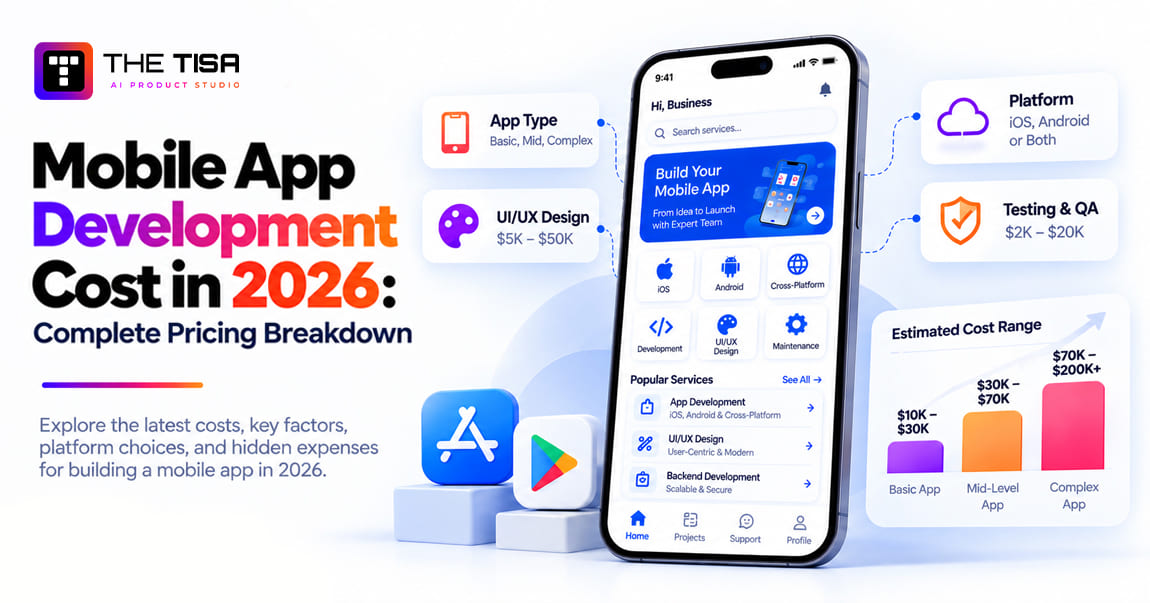
Ask three development firms to estimate your app, and you might get quotes of $35,000, $140,000, and “let’s schedule a call.” None of them is necessarily wrong. Each firm may be estimating a different version of your idea.
The mobile app development cost in 2026 depends on a few key decisions: which features to launch first, which platforms to support, how to protect user data, and who will maintain the app after launch. Make these decisions early, and you can compare quotes more accurately.
Several changes in 2026 also affect app budgets. App stores have revised their fees, new state laws have introduced age-verification requirements, and Apple has opened free AI access to smaller developers. Meanwhile, users continue to spend more on apps. Sensor Tower’s State of Mobile report found that global in-app purchase revenue reached $167 billion in 2025, up 10% from 2024. Non-game apps also generated more revenue than games for the first time, largely driven by AI assistants.
This guide explains what mobile apps cost to build in 2026 and what affects the final price. You can also read about mobile app development to understand the development process.
Key Takeaways
- Most US business apps cost $20,000 to $500,000+, depending on complexity.
- Clutch puts the average app project at $90,780, with a typical timeline of about 11 months.
- Google Play’s service fee dropped to 10% on the first $1M in annual earnings from June 30, 2026.
- Apple now offers free cloud AI access to developers under 2 million first-time downloads.
- Budget 15-20% of the build cost every year for maintenance.
What Is the Average Mobile App Development Cost in 2026?
Mobile app development costs range from around $20,000 for a basic MVP to $500,000 or more for a complex enterprise app. According to Clutch’s 2026 data, the average app project costs $90,780, while most reviewed projects fall between $10,000 and $49,999.
The mobile app pricing guide, updated in September 2026, provides these benchmarks:
| Clutch Benchmark (2026) | Figure |
|---|---|
| Average app project cost | $90,780 |
| Most common project budget | 10,000–49,999 |
| Typical project timeline | About 11 months |
| Average monthly spend | $8,188 |
| Most common agency hourly rate | 25–4 9 |
The data includes vendors from multiple countries, so these figures may be lower than typical US agency pricing. A separate Clutch survey of 158 US small businesses shows how much businesses spend on app development:
| Amount Spent on Their App | Share of Businesses |
|---|---|
| $10,000 or less | 33% |
| 10,001–30,000 | 20% |
| 30,001–50,000 | 14% |
| 50,001–100,000 | 16% |
| More than $100,000 | 16% |
Geography mattered too. In the Northeast, 46% of businesses spent more than $50,000, compared with 25% in the South.
Labor remains a major expense. The Bureau of Labor Statistics reports a median US software developer salary of $135,980 as of May 2025, or roughly $65.38 per hour before benefits and overhead. Agency rates also account for project management, QA, and other operating costs.
What Changed in Mobile App Development in 2026?
Six updates changed app budgets in 2026: new Apple build requirements, a new Android target API rule, lower Google Play fees, Android developer verification, free Apple AI access for smaller developers, and state age-verification laws.
Each one changes the mobile app development cost in a different direction. Some add work, while others remove recurring expenses.
Apple Now Requires Xcode 26 for All Submissions
Since April 28, 2026, Apple’s upcoming requirements mandate that apps uploaded to App Store Connect be built with Xcode 26 or later using the 26-series SDKs. Older apps need a rebuild, dependency updates, and fresh testing before their next release. Teams that also adopt the new iOS 26 visual style should budget for design updates on top of that.
Budget impact: a one-time upgrade cost for existing apps, usually handled within a maintenance plan.
Android Apps Must Target API Level 36
Under Google’s target API level requirements, new apps and app updates must target Android 16 (API level 36) from August 31, 2026. Android 16 changes several platform behaviors, so this is more than a settings change. It means code updates and regression testing.
Budget impact: recurring yearly work, since Google raises the target level every year.
Google Play Cut Its Fees
From June 30, 2026, developers in the US, UK, and Europe can use Google Play Billing, an alternative in-app billing system, or external payment links. As 9to5Google reported, the service fee starts at 10% on a developer’s first $1 million in annual earnings, regardless of billing method. An extra billing fee applies only when a purchase runs through Google Play’s own billing.
Budget impact: lower revenue share for subscription and in-app purchase businesses, but alternative billing requires its own payment integration and support.
Android Developer Verification Started Rolling Out
Google now requires developers to verify their identity, even for apps distributed outside the Play Store. According to Android Authority, user-facing enforcement began in four countries (Brazil, Indonesia, Singapore, and Thailand) on September 30, 2026, with a global rollout planned for 2027.
Budget impact: minor for US-only apps today, but enterprise apps distributed outside the Play Store should plan registration before 2027.
Apple Made AI Features Cheaper to Run
At WWDC 2026, Apple announced free access to its Foundation Models on Private Cloud Compute for developers with fewer than two million first-time App Store downloads, as MacRumors reported. Apple’s on-device model was already free to use.
Budget impact: iOS apps that need summaries, text classification, or simple assistants can now avoid per-request AI fees during early growth. Apps that need Android parity or complex reasoning still require a cloud AI provider.
State Laws Added Age-Verification Duties
Texas, Utah, and Louisiana have passed App Store Accountability Acts. A June 2026 legal update on Mondaq notes that the Texas law is now in effect while it is appealed. Developers must accept age-category data from app stores, use it to confirm a user’s age bracket, and assign age ratings to their apps and in-app purchases.
Budget impact: consumer apps, especially those with younger users, need extra development and legal review.
How Much Does an App Cost by Complexity?
A simple MVP costs $20,000–$ 60,000, a standard app costs $45,000–$ 150,000, a complex app costs $100,000–$ 250,000+, and an enterprise app costs $220,000–$ 500,000+. Features, user roles, integrations, and compliance set the tier.
| Tier | Typical Scope | Timeline | Estimated US Cost ($) |
|---|---|---|---|
| MVP / Simple App | One core workflow, basic login, simple admin | 2-4 months | 20,000-60,000 |
| Standard App | Multiple user roles, payments, integrations | 4-7 months | 45,000-150,000 |
| Complex App | Real-time features, advanced logic, compliance | 6-12 months | 100,000-250,000+ |
| Enterprise App | Large scale, SSO, many integrations, strict security | 9-18 months | 220,000-500,000+ |
Which Tier Fits Your Business?
Work through these questions in order and stop at the first “yes”:
- Do you need one core workflow with basic features? Start with an MVP.
- Do you need multiple user roles, payments, or third-party integrations? Plan a standard app.
- Do you need real-time features or regulatory compliance? Plan a complex app.
- Do you need large-scale infrastructure with enterprise-level security? Budget for the enterprise tier.
If your app falls into the complex category but your budget is tight, start with an MVP. Build the core features first, then add more advanced features once users show demand.
How Much Do Different Types of Apps Cost?
App type shapes cost because each industry has its own must-have features. E-commerce apps typically cost $ 50,000–180,000, while fintech and healthcare apps often pass $100,000 because of security and compliance work.
| App Type | Main Cost Drivers | Typical US Range ($) |
|---|---|---|
| E-commerce | Catalog, cart, payments, order tracking | 50,000–180,000 |
| Healthcare | Patient data protection, EHR links, video visits | 90,000–300,000+ |
| Fintech | Identity checks, bank APIs, fraud monitoring | 100,000–350,000+ |
| On-demand | Customer, provider, and admin apps, live maps | 70,000–250,000 |
| Social media | Feeds, uploads, moderation, notifications | 60,000–250,000 |
| AI-powered | Model integration, data pipelines, testing, usage fees | 60,000–300,000+ |
For healthcare apps, sort out the legal requirements before scoping. The HHS Office for Civil Rights offers guidance for mobile health app developers, including an interactive tool that shows which federal laws may apply.
For AI-powered apps, know what you are paying for. A large language model (LLM) generates answers but doesn’t know your company’s data. Retrieval-augmented generation (RAG) fixes this by fetching relevant documents and passing them to the model with each question. This business guide to RAG explains when that extra layer is worth building. Many apps need only a simple API call, not a custom AI system.
What Factors Affect Mobile App Development Cost the Most?
Scope drives most of the price. The more work your app does behind the screen, the more engineering hours it needs, and hours multiplied by your team’s hourly rate decide the final number. Five areas account for most of that work:
- Features: Offline mode, live chat, and in-app video look small on a wireframe but need heavy backend work.
- Design: A standard component library costs far less than custom animations. Investing in UI/UX design early prevents expensive redesigns later.
- Backend: Managed platforms cut early costs. Firebase, for example, has a no-cost Spark plan and a pay-as-you-go Blaze plan that charges only for usage beyond free quotas.
- Integrations: Payment gateways, CRMs, and ERPs each need setup, error handling, and testing. Legacy systems without modern APIs take the longest.
- Security: Encryption, access controls, and penetration testing are mandatory for apps handling money, health records, or personal data.
Is It Cheaper to Build for iOS, Android, or Cross-Platform?
Cross-platform is usually the cheapest way to reach both iOS and Android because one codebase serves both. Building separate native apps costs the most because you build and maintain two products.
The small business survey mentioned earlier shows a gap between platforms as well. 63% of Android-only projects cost $30,000 or less, compared with 41% of iOS-only projects.
| Approach | Relative Cost | Best For | Trade-Offs |
|---|---|---|---|
| iOS only | Lower | Premium US consumer audiences | Misses Android users |
| Android only | Lower | Broad device reach, field teams | Wide device testing |
| Native for both | Highest | Hardware-heavy or high-performance apps | Two codebases |
| Cross-platform | Often 30-40% less than dual native | Most business apps and MVPs | Some native modules needed |
Flutter and React Native now handle most business apps well. Choose native when your app depends on device hardware or needs new OS features at launch. A cross-platform app development approach suits most other cases.
How Is the Budget Split Across Development Stages?
Development takes the largest share at 40-55%. Discovery and design take about 10-15% each, testing takes 15-20%, and deployment takes around 5%.
| Stage | Share of Budget | What Happens |
|---|---|---|
| Discovery | 10-15% | Requirements, user flows, architecture |
| Design | 10-15% | Wireframes, prototypes, visual design |
| Development | 40-55% | Frontend, backend, integrations |
| Testing and QA | 15-20% | Device, performance, security testing |
| Deployment | ~5% | Store submission, production setup |
A proposal that allocates almost nothing to testing is a red flag. Discovery is also where bad assumptions are cheapest to fix.
How Much Do App Developers Charge Per Hour?
US agencies typically charge 100–200+ per hour, US freelancers 50–150, and offshore teams 25–60. Worldwide marketplace rates run lower. Upwork lists a median of 18–39 per hour for mobile app developers.
| Team Model | Typical Rate | Strengths | Risks |
|---|---|---|---|
| US agency | 100-200+ | Same time zone, strong oversight | Highest cost |
| US freelancer | 50-150 | Flexible for small tasks | Single point of failure |
| Offshore team | 25-60 | Lower cost, full-team capacity | Communication gaps |
| Hybrid | Blended | Balances cost and accountability | Needs clear ownership |
Upwork’s hiring cost data reflects global talent, so treat it as a floor rather than a US benchmark. This comparison of staff augmentation, outsourcing, and in-house hiring explains when each model fits.
How Do You Estimate Your App Budget?
Use this formula:
App cost = estimated hours × blended hourly rate
A standard app needing 1,200 hours at a blended $75 rate costs about $90,000. The same scope at $150 an hour costs about $180,000. The team model alone can double your total.
What Hidden Costs Come After Launch?
The main post-launch costs are store fees, platform commissions, cloud usage, and AI model fees. Many teams underestimate the ongoing mobile app development cost because these charges arrive monthly rather than upfront.
| Cost | Current Figure |
|---|---|
| Apple Developer Program | $99 per year |
| Apple Developer Enterprise Program | $299 per year |
| Google Play registration | $25 one-time |
| App Store commission (Small Business Program) | 15% for developers earning up to $1M |
| Google Play service fee (from June 30, 2026) | 10% on first $1M, plus a billing fee only with Play Billing |
| Cloud, analytics, AI usage | Varies with traffic |
Apple lists its program fees on its membership comparison page, and Google confirms the US$25 Play Console registration fee. Apple’s reduced commission comes from its App Store Small Business Program.
How Much Does App Maintenance Cost Per Year?
Plan for 15-20% of the original build cost every year. A $100,000 app usually needs 15,000–20,000 a year for updates, bug fixes, security patches, and hosting.
Yearly maintenance covers:
- OS and SDK upgrades like the 2026 Xcode and API changes
- Bug fixes and crash monitoring
- Security patches and library updates
- Cloud costs that grow with users
- Small improvements based on feedback
Apps with many integrations or AI features usually land at the higher end. A structured maintenance and support plan turns these costs into a predictable monthly line instead of emergency spending.
How Can You Reduce Mobile App Development Cost Without Cutting Quality?
Fund discovery first, launch with one core workflow, use cross-platform where it fits, and rely on proven services for login and payments. In 2026, iOS teams can also use Apple’s free AI models before paying for cloud AI.
- Plan before you build. Two to four weeks of discovery saves months of rework.
- Ship one workflow first. Expand based on real usage.
- Buy common features. Authentication, payments, and analytics already exist as services.
- Use free AI tiers early. Test on-device and free cloud options before committing to paid APIs.
- Automate testing. Yearly platform updates become faster and cheaper.
Mistakes to avoid:
- Picking a vendor on hourly rate alone
- Cutting QA to hit a launch date
- Adding AI without a defined business problem
- Signing contracts without clear code ownership
What Should You Look for in an App Development Partner?
Look for relevant portfolio work, stage-by-stage estimates, documented security practices, and a clear plan for post-launch updates. Delays and rebuilds cost far more than hourly rate differences.
Before signing, confirm the partner offers:
- Projects similar to yours in industry or technical scope
- A written discovery document you keep
- Separate pricing for design, development, testing, and launch
- Verifiable security standards
- A support plan for yearly OS and store changes
- Direct access to the engineers building your app
Ask how they handled a project that went over scope. The answer reveals more than any proposal.
Building With THE TISA: Where Your Budget Actually Goes
At THE TISA, an estimate breaks the project into individual decisions rather than presenting one overall figure. Every project starts with a short discovery sprint to map user flows, identify integrations that could delay development, and estimate the cost of each feature. This gives you a clear view of where the budget goes and which features you can postpone if costs become difficult to manage.
Feature-level estimates are particularly important for multi-sided products. A food delivery or home-services platform typically needs three connected apps for customers, service providers, and admins, along with live tracking and dispatch logic. Estimating each part separately helps identify which features must launch together and which can wait. For example, an experienced on demand app development company can account for common requirements such as order matching, service allocation, and real-time status updates during the initial planning stage.
The following projects show how different product requirements translate into delivery timelines:
| Project | What Was Built | Delivery Time | Reported Result |
|---|---|---|---|
| Food Delivery On Demand | Mobile ordering and delivery platform for customers, chefs, restaurants, and delivery partners | 3 months | 8,600+ registered customers |
| SendIt | Logistics platform connecting customers, drivers, fleet owners, businesses, and admins | 3 months | 12,500+ registered customers |
| RentACar | Car rental and fleet platform with AI booking assistance and document checks | 2 months | 1,280 confirmed bookings per month |
These projects follow the approach discussed earlier in this guide: start with the essential workflows and add features as actual user needs become clearer.
THE TISA develops products in short cycles, giving stakeholders regular opportunities to test working screens and provide feedback. When a product requires AI capabilities, such as the RentACar booking assistant, the team uses AI integration services to connect models with existing systems. The team also evaluates the available options, including on-device models, free tiers, and paid APIs, to keep integration costs under control.
Data protection also remains part of the development process, with documented security standards guiding how projects handle security requirements. After launch, the same engineers can manage annual app store requirements, so ongoing updates don’t require a new team to learn the product from scratch. For more examples of completed projects across logistics, education, and SaaS, see THE TISA’s software development case studies.
Conclusion
The price of an app is the sum of choices about scope, platform, team, and long-term ownership. Survey data shows budgets ranging from under $10,000 to well over $100,000, and the 2026 changes to store fees, build requirements, and AI access shift those numbers further. Once you define your choices, the mobile app development cost becomes something you can plan around rather than guess at.
Before committing, ask three questions. Does the first release prove demand with one strong workflow? Does the budget cover two years of maintenance and store updates? Can your partner show how they control scope and protect your code ownership?
Teams that answer these early usually launch sooner and spend less over the life of the app.
Frequently Asked Questions
Q1. Is a fixed-price contract or a time-and-materials contract better for an app project?
Ans. Fixed price suits small, fully documented scopes such as a defined MVP. Time and materials suit products that will change during development because it avoids constant renegotiation. Many companies use fixed pricing for discovery and the first release, then switch to a monthly retainer.
Q2. Can AI features be added to an existing app without rebuilding it?
Ans. Usually, yes. AI features connect through backend APIs, so the existing app needs new screens or endpoints rather than a rewrite. Preparing clean, accessible data is often the larger task. A short technical audit shows whether the current architecture can support it.
Q3. Who owns the source code when an outside company builds the app?
Ans. That depends on the contract. Look for a clause that transfers full intellectual property rights on payment, along with access to code repositories, cloud accounts, and store accounts registered to the business. Without these terms, switching vendors later becomes costly.
Q4. How can a business stop scope creep from inflating the budget?
Ans. Keep a prioritized feature list and route every new request through a change log that shows its cost and timeline impact. Assign one decision-maker on the business side. Most overruns come from many small, unapproved additions rather than one big change.
Q5. How soon can a mobile app deliver a return on investment?
Ans. It depends on the model. Internal apps that replace manual work often show savings within months. Consumer apps usually take longer to build an audience and refine pricing. Setting measurable goals before development, such as hours saved or conversion targets, makes ROI easier to track.