
In September 2026, Cloudflare found a bug that allowed one customer to access another customer’s data. A security researcher showed that leftover files from one account, including full databases, were accessible to other accounts. Cloudflare fixed the cross-tenant exposure within three days, and no one misused it. Still, the incident shows how easily customer data can leak on a shared platform.
AI products face similar risks across multiple areas. Customer data passes through prompts, search indexes, caches, and logs, creating more opportunities for cross-tenant exposure. IBM found that 13% of organizations reported breaches of AI models or applications, and 97% of those organizations lacked proper AI access controls.
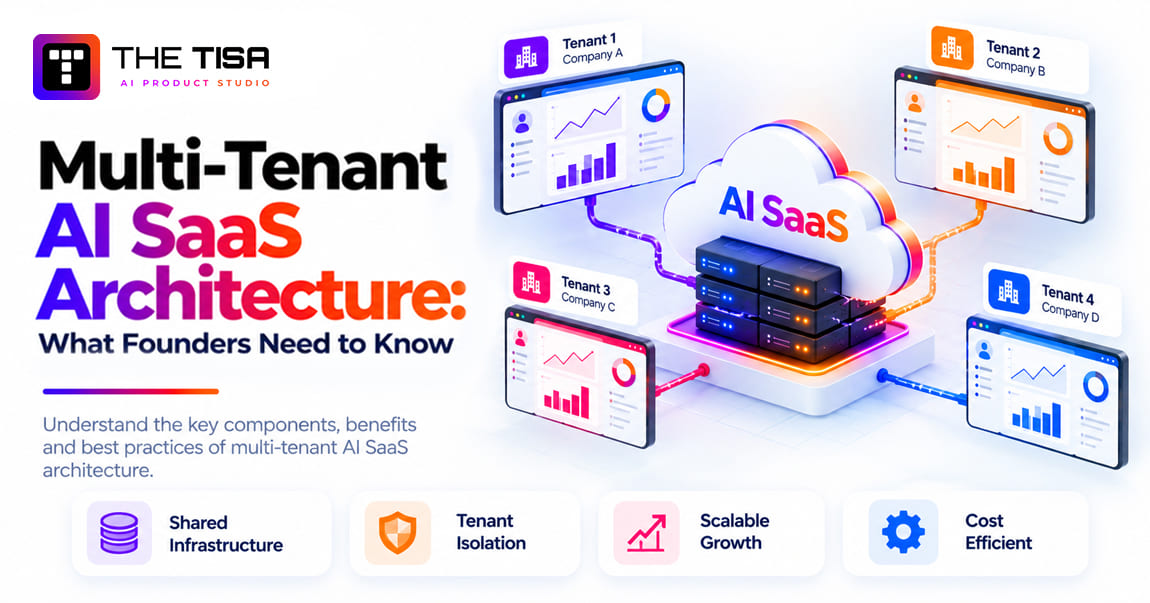
This is where Multi-Tenant AI SaaS Architecture becomes important. It allows one AI product to serve multiple companies on a shared platform while keeping each company’s data, AI context, and costs separate. US enterprise buyers pay close attention to these safeguards before signing a contract.
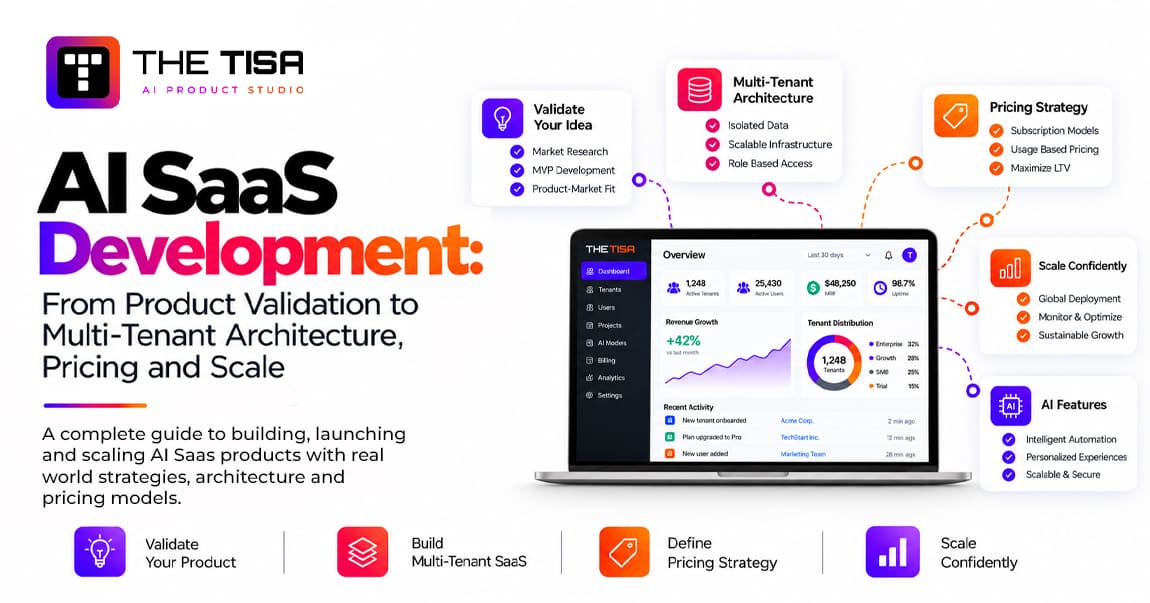
If you are still planning your product, start with our guide on building an AI SaaS product from validation to scale. This article explains how the architecture works, which isolation model to choose, where AI adds security risks, what affects development costs and timelines, and when to work with a development partner.

What Is Multi-Tenant AI SaaS Architecture?
Multi-Tenant AI SaaS Architecture is a design approach in which one AI application serves multiple customers (tenants) through shared infrastructure while keeping each tenant’s data, configuration, and AI context separate. Each customer uses the same platform but accesses only its own information and settings.
A tenant usually represents a company account rather than an individual user. For example, a 40-seat agency counts as one tenant, just like a hospital network.
Why Does Multi-Tenancy Matter More for AI Products?
AI introduces three additional challenges:
- Tenant data enters the model’s context. In traditional Multi-Tenant SaaS Architecture, developers mainly manage data isolation at the database level. AI products also pass customer data through prompts, embeddings, caches, and logs, creating more points where information could leak.
- Compute costs vary between tenants. Every AI request consumes tokens or GPU resources. One tenant may use significantly more resources than another, even under the same pricing plan.
- Shared models need tenant-specific context. The same LLM may serve every customer, but each tenant expects answers based only on its own data, knowledge, tone, and business rules.
A well-designed system lets you build one platform, release features to all customers, maintain a single codebase, and use shared infrastructure efficiently. These benefits make Multi-Tenant SaaS Architecture practical for growing products, while AI requires closer attention to data isolation, resource usage, and tenant-specific responses.
From Idea to Scale: How Does a Multi-Tenant AI Product Come Together?
A multi-tenant AI product moves through six stages. Tenancy decisions belong in the architecture stage, not after launch. Adding isolation later can require complex data migrations.
| Stage | Key question | Tenancy decision to make |
|---|---|---|
| 1. Validate the idea | Will customers pay to solve this problem? | Define the tenant: a team, company, or franchise group |
| 2. Design the architecture | How will data and AI context stay separate? | Choose an isolation model for each layer |
| 3. Build the MVP | What is the smallest product that proves value? | Add a tenant ID to every table, API call, and AI request |
| 4. Test and secure | Can one tenant access another’s data? | Run automated cross-tenant leakage tests |
| 5. Launch and onboard | How quickly can a new customer get started? | Set up self-service tenant provisioning |
| 6. Scale | Which tenants need more capacity or isolation? | Introduce tiered plans, quotas, and dedicated resources for larger accounts |
What Does an AI SaaS Platform Architecture Look Like, Layer by Layer?
A production-ready AI SaaS platform has six layers: frontend, API gateway, application layer, AI services, data layer, and infrastructure. Tenant context must flow through each layer to keep customer data and AI requests separate.
a. Frontend (shared)
Web and mobile apps serve all tenants through a single codebase. Branding, feature flags, and settings load at runtime based on the customer’s account or subdomain.
b. API gateway (shared)
The API gateway handles authentication, rate limiting, tenant routing, and load balancing. It identifies the tenant behind each request and attaches that identity before passing the request to other services. Per-tenant rate limits prevent one customer from overwhelming shared resources.
c. Application layer (shared services)
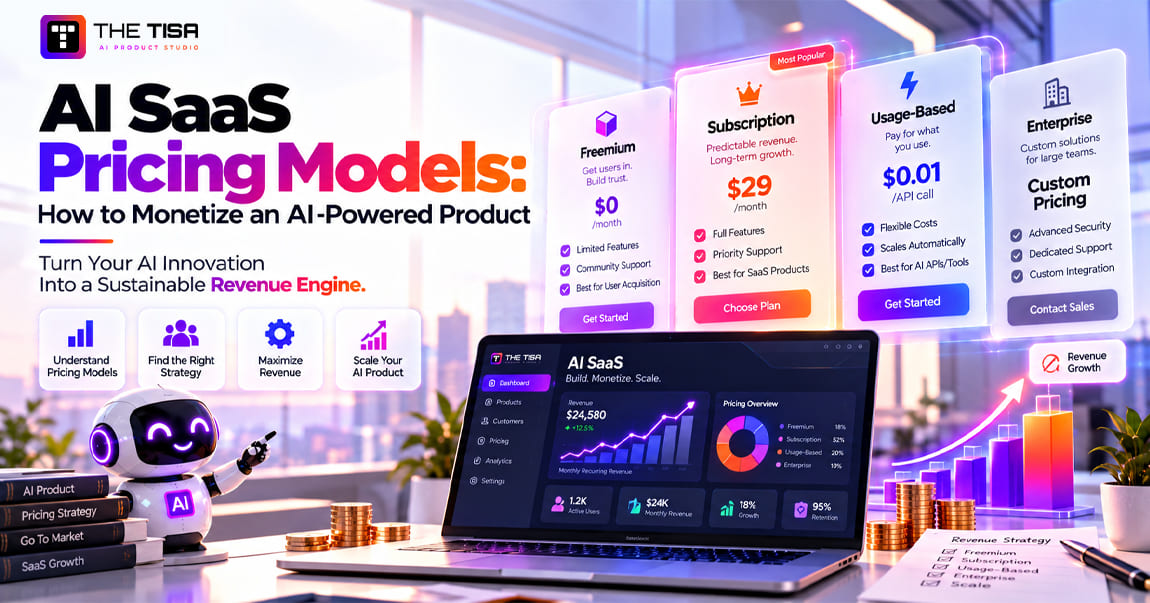
This layer manages business logic, tenant accounts, user roles, and usage metering. Since token consumption affects profit margins, plan usage tracking and billing early. If you charge per seat, credit, or outcome, align usage metering with your AI SaaS pricing model.
Many teams start with a modular monolith and split services as the product grows, depending on the trade-offs between monolith and microservices.
d. AI models and services
This layer handles the AI functions that distinguish these products from traditional SaaS applications. Key terms include:
- LLM (large language model): A model that reads and generates text, such as GPT or Gemini, usually accessed through an API.
- Embeddings: Numerical representations of text that help software find content based on meaning rather than exact keywords.
- Vector database: A database that stores embeddings and retrieves similar ones for a query.
- RAG (retrieval-augmented generation): A system that retrieves relevant tenant documents and passes them to the LLM to generate answers based on that tenant’s data. RAG for business applications follows the same approach.
- Fine-tuning: Further training a model on custom examples to adjust its responses for specific tasks. Most multi-tenant products don’t need separate fine-tuned models for each customer initially. RAG and prompt configuration can meet many requirements at a lower cost.
Every retrieval query must target the correct tenant. Pinecone, for example, recommends using one namespace per tenant. This keeps searches within each tenant’s records and simplifies offboarding because you can delete that tenant’s namespace.
A routing layer lets you select models for specific tenants or tasks as prices and requirements change, supporting a vendor-agnostic AI approach.
e. Data layer (isolated per tenant)
This layer stores tenant records, documents, embeddings, and chat history. Shared caches must include a tenant key when storing customer-specific information. PostgreSQL row-level security policies enforce tenant-level access rules directly in the database, adding protection if application code misses a tenant filter.
f. Infrastructure
Infrastructure supports the platform through cloud hosting, monitoring, autoscaling, and backups. Track performance metrics per tenant to identify customers generating higher loads or experiencing slowdowns.
Silo, Pool, or Bridge: Which Tenant Isolation Model Fits Your Product?
For most early-stage AI products, a pooled model with strong logical isolation is a practical starting point. As enterprise or regulated customers grow, you can provide dedicated resources to meet their requirements. AWS explains these three approaches in its guide to silo, bridge, and pool partitioning models.
| Factor | Silo (dedicated per tenant) | Bridge (mixed) | Pool (fully shared) |
|---|---|---|---|
| Data separation | Separate database or stack | Shared stack with separate schemas or selected dedicated services | Shared tables with tenant ID |
| Cost per tenant | Highest | Medium | Lowest |
| Onboarding speed | Slower due to provisioning | Moderate | Fastest |
| Noisy neighbor risk | Very low | Low to medium | Highest without quotas |
| Best fit | Healthcare, finance, and government buyers | Growing products with different customer tiers | Startups and SMB-focused tools |
Many mature products use the bridge model, sharing web and application layers while giving large enterprise tenants dedicated resources, such as a separate vector index or model deployment. Microsoft’s guidance on multitenancy with Azure OpenAI describes similar options, including shared deployments and tenant-provided resources.
What Challenges Do Founders Underestimate?
One of the biggest risks in Multi-Tenant AI SaaS Architecture is cross-tenant data exposure through the AI layer, not just the database. Founders need to account for several key challenges.
AI-specific data leakage. A shared prompt cache, an unfiltered vector search, or a model fine-tuned on mixed tenant data can expose one customer’s information to another. Microsoft’s secure multitenant RAG reference architecture explains how to enforce authorization during retrieval.
Noisy neighbors. When tenants share resources, one customer’s heavy usage can slow down the platform for others. Microsoft describes this as the noisy neighbor antipattern. In AI products, one tenant may exhaust shared model rate limits, delaying other customers’ requests.
Different tenant requirements. One customer may need US-only data storage, while another requires a specific SSO provider. Without configuration-driven design, each request can lead to custom code. Well-designed Multi-Tenant AI Applications handle these differences through settings rather than separate codebases.
Unpredictable model costs. Without per-tenant token tracking, founders cannot identify which customers consume the most resources or whether their accounts remain profitable.
Compliance pressure. IBM’s Cost of a Data Breach Report 2025 puts the average cost of a US data breach at a record $10.22 million. Healthcare customers also expect HIPAA compliance. HHS guidance on HIPAA and cloud computing explains when a vendor handling protected health information must sign a business associate agreement (BAA). These requirements also shape enterprise reviews of AI SaaS security and compliance.
Best Practices for Multi-Tenant AI System Design
Good Multi-Tenant AI System Design treats tenant identity as a first-class value that travels with every request, from login to the final model call.
- Plan for tenancy from day one. Add a tenant ID to every table, cache key, log line, queue message, and vector record.
- Enforce isolation in two places. Filter in application code and enforce again at the database or index level.
- Use strong identity controls. Support SSO and role-based access early; enterprise buyers will ask. Most US enterprise security reviews also expect a SOC 2 report based on the AICPA Trust Services Criteria.
- Meter everything per tenant. Track tokens, API calls, storage, and latency by account.
- Test for leakage continuously. Automated tests should try to retrieve Tenant B’s data as Tenant A on every release.
How Much Does It Cost and How Long Does It Take?
Cost and timeline depend less on the AI model and more on isolation depth, integrations, and compliance scope.
| Cost driver | Why it matters | How to control it |
|---|---|---|
| Isolation model | Silo multiplies infrastructure per tenant | Start pooled, offer silo as a premium tier |
| Model inference | Recurring cost that grows with every active user | Route simple tasks to smaller models, cache safe responses |
| Data pipelines | Document ingestion and embedding take engineering time | Support a few file types well before adding more |
| Integrations | Each CRM, ERP, or EHR connection adds scope | Prioritize integrations your first customers need |
| Compliance | SOC 2 and HIPAA add process, tooling, and audit cost | Build audit logs and access controls early |
| Ongoing maintenance | Models, APIs, and prompts change over time | Budget for monitoring and updates, not just launch |
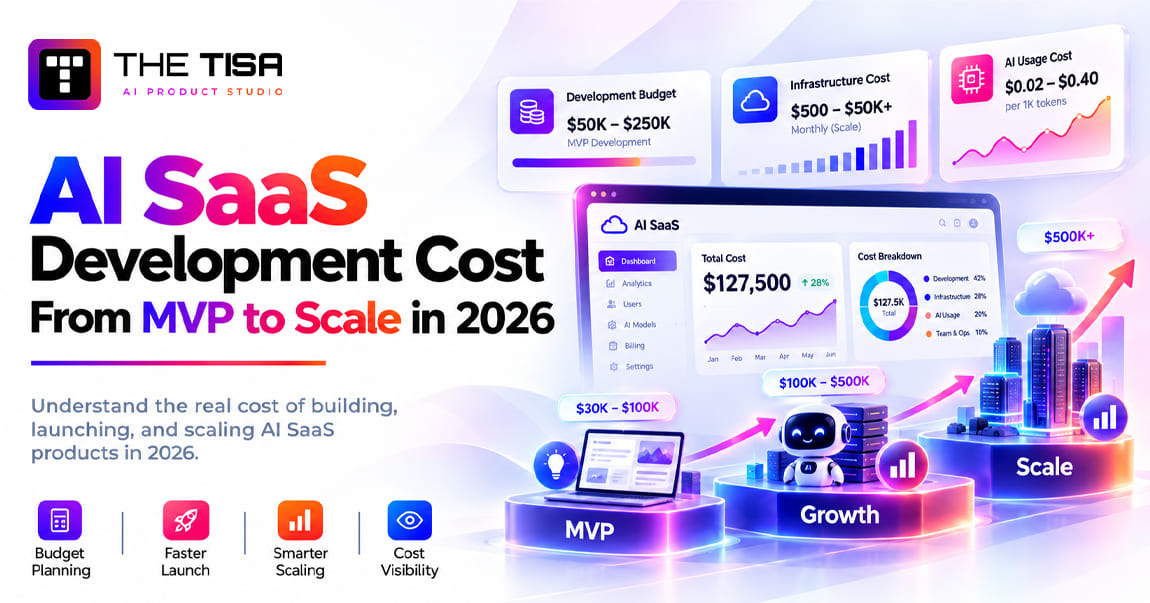
As a planning range, teams often scope a focused multi-tenant AI MVP in roughly three to five months, while enterprise-ready platforms with compliance and multiple integrations take longer. For detailed budget ranges, see our analysis of AI SaaS development cost from MVP to scale.
Where Is Multi-Tenant AI SaaS Architecture Used Today?
Multi-Tenant AI SaaS Architecture fits any product where many organizations need the same AI capability applied to their own private data.
| Product type | Typical tenants | What isolation protects |
|---|---|---|
| AI writing platform | Marketing teams and agencies | Brand voice, drafts, client assets |
| Healthcare AI assistant | Clinics and hospital groups | Patient records and clinical notes |
| E-commerce AI | Online retailers | Product catalogs, customer behavior data |
| EdTech platform | Schools and training institutes | Student records and course content |
| SaaS analytics tool | B2B companies | Business metrics and dashboards |
| Custom enterprise AI | Business units or subsidiaries | Internal documents and workflows |
For regulated sectors, our overview of HIPAA-compliant AI use cases shows what works in practice.
Should You Build In-House or Bring in a Development Partner?
Build in-house if you already have senior engineers with production experience in multi-tenant systems and LLM pipelines. Bring in a partner if your team is strong on product but new to tenant isolation, AI evaluation, or compliance-ready infrastructure.
Hiring senior AI and platform engineers in the US often takes months. A hybrid model works well: a partner builds the foundation alongside your team and hands over a documented codebase.
When evaluating an AI SaaS Development Company, ask:
- Can they show how tenant isolation works at the data, retrieval, and model layers?
- Do they meter AI cost per tenant from the first release?
- How do they test for cross-tenant data leakage?
- Will you own the code, infrastructure accounts, and documentation?
- What does support look like after launch?
Vague answers are a warning sign, whatever the portfolio says.


How THE TISA Helps Teams Turn a Multi-Tenant Blueprint Into a Live Product
Picture a familiar starting point: early customer interest, a prototype on a single LLM API, and no clear answer to “how do you keep our data separate?” That gap is where THE TISA usually comes in.
Work starts with architecture, not code. The team maps the tenant model, which customers need deeper isolation, and which features truly need RAG or agents. This discovery follows a documented AI software development process, so scope and risk are visible before the first sprint.
Full-stack and AI engineers then build end to end: tenant-aware APIs, frontend, retrieval pipelines, model routing, metering, and cloud deployment. The same thinking shaped Clove, an AI project management SaaS built by the team.
After launch, prompts drift and model prices change, so ongoing maintenance and support keeps monitoring, cost tuning, and isolation testing running. For founders who want one partner from blueprint to scale, THE TISA works as a dedicated AI SaaS Development Company.
Conclusion
Multi-tenancy is not a detail to sort out after launch. It shapes your margins, your security posture, and how quickly enterprise buyers say yes. AI adds new surfaces to protect: prompts, embeddings, caches, and model deployments.
Before moving forward, evaluate four things: who your tenant really is, which customers will demand stronger isolation, how you will track AI cost per account, and whether your team has shipped this kind of system before. Clear answers save months of rework, and a short architecture review now is far cheaper than a rebuild later.
Frequently Asked Questions
Q1. Can a single-tenant AI product be converted to multi-tenant later?
Ans. Yes, but it is costly. Conversion means adding tenant keys to existing data, rebuilding vector indexes, rewriting queries, and re-testing for leakage. Products expecting more than a handful of customers save money by designing for tenancy before the MVP.
Q2. Does each tenant need its own AI model?
Ans. Rarely. Most products serve all tenants from shared foundation models and personalize results through tenant-scoped retrieval, prompt settings, and configuration. Dedicated models or deployments make sense mainly for large enterprise accounts with strict contractual, latency, or residency requirements.
Q3. How can a SaaS company prove tenant data isolation to enterprise buyers?
Ans. Buyers want evidence: an architecture diagram showing isolation per layer, automated cross-tenant test results, third-party penetration test reports, audit logs, and ideally a SOC 2 Type II report.
Q4. What hidden costs appear after launching a multi-tenant AI SaaS product?
Ans. The usual surprises are inference spend from a few heavy tenants, re-embedding documents when switching embedding models, storage growth from conversation logs, and engineering time spent on tenant-specific requests. Per-tenant cost dashboards and plan-level quotas keep these in check.
Q5. Is it safe to outsource multi-tenant AI development to an offshore team?
Ans. It can be, with the right safeguards: documented security practices, ISO 27001 or comparable controls, US time-zone overlap, full client ownership of code and accounts, and a clear handover plan.
Build a Scalable Multi-Tenant AI SaaS Platform
Build an AI SaaS platform that serves multiple customers securely and scales with your business. Talk to THE TISA about multi-tenant architecture, data isolation, tenant management, AI integration, and infrastructure planning to create a reliable SaaS product ready for growth.
Discuss Your AI SaaS Architecture Project →