Your first AI feature is live, the board wants three more, and your five-person engineering team has become a bottleneck. You hire more developers, but six months later, releases are slower and model accuracy is slipping.
The problem usually isn’t the new engineers. The team has grown faster than the systems needed to maintain consistency. Code review standards, evaluation pipelines, data ownership, and clear decision-making responsibilities have not kept pace. This is the central challenge of scaling AI-native engineering teams.
The pressure to expand is real. The U.S. Census Bureau’s Business Trends and Outlook Survey shows that AI use among U.S. businesses remained between 17% and 20% from December 2025 to May 2026, with more businesses expecting to adopt AI within the following six months. Google’s 2025 DORA report on AI-assisted software development also found that AI amplifies existing engineering practices. It strengthens teams with sound processes while exposing weaknesses in their workflows.
A sound AI team scaling strategy requires the right processes, responsibilities, and quality standards alongside team growth. This guide explains how to scale an AI team while maintaining quality and delivery consistency across AI software development projects.

Why Does Quality Drop When AI Teams Grow?
Quality drops because AI teams scale output faster than review, evaluation, and ownership. Code gets written quickly; deciding whether it is correct and safe does not speed up at the same rate. This is the core tension in scaling AI-native engineering teams.
AI adds risks traditional software lacks. Google researchers showed in Hidden Technical Debt in Machine Learning Systems that ML systems inherit every maintenance problem of regular code, plus new ones from data dependencies and a changing world. A model can pass every test today and degrade next month.
In Stack Overflow’s 2025 survey, 46% of developers said they distrust the accuracy of AI tool output, with “almost right” answers as the top frustration. Spread that across 30 engineers and no single code review catches it.
The early symptoms are predictable: senior engineers become approval queues, teams build duplicate retrieval pipelines, prompt changes ship unmeasured, and new hires learn tribal knowledge instead of written standards.
What Makes Scaling AI-Native Engineering Teams Different?
An AI-native team builds products around AI and uses AI tools in its development process. This creates two areas to manage: code quality and the AI behavior customers experience. To understand how to scale an AI team, companies must identify the technologies their products need and the skills required to manage them.
| Concept | In plain language | Where it shows up | Who usually owns it |
|---|---|---|---|
| LLM | A large language model that generates text from instructions | Assistants, summaries, drafting | ML/AI engineers |
| RAG | Retrieval-augmented generation: the model retrieves relevant information from documents before answering | Support bots, internal knowledge search | AI and backend engineers |
| Embeddings and vector database | Numeric representations of text that help systems find similar meanings, not just matching words | The search layer behind RAG | Data and backend engineers |
| Fine-tuning | Additional training on your own examples to adjust model behavior | Domain-specific tasks, response style | ML engineers |
| AI agents | Software that uses a model to plan and perform multi-step actions through APIs | Workflow automation, ticket triage | AI, backend, and DevOps engineers |
| Evals | Repeatable tests that measure model output against expected results | Testing prompts and models before release | ML engineers and QA |
Not every product needs all these technologies. A well-built RAG system, for example, may solve a knowledge retrieval problem without fine-tuning. Companies should assess their needs before hiring additional ML specialists. This comparison of fine-tuning, prompt engineering, and RAG explains the trade-offs.
A practical AI team scaling strategy starts with the product architecture. As companies grow their AI engineering teams, they should hire specialists based on actual technical needs.
How to Scale an AI Team: A 7-Step Roadmap
Each step builds on the previous one. Hiring before setting clear standards is a costly mistake in any AI team scaling strategy.
Step 1: Tie Headcount to Product Goals
Before opening roles, identify the AI capabilities your roadmap needs over the next 12 months and decide which ones to build or buy.
A recommendation engine and a HIPAA-compliant clinical summarizer require different teams. For each capability, list its data requirements and expected business results, such as hours saved or revenue influenced. If an existing API or SaaS product can meet the need, a dedicated hire may not be necessary. A build vs. buy framework for AI can help guide that decision.
The output should be a one-page capability map. Every hiring request should connect to it.
Step 2: Design a Pod Structure That Can Copy Itself
Organize engineers into small, cross-functional pods that own one product area from development to delivery. Support them with a shared platform group that maintains common tools and infrastructure.
| Role | Typical count per pod | Owns |
|---|---|---|
| Engineering manager or tech lead | 1 | Priorities, delivery, people, technical decisions |
| ML/AI engineers | 2-5 | Model selection, prompts, evaluation, fine-tuning |
| Data engineers | 2-4 | Pipelines, ETL, data quality, embedding stores |
| Backend engineers | 2-5 | APIs, integrations, business logic, scalability |
| Frontend engineers | 2-4 | Interfaces, dashboards, AI feedback flows |
| DevOps/MLOps engineers | 1-3 | Deployment, monitoring, infrastructure, cost control |
| Product manager or designer | Often shared | Roadmap, user research, AI user experience |
Each pod should ship features from data to UI without waiting on another team. Knowing how to scale an AI team also means recognizing when to add another pod instead of stretching one beyond 10 or 12 people. Since AI features involve more than the model itself, AI full-stack development skills matter across pods.
The platform group maintains shared model access, evaluation frameworks, logging, and CI/CD templates. This prevents pods from building the same tools independently.
Step 3: Match the Hiring Model to Each Gap
Hire in-house for long-term core capabilities. Use flexible hiring models when you need specialized skills or faster delivery.
The U.S. Bureau of Labor Statistics projects data scientist employment to grow 34% from 2024 to 2034, along with 15% growth for software developers, QA analysts, and testers. Competition for technical talent remains high, so an entirely in-house hiring plan can leave important roles open for months.
| Hiring model | Best for | Strengths | Watch out for |
|---|---|---|---|
| In-house team | Core IP, long-running AI products, regulated data | Full control, deep context | Slow hiring, highest fixed cost |
| Remote employees | Growing companies needing specific skills | Wider talent pool, flexible hiring | Time zones, onboarding discipline |
| Dedicated team (partner) | Fast scaling, end-to-end delivery | Ready team, established processes, quick start | Needs clear ownership and knowledge transfer |
| Freelancers/contractors | Prototypes, short tasks, niche skills | Fast, low commitment | Inconsistent standards; knowledge leaves with them |
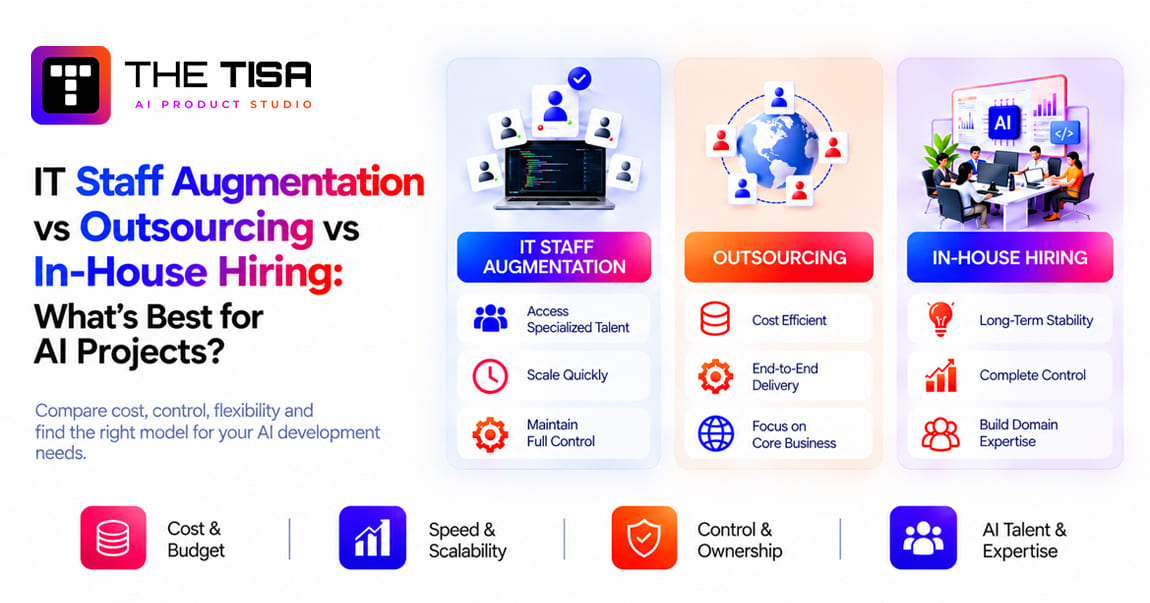
Most companies combine these models. This comparison of staff augmentation, outsourcing, and in-house hiring for AI projects explains their trade-offs.
Whatever the model, assess how candidates make technical decisions. Ask how they would test an LLM feature or decide when AI output needs human review.
Step 4: Write the Standards Before the Team Doubles
Document engineering practices while the team is still small enough to agree on them.
A short engineering handbook gives everyone a common reference. Cover:
- Coding and review rules. Require a second reviewer for changes to prompts, model configurations, or data pipelines.
- Architecture decision records for changes that affect multiple pods.
- AI tool policy: Specify approved coding assistants and the data they can access.
- Service boundaries. Decide when to use a modular monolith or microservices. This comparison of monolith vs. microservices for AI applications explains the trade-offs.
- Definition of done: Include tests, evaluations, documentation, and monitoring.
A 60-page wiki that nobody reads is no better than having no standards.
Step 5: Build Quality Gates for Code, Data, and Models
Maintaining quality at scale requires separate checks for code, data, and model behavior. Traditional QA alone does not cover all three.
| Gate | What it checks | Practical examples |
|---|---|---|
| Code | Correctness and maintainability | Unit, integration, and performance tests; code review; static analysis |
| Data | Inputs before training or retrieval | Schema checks, freshness, missing values, PII detection |
| Model | AI behavior | Golden-dataset evaluations, hallucination scoring, bias checks, comparison with the current production version |
| Security and compliance | Risk exposure | Access control, secrets management, audit logs, regulatory requirements |
| Production | Live behavior | Latency, cost per request, drift alerts, user feedback |
An evaluation uses fixed inputs and expected answers to measure model output. Run every prompt or model change against this set. If results fall below your threshold, hold the release until the team fixes the issue. This helps catch regressions before production.
For regulated U.S. industries, build compliance checks into the development pipeline. AI systems handling patient data must follow the safeguards in the HIPAA Security Rule. Enterprise buyers may also ask about SOC 2. This overview of AI SaaS security and compliance covers related requirements.
Step 6: Make Collaboration Work Without More Meetings
As the team grows, use regular check-ins and written decisions to keep everyone informed without adding unnecessary meetings.
- Hold weekly pod planning, biweekly cross-pod architecture reviews, and monthly roadmap reviews.
- Use asynchronous communication through design documents, decision logs, and recorded demos, especially with remote or offshore engineers.
- Maintain a shared AI playbook with approved prompt patterns, evaluation templates, and known failure cases.
- Define clear escalation paths for disagreements between product and engineering.
For distributed teams, protect three to four hours of daily overlap. Also, establish a generative AI governance policy that defines who approves model vendors and which data teams can send to third-party APIs.
Step 7: Measure, Then Scale Again
Track metrics across delivery, quality, model performance, cost, and team health. Add another pod only when existing teams deliver consistent results.
| Area | Metric | Why it matters |
|---|---|---|
| Productivity | Features delivered, sprint predictability | Shows whether new hires improve output |
| Code quality | Change failure rate, escaped defects | Identifies quality problems early |
| Model performance | Evaluation accuracy, hallucination rate, drift alerts | Tracks AI-specific quality |
| Reliability | SLO attainment, time to restore service | Protects user-facing stability |
| Time to market | Lead time from idea to production | Reveals delivery bottlenecks |
| Cost efficiency | Cost per feature, inference cost per request | Helps control cloud and API spending |
| Team health | Time to first production change, retention | Highlights onboarding and retention issues |
Set reliability targets using Google’s guidance on service level objectives. Avoid relying on lines of code or pull request counts because AI assistants can increase both without improving delivery.
A practical rule for scaling AI-native engineering teams: if the change failure rate rises or evaluation scores decline for two consecutive sprints after new hires join, pause expansion and fix the onboarding or quality issues.
What Mistakes Hurt Most When Growing an AI Engineering Team?
The costliest mistakes are structural, not technical, and they surface as slow releases long before anyone names the cause.
| Mistake | Early warning sign | Better approach |
|---|---|---|
| Hiring before the architecture is clear | New hires build throwaway prototypes | Finish the capability map and pod design first |
| Treating AI tools as a strategy | Pull request volume rises along with defects | Pair tools with review rules and evals |
| No owner for evals or data quality | “Who changed the prompt?” during incidents | Give the platform group clear ownership |
| Postponing security until enterprise deals | Security questionnaires stall sales | Build compliance controls from the first sprint |
| Ignoring technical debt | Each release takes longer than the last | Reserve fixed sprint capacity for debt reduction |
Growing an AI engineering team without shared business goals is the quiet version of every mistake above. Revisit the capability map quarterly.


How Much Does It Cost and How Long Does It Take to Scale an AI Team?
Cost depends mainly on your role mix, hiring model, and ongoing inference spend. The timeline depends on hiring speed and how much foundation already exists.
For U.S. companies, the biggest drivers are salaries, recruiting delays on senior roles, cloud and model API costs (budget them per request), tooling for observability and evals, and hidden costs like onboarding and rework. For product-level figures, see this guide to generative AI development cost.
| Phase | Planning range | Output |
|---|---|---|
| Discovery and capability map | 2-4 weeks | Prioritized AI roadmap |
| Team design and hiring plan | 2-3 weeks | Pod structure, roles, hiring mix |
| Hiring or partner onboarding | 8-16 weeks in-house; 2-4 weeks with a dedicated team | Staffed pod |
| Standards, platform, and eval baseline | 4-6 weeks, in parallel | Handbook, CI/CD, first eval suite |
| First new pod fully productive | Roughly one quarter | Features shipping under quality gates |
These are planning ranges, not guarantees. Clean data and existing CI/CD shorten them; when scaling AI-native engineering teams in regulated sectors, add time for compliance reviews.
When Does an AI Development Partner Make Sense?
A partner makes sense when the roadmap needs skills you can’t hire fast enough, when you need a working team in weeks rather than quarters, or when your team lacks experience with evals, MLOps, or compliance.
Watch for critical roles open for months, or a prototype nobody knows how to take to production. Before signing, ask:
- Can you show AI systems running in production, not just demos?
- How do you evaluate model quality before each release?
- Who owns the code, models, and data after the engagement?
- Which security certifications and practices do you follow?
- How do you document work and transfer knowledge to our in-house team?
- How many working hours overlap with our time zone?
A partner who can’t answer the eval and knowledge-transfer questions will add headcount, not capability. These questions are the fairest way to judge the best AI powered software development company for your situation, and a sound AI team scaling strategy treats any partner as part of the same quality system.
Where THE TISA Plugs Into Your Scaling Plan
Companies at different stages of growth face different challenges when scaling AI teams. The right starting point depends on the bottleneck, not a fixed service package.
“We know we need AI, but not which team to build.” Product discovery and architecture planning help define the required capabilities and pod structure before hiring begins. The AI software development process takes projects from discovery through production.
“Our roadmap is ahead of our hiring.” Senior ML, data, backend, frontend, and DevOps engineers can join through IT staff augmentation or as part of a dedicated pod. They work within existing sprints and repositories, keeping project knowledge within the team.
“The AI layer is the gap.” RAG pipelines, AI agents, and model integrations can extend existing products through AI integration services, including API connections and cloud deployment.
“Quality is slipping as we grow.” Evaluation suites, CI/CD pipelines, monitoring, and cost tracking help teams maintain quality as they expand. Ongoing maintenance and support also helps keep production systems reliable. Security practices should account for relevant standards, including ISO 27001.
Conclusion
Scaling AI-native engineering teams is less about hiring speed and more about protecting judgment as output grows. Companies that keep quality high define capabilities first, organize into self-contained pods, choose hiring models gap by gap, and gate code, data, and models before the team doubles.
Before moving forward, check three things: are your standards written down, is every model change measured against an eval, and would your metrics reveal a quality slide within one sprint? If any answer is no, fix that first. That is how to scale an AI team safely: one stable pod at a time, with internal hires, a partner like THE TISA, or both.
Frequently Asked Questions
Q1. At what team size do formal engineering processes become necessary?
Ans. There is no fixed number. The trigger is usually the second team, or key decisions waiting on one person, often somewhere between 8 and 15 engineers. Lightweight standards then cost far less than retrofitting them at 40.
Q2. Can AI coding assistants replace the need to hire more engineers?
Ans. Not fully. Assistants raise individual output but add no review capacity, architectural judgment, or production accountability. They often shift the bottleneck from writing code to verifying it.
Q3. How long should it take a new AI engineer to become productive?
Ans. With a handbook, a ready environment, and an onboarding buddy, a small production change within the first two weeks is realistic. Full productivity on complex model or data work takes a few months; longer ramps usually signal missing documentation.
Q4. Is it safe to give an external partner access to proprietary data and models?
Ans. Yes, with the right controls: NDAs, IP assignment, a Business Associate Agreement for health data, least-privilege access, and environments in your own cloud account. Keep audit logs and revoke access the day an engagement ends.
Q5. How should leadership measure ROI from expanding an AI team?
Ans. Compare business results with fully loaded cost: revenue influenced by AI features, operations hours saved, faster releases, and avoided costs. Set a baseline before expanding so the comparison holds up.
Scale Your AI Engineering Team Without Losing Quality
Grow your AI engineering capabilities without compromising code quality, collaboration, or delivery standards. Talk to THE TISA about building the right team structure, adding specialized expertise, and scaling development capacity while maintaining consistent engineering practices.
Discuss Your AI Team Scaling Project →