



Your resume-screening model already sends fit scores to your applicant tracking system. Your underwriting model sends risk tiers to Salesforce. Your team may not consider these outputs final decisions, but regulators in two states may treat them that way.
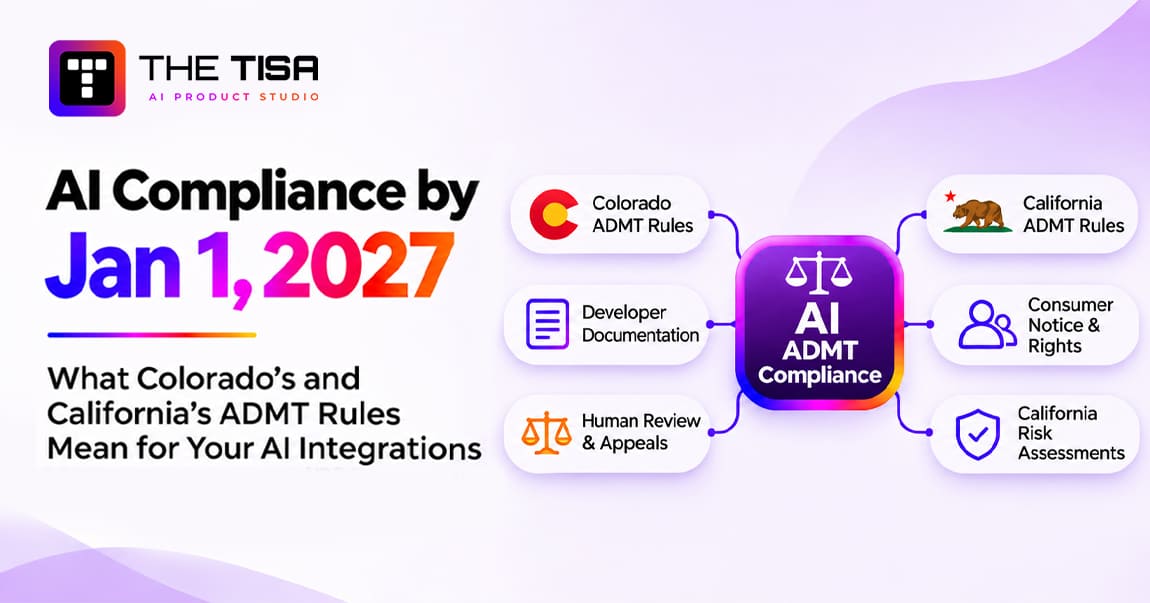
California’s updated CCPA regulations, including provisions governing automated decisionmaking technology (ADMT), became effective on January 1, 2026. However, businesses using ADMT for significant decisions have until January 1, 2027, to comply with the specific ADMT requirements, as White & Case explains. Colorado’s revised AI law, SB 26-189, takes effect on the same date and covers consequential decisions made on or after it.
For most companies, ADMT compliance is as much a software integration task as a legal requirement. Businesses need to show users a notice before the model runs, explain its output using data their systems actually record, and give human reviewers the context and authority to change the outcome. Existing CRM, ATS, and HRIS platforms rarely provide these capabilities out of the box.
This guide explains which workflows fall under California’s AI laws and the Colorado AI Act. It covers the notice, explanation, and human-review features to add to CRM and HR integrations, how Colorado treats contract terms that shift liability, and how to prepare before January 1, 2027.

What Is the Status of the Colorado AI Act?
The original Colorado AI Act no longer exists. On May 14, 2026, Governor Polis signed SB 26-189, which repeals and replaces the 2024 law. The new law narrows the original and moves the effective date from June 30, 2026, to January 1, 2027. It now centers on consumer transparency and rights, as Eckert Seamans explains.
The rewrite removed the duty of care, risk management programs, impact assessments, and reporting requirements to the Attorney General. What remains is a framework built around transparency and recourse. Deployers must provide notice before use, explain adverse outcomes within 30 days, and offer meaningful human review where commercially reasonable. EPIC and Finnegan provide more detail on these changes.
The enforcement timeline is less clear. On April 27, 2026, the court ordered the Colorado Attorney General not to initiate enforcement, including an investigation, for alleged violations of SB 24-205 or replacement or amending legislation occurring on or before fourteen days after the court rules on xAI’s forthcoming preliminary-injunction motion. xAI must file that motion within 28 days after final adoption of implementing rules. Legal 500’s analysis covers this timeline in detail. The Attorney General must adopt those rules by January 1, 2027. As of early November 2026, the rules had not yet been adopted following the October 26 hearing, according to Recording Law.
Enforcement may start later than January 1, 2027, but the law still applies to decisions made from that date. The enforcement delay also doesn’t pause liability under anti-discrimination law. Treat January 1, 2027, as your engineering deadline.
Which California AI Laws Apply to Automated Decision-Making?
California has several AI laws. For integrations, the CCPA ADMT regulations matter most, but others apply alongside them:
- Civil Rights Council employment rules took effect on October 1, 2025. They prohibit discriminatory automated-decision systems under FEHA. Employers must also keep ADS-related records for at least four years, counted from when the record was made or from the personnel action, whichever is later.
- SB 53, AB 2013, and SB 942 cover frontier model safety, training data disclosure, and AI content transparency. They mostly apply to companies that build models.
The ADMT rules apply when technology replaces or substantially replaces human decisionmaking. A human reviewer must independently evaluate the ADMT output alongside relevant information and have the authority to change the decision. Simply approving the system’s recommendation without meaningful review does not qualify.
The rules create three duties: a pre-use notice, a right to opt out (or a qualifying appeal to a human), and a right to see how ADMT was used. Risk assessments follow their own schedule. Initial risk assessments for qualifying existing processing activities must be completed by December 31, 2027. New covered processing activities generally require an assessment before processing begins. The risk assessment attestation must be submitted to the CPPA by April 1, 2028. Secure Privacy explains these requirements in detail.
Other new AI regulations expected to be implemented in 2026 did arrive. Illinois HB 3773 and Texas’s TRAIGA both took effect on January 1, 2026. On December 11, 2025, President Trump signed an executive order that questions whether state AI laws can be enforced, as King & Spalding noted. For now, those laws remain enforceable.
Which Integrated Workflows Fall in Scope?
Any AI output that feeds a decision about someone’s job, credit, insurance, housing, healthcare, or education may be covered. Each state uses a different test, and that difference affects your architecture.
California asks whether technology replaces human judgment. Colorado asks whether it materially influences the decision. Adding a human review step might take a workflow out of California’s rules while leaving it inside Colorado’s. Plan your ADMT compliance work around the stricter test.
| Workflow | Typical integration point | Colorado | California | Most important hook |
|---|---|---|---|---|
| Hiring and HR | ATS ranking, interview scoring, promotion signals in HRIS | Yes | Yes | Notice in the application flow, human review queue |
| Lending and credit | Underwriting scores in a loan system or CRM | Yes | Yes (GLBA-covered data is exempt) | Reason codes for adverse outcomes |
| Insurance | Underwriting, pricing, claims triage | Yes (insurer exceptions) | Generally no | Explanation and data correction |
| Housing | Tenant screening in property platforms | Yes | Yes | Correction of third-party data |
| Healthcare | Access to care, coverage, care prioritization | Yes (HIPAA exceptions) | Yes | Qualified clinical reviewer |
| Education | Admissions, scholarship scoring | Yes | Yes | Appeal path before final decision |
Colorado excludes tools used only to summarize, organize, or route information for human review of administrative tasks. Scheduling, customer service triage, marketing, search, and product recommendations are also excluded. An LLM that drafts candidate summaries is likely out of scope, but the same LLM ranking candidates is in scope. Colorado’s proposed rules would presume ADMT outputs influence decisions unless shown to be minor, so document any exclusion.
The ADMT Compliance Hooks to Build Into CRM and HR Integrations
The simplest pattern is a decision gateway: a small service that sits between your model and your system of record. Every AI call that can affect a covered decision goes through it. That way you build compliance once instead of patching each integration separately.
1. Pre-use notice hook
The notice has to appear before the model processes a person’s data. The gateway checks whether the person has seen the current version of the notice and blocks the call if they haven’t. It then records the notice version, the timestamp, and the channel. California lets you include the Pre-Use Notice in your CCPA notice at collection, but a cookie banner alone isn’t enough. Colorado’s rules on notice content are still pending, so keep your templates configurable.
2. Decision record
Log the model and prompt versions, each input with its source, the output, the reason codes, and any human action. These are recommended engineering practices for demonstrating compliance. Colorado requires deployers to keep records for three years after each consequential decision, and developers for three years. California’s FEHA rules require employers to keep ADS-related employment records for four years. Keep records for the longest applicable period.
3. Explanation generator
Colorado requires a plain-language disclosure within 30 days of an adverse outcome. It must cover the decision, the ADMT’s role, and how to exercise rights. California access requests ask how the output affected the outcome. Generate both from stored reason codes using templates. An LLM (the kind of model behind ChatGPT) can improve the wording, but it should never make up reasons. An explanation the model guessed at creates legal risk instead of meeting the requirement.
4. Opt-out, appeal, and correction intake
California requires two or more opt-out methods, and at least one must match how the business mainly interacts with consumers. Colorado requires a way for people to correct inaccurate data and ask for reconsideration. Send these requests through webhooks into objects you already use, such as a Salesforce Case or a HubSpot ticket, so they don’t get lost in an inbox. An AI CRM integration guide shows how those objects connect to model outputs.
5. Human review queue with real authority
Reviewers need to see the output, the inputs, and the reason codes, and they need an override that actually works. Colorado requires an opportunity to appeal an adverse consequential decision through meaningful human review, to the extent commercially reasonable. Track how often reviewers override the model. If they never disagree with it, that’s a warning sign. If you run AI agents (software that plans and takes actions on its own), add a checkpoint before any covered action.
Your AI governance policy is a separate project. These hooks are the technical layer it depends on.
The Colorado Clause That Voids Liability Shifting
Under SB 26-189, contractual provisions that indemnify, defend, or hold a developer or deployer harmless for damages resulting from its own acts or omissions involving covered ADMT-related violations of Colorado anti-discrimination laws are void as against public policy, as Ogletree explains.
Liability follows relative fault. Suppose a deployer uses covered ADMT the way the developer intended, documented, marketed, advertised, configured, or contracted it, and the results are still discriminatory. In that case, the developer may be liable for its share of responsibility. The deployer may be liable for uses outside that scope. Crowell’s client alert calls this a direct risk-transfer concern for AI procurement.
As a result, “intended use” becomes something you may have to prove with technical records. Keep versions of vendor documentation, log your configuration, and note any fine-tuning. Substantially modifying a vendor’s model can make you a developer too.
Colorado’s proposed rules also add a “midstream developer” category for firms that integrate covered ADMT into their products. They must get documentation from upstream developers and pass it to customers. If you build on a third-party model, plan for this now, though final rules may change.
If you sell AI features, you are the developer. Build documentation, configurable notices, and exportable decision logs into the product. Enterprise buyers will ask for them, and having ADMT compliance support built in speeds up their procurement process.
Colorado vs. California at a Glance
| Factor | Colorado (SB 26-189) | California (CCPA ADMT rules) |
|---|---|---|
| Applies from | Decisions made on or after Jan 1, 2027 | By Jan 1, 2027 for ADMT already in use; at the time of use for new uses after that |
| What triggers it | Materially influences a consequential decision | Replaces or substantially replaces human decisionmaking |
| After an adverse decision | Plain-language disclosure within 30 days | Access right on request |
| Human role | Meaningful review where commercially reasonable | Opt-out or qualifying human appeal |
| Enforcement | Attorney General only; 60-day cure right ends Jan 1, 2030 | CPPA and California AG |
A Realistic Plan Before January 1, 2027
With the deadline close, close the riskiest gaps first.
- Inventory and classify (weeks 1-2). List every model, score, and vendor tool that affects a person, and check each one against both states’ tests.
- Build the gateway and decision record (weeks 2-4). Start with the workflow that handles the most decisions.
- Add intake and review queues (weeks 4-6). Connect opt-out, correction, and appeal requests to your CRM or HRIS.
- Test (weeks 6-7). Replay past decisions, check that notices display correctly on every channel, and confirm that explanations match the logged reasons.
If you can’t cover every workflow by January 1, 2027, finish the highest-volume one first and record a dated plan for the rest.
The effort depends on how many systems you touch, whether your vendors expose reason codes through APIs, and how old your stack is. Legacy systems usually take the longest, and they often drive the real cost of ADMT compliance.
Common mistakes include:
- Assuming a human reviewer exempts you in Colorado
- Letting an LLM write explanations that aren’t based on logged reason codes
- Hiding opt-outs in cookie banners
- Not logging model versions
- Relying on vendor indemnities that Colorado now voids


What Working With THE TISA Looks Like on an ADMT Retrofit
Most teams don’t need a new AI product for this. They need their existing integrations to show what they did and why. That’s how THE TISA approaches ADMT compliance work.
We start by meeting with your product owners and legal counsel and tracing each AI touchpoint from the data source to the final decision. Your counsel decides what the law requires. Our engineers figure out how to deliver it without slowing down the product.
Next, our AI integration team builds the decision gateway as an API-first service. It connects to your current CRM, ATS, or HRIS instead of replacing it. Our full-stack developers build the notice, opt-out, and request pages. QA engineers write replay tests that confirm every explanation matches its logged reason codes. After launch, our maintenance and support team keeps templates and logging up to date as Colorado finalizes its rules.
Conclusion
The January 1, 2027 deadline is less about writing new policies and more about making your existing AI integrations accountable. If a model scores, ranks, or filters people in a covered area, your system needs to provide a notice before it runs, record its decisions, explain its outcomes when requested, and allow a human reviewer to reverse a decision.
Before you commit a budget, identify which workflows fall under either state’s rules, whether your vendors can provide the required documentation, and whether your existing systems can log decisions without a rebuild. Starting your inventory now will put you in a better position than waiting for Colorado’s final rules.
Frequently Asked Questions
Q1. How much does ADMT compliance engineering cost?
Ans. The cost depends on the number of workflows involved, the systems they connect to, and whether vendors provide access to decision data through APIs. A single-workflow implementation generally costs less than a rollout across multiple systems. An AI integration cost guide explains the main cost factors.
Q2. How long does ADMT compliance implementation take?
Ans. A single, well-documented workflow can often be covered in a few weeks. Multiple systems, legacy platforms, or vendors without APIs can extend implementation to several months.
Q3. Does adding a human reviewer exempt a business from ADMT rules?
Ans. In California, meaningful human involvement may affect whether a decision falls under the ADMT rules. The reviewer must genuinely evaluate the output and have the authority to change the decision. In Colorado, human review does not automatically exempt AI systems that materially influence consequential decisions.
Q4. Is a business responsible when it uses a vendor’s AI inside its HR platform?
Ans. Yes. Businesses acting as deployers may have responsibilities for notices, explanations, and human review. Vendors should provide relevant technical documentation. Under Colorado’s law, contractual provisions cannot shift liability for a party’s own covered anti-discrimination violations to another party.
Q5. What should businesses look for in an ADMT compliance development partner?
Ans. Look for experience with the relevant CRM or HRIS, the ability to work alongside legal counsel, reliable decision logging and testing practices, and ongoing maintenance support. The partner should also be able to integrate compliance features without requiring a complete system rebuild.
Preparing Your AI Integrations for ADMT Compliance?
Make your AI integrations ready for Colorado’s and California’s ADMT requirements. Talk to THE TISA about building compliance features into your existing CRM, ATS, and HRIS systems, including decision logging, user notices, and human review workflows.
Discuss Your AI Integration Project →