



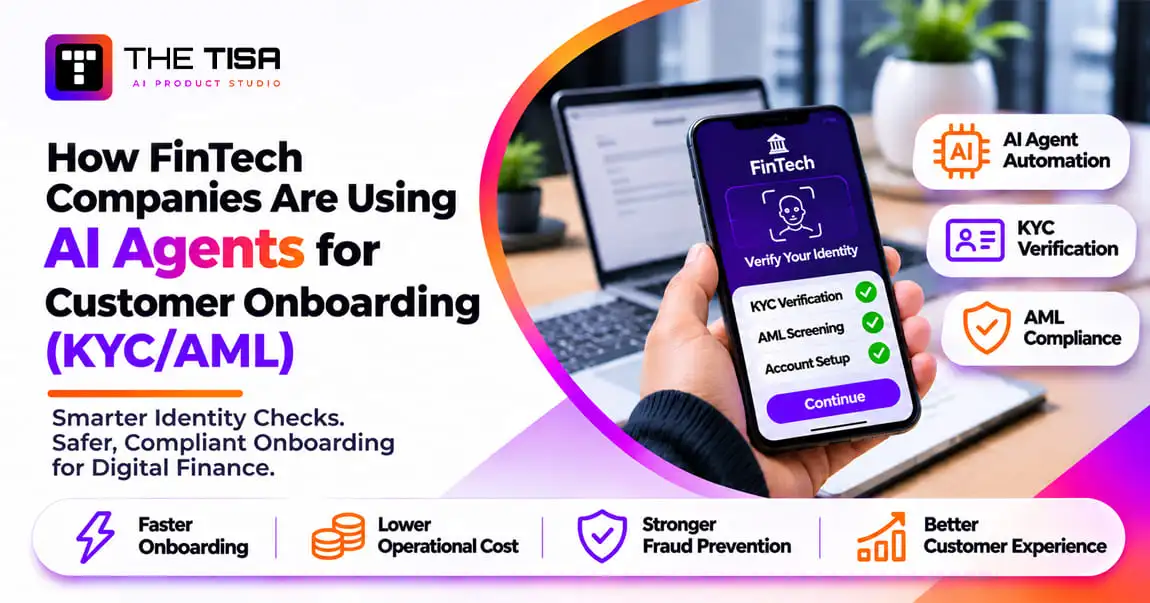
A new customer opens your app, uploads a driver’s license, takes a selfie and waits. Behind that screen, your compliance team still checks documents, runs sanctions searches and chases missing proof of address. Every unnecessary delay increases the risk of losing a potential customer. Backbase reports that seventy percent of financial institutions lost clients last year because onboarding was too slow.
Fraud makes the problem harder. Entrust’s 2027 Identity Fraud Report found that deepfake attacks rose 165% year over year, and financial services accounted for 94% of detected deepfakes globally. Manual review can’t keep up with that volume.
That’s why AI agent projects for KYC and AML onboarding have moved from slide decks to production. Banks and fintechs now use agents that collect data, verify identity, screen against watchlists and prepare case files for a human to approve.
This guide explains how these systems work. You’ll learn where AI fits in onboarding and AML, what changed in 2026, what’s coming in 2027, how the architecture looks and what drives cost. If you lead product or engineering at a US fintech, it should help you decide whether to build, buy or wait.
Key Takeaways
- AI agents can coordinate document verification, sanctions screening, risk assessment and case preparation, reducing repetitive onboarding work.
- Compliance teams remain accountable for risk decisions, suspicious activity reporting and regulatory obligations.
- Multi-agent architectures work best when each agent has defined permissions, approved tools and traceable actions.
- Fintech companies should begin with a focused pilot, measure results against existing processes and expand only after validating security, accuracy and compliance.

What Do AI Agents for KYC/AML Onboarding Actually Mean?
AI agents for KYC/AML onboarding are software systems that coordinate identity verification, compliance screening and risk assessment through connected tools and APIs. They automate repetitive steps and route cases that need further review to compliance teams. Legitimate users get approved faster, and risky ones are sent to a human reviewer.
Here’s what each term in the topic means:
- FinTech: Companies that deliver financial services through software, such as digital banks, payment apps and lending platforms.
- Customer onboarding: The process of signing up a new customer, from the first form to an active account.
- KYC (Know Your Customer): Checks that confirm customers are who they claim to be, such as verifying their ID and address. KYB (Know Your Business) applies the same idea to companies and their real owners.
- AML (Anti-Money Laundering): Rules and controls that stop criminals from moving illegal money. They include sanctions screening, transaction monitoring and reporting suspicious activity.
- AI agent: Software that works toward a goal across several steps. It reads inputs, decides the next action, calls tools such as APIs and checks its results. Unlike traditional RPA bots, which follow fixed scripts, it adapts when a document or screen changes. A large language model (LLM) usually does the reasoning. Think of the LLM as the brain and the tools as its hands.
In practice, the agent does the repetitive checking work, and your compliance team keeps the final say on anything unclear.
How Are FinTech Companies Using AI?
Fintech companies use AI for fraud detection, credit decisions, compliance, customer support and internal operations. Onboarding often comes first because drop-off, approval time and cost per review are easy to measure. All of these use cases, from fraud models to onboarding agents, depend on clean, well-governed data. That theme runs through AI in financial services.
How Can AI Agents Be Used in Customer Support?
AI agents answer routine questions, help users who get stuck during onboarding and pass sensitive issues to staff. A well-built AI agent in fintech support can tell an applicant exactly which document failed and why.
Boundaries matter. The agent must never reveal why an account was flagged. Financial institutions and their personnel generally cannot notify a person involved in a suspicious transaction that a Suspicious Activity Report (SAR) has been filed, subject to applicable legal exceptions. This restriction is commonly known as SAR tipping-off.
How Are Companies Using AI for Onboarding?
Companies use AI to speed up data collection, document checks, screening and case preparation. Humans still make the call on risky or unusual cases.
A typical AI-powered customer onboarding flow looks like this:
| Step | What the agent does | Human role |
|---|---|---|
| Intake | Pre-fills forms and requests only missing data | None for clean cases |
| Identity check | Reads the ID, matches the selfie, checks liveness | Reviews mismatches |
| Screening | Runs sanctions, politically exposed person (PEP) and adverse media checks | Clears hits |
| Risk scoring | Assigns a risk tier with reasons | Approves high-risk tiers |
| Case file | Builds a timestamped audit record | Signs off |
Large banks already run this model. Deutsche Bank’s private bank launched an agentic AI solution that automates the research, documentation and preparation of Source of Wealth information. The bank’s Emerging Markets business is forecast to onboard around 30 per cent more clients in 2026 than in 2025.
KYB is harder. Agents can pull registry data and trace ownership chains, but layered structures and offshore entities still need an experienced analyst.
How Is AI Used in AML?
AI supports AML in three ways: better screening, better transaction monitoring and faster investigations.
Machine learning models rank alerts by how likely they are to signal real risk. AI agents for AML compliance then gather context, such as linked accounts and past alerts, and draft a case summary. An investigator decides whether to file a SAR.
Agents also make continuous (“perpetual”) KYC possible. Instead of reviewing customers every few years, the system reacts to trigger events, like a sanctions list update or a sudden change in how a customer transacts.
What Changed in 2026 and What Is Coming in 2027?
Regulators introduced several changes in 2026 that affect how fintech companies use AI agents for KYC/AML onboarding.
- FinCEN program rule: On April 7, 2026, FinCEN issued a proposed rule to reform AML/CFT programs around measurable effectiveness. Published in the Federal Register on April 10, the proposal discusses a more risk-based approach to compliance and the use of machine learning, generative AI, digital identity and blockchain analytics. Firms would get 12 months to implement the changes after a final rule is issued.
- Model risk guidance: On April 17, 2026, the OCC, Federal Reserve and FDIC jointly issued Revised Guidance on Model Risk Management, updating and replacing the 2011 guidance commonly known as SR 11-7. The revised guidance explicitly excludes generative AI and agentic AI models from its scope. The agencies indicated that they would seek separate input on AI-related model risk management.
- Stablecoins: On October 21, 2026, the OCC issued its final rule implementing the GENIUS Act, effective January 18, 2027. However, BSA/AML and OFAC sanctions requirements for stablecoin issuers will be addressed through separate rulemaking.
- EU AMLR: The new EU Anti-Money Laundering Regulation (AMLR) applies from July 10, 2027, and also matters for US fintechs serving EU customers. EY’s overview explains the implications for financial firms.
- Vendors: Fenergo launched Fen-AI in July 2026. The agentic layer coordinates AI tasks across onboarding, periodic reviews, ongoing monitoring and material client changes, as outlined in the launch announcement.
How Do You Build AI Agents for KYC/AML Onboarding?
Most production systems use several narrow agents instead of one big one. An orchestration layer coordinates them and keeps the full audit trail. In this multi-agent AI system design, each agent gets only the permissions it needs, so each one is easier to audit.
- Document agent: Reads IDs, bank statements and company filings using optical character recognition (OCR) and vision models.
- Screening agent: Calls sanctions, PEP and adverse media APIs.
- Risk agent: Applies your written risk policy and explains every score.
- RAG layer: Retrieval-augmented generation (RAG) lets agents look up your policies before they act. A vector database stores those policies as embeddings, which are numeric “fingerprints” of meaning. That way the agent quotes your rules instead of guessing.
- Integration layer: Connects core banking, CRM and case management. Model Context Protocol (MCP) gives agents a standard way to call these tools.
- Review console: Shows analysts the evidence, the agent’s reasoning and one-click actions.
Auditors will ask where customer personal data (PII) is stored and which model providers can see it.
How Long Does AI Agent Implementation Take, and What Affects the Cost?
Implementation costs depend on the number of integrations, verification volume, vendor pricing, security requirements and ongoing compliance monitoring.
| Option | Typical timeline | Best fit |
|---|---|---|
| Buy a KYC platform | 1-3 months | Standard consumer KYC |
| Platform plus custom agents | 3-6 months | Growing fintechs with unique flows |
| Fully custom build | 6-12 months | Complex KYB, multiple products or regions |
Hidden costs include LLM usage, per-check vendor fees and ongoing monitoring. These recurring items often shape total AI agent development cost more than the initial build does.
What Risks Do Teams Underestimate With AI Agents for KYC/AML Onboarding?
The biggest risks are decisions nobody can explain, weak audit trails, data leaks and too much automation. Common mistakes include:
- Letting agents reject customers without human review
- Skipping baseline metrics, so you can’t prove the system improved anything
- Sending PII to model APIs without proper data agreements
- Testing only clean documents and ignoring deepfakes
Where Should Humans Stay in the Loop?
Agents can process straightforward, low-risk applications automatically when approved policies permit it. Compliance analysts should review flagged cases, PEP matches, complex ownership structures, high-risk applicants, high-risk jurisdictions and unclear adverse media, and make every SAR decision. Write down these escalation rules before launch, so examiners can see who decided what and why.


From Pilot to Production: How THE TISA Approaches KYC Agent Projects
Many AI agent projects for KYC/AML onboarding struggle to move beyond a promising demo to a system that meets compliance requirements. THE TISA focuses on building solutions that work within real onboarding operations.
The process starts with a short discovery sprint. The team maps the existing onboarding flow, identifies where applicants drop off and selects one focused use case, such as document verification for standard-risk applicants. From there, AI agent development connects the agents to the KYC vendors and core systems the business already uses.
The project also includes the supporting review console, APIs, cloud infrastructure and test suite, including fraud tests using synthetic IDs. Once the onboarding system is stable, the same APIs and data model can support other workflows, such as payments and lending, through broader fintech software development services.
When evaluating a fintech software development company, ask three questions: Can the team demonstrate how it builds an audit trail? How does it test the system against fraud? Who will maintain the system after launch?
Conclusion
AI agents for KYC/AML onboarding are no longer experiments. Banks run them in production, and US regulatory developments are also bringing greater attention to technology, risk-based controls and measurable AML program effectiveness. The upside is faster approvals, fewer false alerts and stronger audit records.
The risk is just as real. An agent without guardrails can approve the wrong customer at scale. Before moving forward, assess your data quality, integrations, explainability needs and who owns oversight. Start with one narrow use case, measure it against a baseline and expand only when compliance trusts the results. The strongest results come from teams that treat compliance as a design input, not a final review.
Frequently Asked Questions
Q1. How much does it cost to build AI agents for KYC automation?
Ans. A pilot built on licensed KYC APIs costs far less than a custom multi-agent KYB system. Budget for LLM usage, vendor fees and monitoring, not just the build.
Q2. How long does an AI onboarding rollout take?
Ans. A focused pilot often takes two to four months. Production with multiple agents and compliance sign-off usually takes six months or more.
Q3. Are AI agents allowed under US AML rules?
Ans. Yes. Regulations don’t ban AI, but you remain accountable. You need explainable decisions, human oversight and a complete audit trail.
Q4. Should we build or buy AI agents for KYC/AML onboarding?
Ans. Buy when your flow is standard and speed matters most. Build or extend when you have complex KYB or custom risk logic.
Q5. Can AI agents replace compliance analysts?
Ans. No. Agents take over repetitive work, while analysts make the judgment calls and SAR decisions.
Q6. How do we choose an AI development partner?
Ans. Look for experience with regulated data, rigorous testing, strong security and a maintenance plan. A structured checklist for choosing an AI agent development company makes vendor comparisons fairer.
Building AI Agents for Secure KYC/AML Onboarding?
AI agents for fintech onboarding require more than automated identity checks. Talk to THE TISA about your KYC/AML workflows, identity verification, compliance requirements, and security controls to understand the right approach for building and deploying AI-driven onboarding systems.
Discuss Your KYC/AML AI Project →