


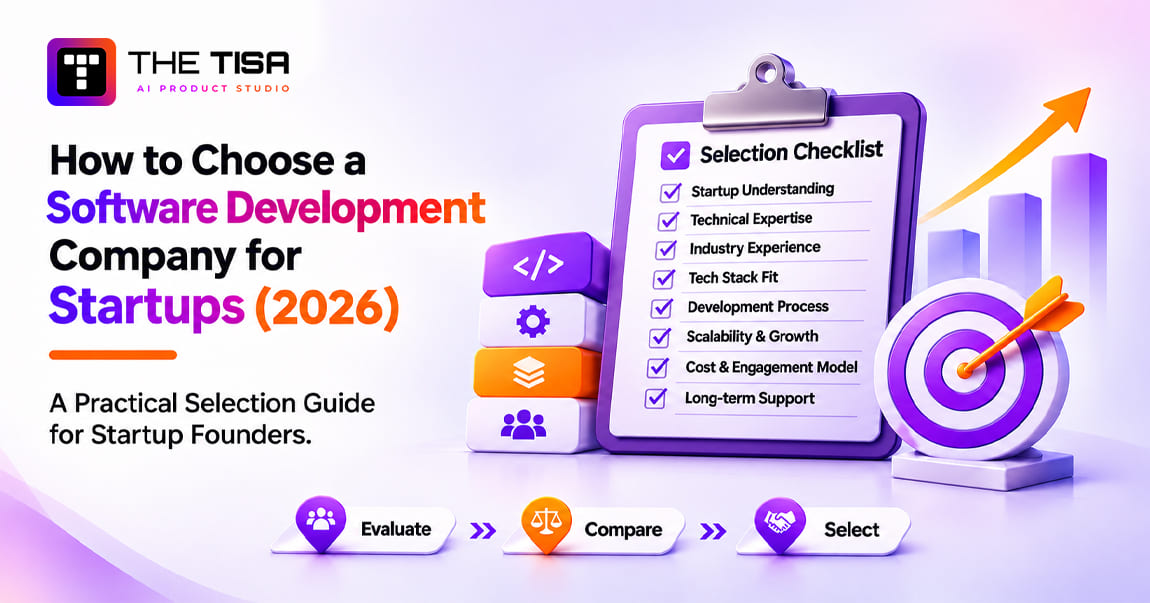
A software development company for startups should do more than just build an application. It should understand your business goals, identify the problem you want to solve and develop reliable software that supports your day-to-day operations. The right development partner brings relevant project experience, understands your workflow, provides a clear cost estimate and divides the work into manageable phases.
If you’re comparing three to five vendors, you’ll likely hear similar claims about their technical skills and AI expertise. Knowing which company can actually deliver what your startup needs is not always easy. This guide will help you compare potential partners using a weighted scoring framework, identify common red flags, prepare the right questions and understand the software development trends and costs that matter when choosing a partner in 2026.
Key Takeaways
- Score every vendor on the same weighted criteria, with production experience weighted highest.
- Start with one workflow problem. A vendor who opens with a technology pitch is selling, not scoping.
- Pay in phases, so you can stop, adjust or continue at each gate.
- Pay for consulting first when your data, scope or build-versus-buy answer is unclear.
- Settle security, data ownership and IP terms before you sign.

The Situation Most Startup Buyers Are In
You have an idea, a limited runway and a small team, but no in-house AI engineers. Every vendor sounds capable, and none gives you a number you trust. Three worries come up again and again:
1. “Will it work in production, or only in a demo?” Prototypes are cheap. Systems that handle real users, messy data and uptime requirements are not.
2. “Will the price double?” Fixed-looking quotes often hide change orders.
3. “Will I be locked in?” If the vendor owns the code, the prompts or the pipelines, switching later is painful.
The sections below address each worry.
What Should a Startup Look for in a Software Development Company?
Look for a software development company for startups that can show live systems, explain its development process clearly and connect each feature to a business outcome. Technical skills are the baseline; industry knowledge, transparency and practical experience help you choose the right development partner.
- Production proof. Ask which systems are live, how long they have been running, how the team tests and monitors output quality, and what happens when an AI model gives a wrong answer. Look for case studies that explain the workflow, technology stack and business results. The NIST AI Risk Management Framework provides guidance on testing, monitoring and accountability.
- Industry understanding. A fintech startup needs audit trails and proper data handling, while a logistics business needs exception routing and reliable integrations. A vendor that does not ask about your current process may end up building around what it already knows.
- Process transparency. You should understand how the company takes a project from discovery through development and deployment. Compare its approach with the stages outlined in THE TISA’s AI software development process.
A Weighted Scoring Framework for Comparing Vendors
A gut-feel comparison often favors the vendor with the best presentation. A weighted scoring framework helps you evaluate every software development company against the same criteria and compare its actual capabilities.
Step 1: Set the evaluation weights. Adjust them to match your project requirements, but agree on the weights before meeting vendors.
| Evaluation criterion | Weight | Strong signal (score 5) | Warning sign (score 1) | How to verify |
|---|---|---|---|---|
| Production experience | 25% | Live systems with named workflows and measured results | Only prototypes or generic demos | Case studies and a reference call |
| Technical expertise | 20% | An engineer explains the architecture and testing approach | Vague answers; a salesperson handles every technical question | Architecture walkthrough with an engineer |
| Industry experience | 15% | Asks about your compliance, data and integrations | Pitches the same solution to every buyer | Ask for work in your sector |
| Pricing transparency | 15% | Phased scope, itemized estimate and clear change-order rules | One large fixed quote with vague scope | Ask what triggers a change order |
| Security and IP ownership | 15% | You own the code, prompts and pipelines; access controls are clear | Vendor retains core components; no clear data policy | Read the IP and data clauses |
| Post-launch support | 10% | Monitoring, patching and a written support plan | Handoff ends at deployment | Ask for support terms in writing |
Step 2: Score each criterion from 1 to 5. Give every vendor a separate score, using the strong signals and warning signs in the table as your reference.
Step 3: Calculate the weighted score.
Weighted score = Σ (criterion score × criterion weight)
The result will range from 1.00 to 5.00. Multiply it by 20 to get a score out of 100.
Worked example (hypothetical vendors and scores, for illustration only):
| Criterion (weight) | Vendor A | Vendor B | Vendor C |
|---|---|---|---|
| Production experience (25%) | 5 | 3 | 4 |
| Technical expertise (20%) | 4 | 5 | 3 |
| Industry experience (15%) | 3 | 4 | 2 |
| Pricing transparency (15%) | 4 | 2 | 5 |
| Security and IP ownership (15%) | 4 | 3 | 2 |
| Post-launch support (10%) | 3 | 4 | 2 |
| Weighted score | 4.00 (80/100) | 3.50 (70/100) | 3.15 (63/100) |
Vendor A ranks first, mainly because of its strong production experience, which carries the highest weight. Vendor C offers the clearest pricing but still ranks last because its lower scores for security and post-launch support affect the overall result.
Two rules to keep the scores reliable:
- Treat a score of 1 for security and IP ownership as a veto, regardless of the vendor’s total score.
- Score based on evidence, not claims. If you cannot verify a vendor’s claim, give that criterion no more than 2.
Red Flags to Watch for When Hiring a Software Development Company
- A precise quote after one call. Nobody can price a project accurately without reviewing its scope and data.
- Every example is “under NDA.” If the vendor cannot arrange a reference call, you cannot verify its work.
- The sales team is not the development team. Ask who will write the code and whether you can meet them.
- “We test thoroughly.” Ask what the team tests, who tests it and how it measures AI output quality.
- No discovery phase. The team may make decisions mid-build, when changes cost the most.
- Everything is “AI” and nothing is scoped. If the pitch names have no workflow or success metric, you cannot measure results.
Questions to Ask Before Hiring a Software Development Partner
About the work
- Show me a system you have built that is live today. Who uses it, and how long has it been running?
- Can you share a client reference?
- Which of your previous projects is closest to mine?
About the process
- What happens during discovery, and what will I receive at the end?
- How do you divide the project into phases, and when will you review the progress?
- What could trigger a change in scope or additional costs?
About quality and security
- How do you test AI output before and after launch?
- How do you control access, and what data leaves my system?
- Who handles issues when something breaks after launch?
About ownership and exit
- Will I own the code, prompts and data pipelines once I make the payment?
- What documentation and project handover will you provide if I decide to leave?
- Who will maintain the product after launch, and how much will it cost?
How to Verify a Software Development Company’s Technical Expertise
- Review case studies for specifics. A genuine case study explains the challenge, technology stack, approach and results, including what the team did not measure. If it only makes general claims, treat it as marketing.
- Ask an engineer for an architecture walkthrough. Find out how the team would structure your product, store data and manage permissions.
- Ask what the code controls and what the AI model controls. A capable team handles fixed tasks, such as dates, permissions and calculations, through regular code and uses the model for tasks that require interpretation.
- Ask how the team evaluates output. It should test realistic samples, not rely only on prepared demos.
- Take a reference call. Ask the client what went wrong and how the company handled it.
- Start with a small paid phase. A short discovery or prototype project shows how the team works before you commit to the full project.
What’s the Best AI Development Company for Startups in the US?
Finding the best AI development company for startups depends on your product, budget and stage of growth. A seed-stage SaaS founder, a logistics scale-up and an enterprise innovation team all need different capabilities. Use the scoring framework above and add these AI-specific checks to the technical expertise criterion:
- AI depth. Can the team work with generative AI, retrieval-augmented generation (RAG), which lets models retrieve information from your own documents, and workflow automation? The original RAG research paper explains the technique.
- Startup fit. Can they scope and build MVPs, or do they mainly handle large development projects?
- Data and compliance handling. Can they address security, privacy and US requirements for your industry? The FTC’s data security guidance for businesses provides a useful baseline.
- Team stability. Will the same people who plan and scope the project also handle its development?
In-House Development vs Outsourcing for Startups
There is no universal winner. The right approach depends on how central the software is to your competitive advantage, how quickly you need to launch and whether you can hire the required talent.
| Factor | In-House Team | Outsourced Software Development Company | Hybrid |
|---|---|---|---|
| Speed to start | Slow: recruitment can take months | Fast: an existing team is available | Moderate |
| Control | Highest | Depends on the contract and process | High over the product, shared over engineering |
| Cost structure | Salaries, benefits and recruitment costs, even during slow periods | Based on project scope or monthly fees | Combination of both |
| Best when | Software is your core IP and you can hire experienced developers | You need an MVP quickly or lack AI expertise | You retain product ownership and need additional engineering capacity |
| Main risk | Hiring delays and dependence on key employees | Unclear ownership and handover | Extra coordination between teams |
If a startup needs additional developers without expanding its permanent team, IT staff augmentation is another option. The differences between staff augmentation, outsourcing and in-house hiring for AI projects can help founders understand which engagement model best fits their project requirements.
When Should a Startup Hire a Software Development Consultant Before Building?
Consider software development consulting for startups when the problem is not clearly defined, the data has not been tested, or you are still deciding whether to build or buy. Consulting can cost less than building the wrong product.
Pay for consulting first if:
- You cannot clearly explain the target workflow and success metric in two sentences.
- You do not know whether your data is clean, labelled and legally usable.
- Investors or board members need a technical plan and an estimated cost range.
- You are deciding between custom software development, an off-the-shelf tool and API integration.
Skip consulting and move straight to development if you already have a scoped specification, clean data and an internal owner responsible for the product.
A good consulting phase should end with a written architecture, a list of risks and a phased cost estimate that you can take to any vendor, including a competitor. This ensures you can use the consultant’s recommendations independently when selecting a development partner.
How Much Does a Software Development Company Charge a Startup?
Cost depends on scope, data readiness, integrations, compliance and team model. No vendor can give a reliable estimate before reviewing these requirements. The following ranges can help startups plan their budgets.
What moves the price most: Scope clarity, data readiness, integration load, compliance and team seniority. Vague requirements can increase estimates, while data preparation can take as long as integration. Healthcare, payment and financial products also require additional engineering.
Indicative planning ranges. These estimates come from THE TISA’s published cost guides. They reflect US-market budgets for a scoped feature list and a vendor team covering design, development and QA. They exclude cloud hosting, third-party API fees, AI model usage and maintenance.
| Project type | Typical range (USD) | Typical timeline |
|---|---|---|
| MVP / prototype | 20,000–80,000 | 1-3 months |
| Web application | 40,000–150,000 | 3-6 months |
| AI-powered application | 100,000–400,000 | 4-9 months |
| Multi-tenant SaaS platform | 200,000–800,000 | 6-12 months |
| AI prototype | 10,000–25,000 | 4-8 weeks |
| AI MVP | 25,000–75,000 | 8-12 weeks |
| Production AI SaaS | 200,000 | 15-30 weeks |
| Enterprise AI SaaS | 200,000–500,000+ | Varies by scope |
Note: AI prototype and AI MVP timelines are suggested planning estimates, not figures explicitly stated in the cited guide. Enterprise AI SaaS timelines depend on project complexity, integrations and infrastructure requirements.
The AI SaaS guide estimates 15-30 weeks for a production-ready product. The custom software guide recommends budgeting around 15-20% of the initial build cost annually for maintenance. Treat quotes far below these ranges with caution, as they may exclude discovery, testing, security or post-launch support.
Engagement Models Compared
| Model | Best for | Cost behavior | Main risk |
|---|---|---|---|
| Fixed scope | Well-defined MVPs | Predictable if scope holds | Change orders when scope shifts |
| Time and materials | Evolving products | Flexible, based on effort | Budget increases without clear limits |
| Dedicated team or staff augmentation | Long roadmaps | Steady monthly cost | Requires your own management time |
| Phased milestones | Most startups | Payments released per phase | Requires clear phase definitions |
How Much Does Custom AI Development Cost?
Cost depends on the use case, data and integration requirements. Document classification generally costs less than a multi-agent workflow platform. Ask vendors to separate discovery, development, integration and running costs. Cloud inference and model usage fees continue after launch. The OpenAI API pricing page explains usage-based charges. For projects involving existing software or new AI products, AI integration services and AI development services cover the relevant development requirements.


How Do You Build an MVP for an AI Startup?
Start with one workflow, define a success metric, test your data and release the smallest version that real users can try. An MVP, or minimum viable product, is the simplest release that proves your idea works, not a reduced version of your final product. Y Combinator’s startup library offers practical guidance on defining early products and speaking with users.
- Define the workflow. Identify the users, their current process and its main problem.
- Set the metric. Choose a measurable result, such as task time or error rate.
- Audit the data. Check that enough usable data is available.
- Test the model. Measure accuracy using real samples.
- Build the first version. Include authentication, logging and monitoring.
- Release to a small user group. Measure results and expand based on feedback.
Case Study: Clove, an AI Project Management SaaS
Clove is a project management platform for startups, agencies and software teams in the US, developed by THE TISA for founder Lane Snuffer. Read the full Clove case study for more details.
The challenge. Project information was scattered across spreadsheets, emails, chats and separate tools. Managers tracked progress manually, task ownership was unclear, and each customer needed a separate workspace with appropriate access permissions. Clove needed a multi-tenant SaaS platform to manage these requirements.
The solution. The team developed a multi-workspace platform with project management, sprint planning, Kanban boards, real-time collaboration, role-based permissions, dashboards and audit logs. It also included an OpenAI-powered planning layer with six features: sprint planning, flowchart design, automated deadlines, smart reminders, task assignment and skill-based team building.
Technology stack.
| Layer | Technology |
|---|---|
| Frontend | React, TypeScript, Tailwind CSS, Redux |
| Backend and API | Node.js, Express, REST APIs |
| Database | MySQL |
| Real-time | Socket.IO |
| AI layer | OpenAI API |
Implementation approach. Three developers took Clove from discovery to launch in four months, following six stages: requirement analysis, UI/UX design, core development, Kanban board development, real-time collaboration, and testing and deployment.
A key decision involved how the team integrated AI. OpenAI reads a project brief and creates a structured draft of milestones, tasks, dependencies and suggested owners. The application code then validates permissions, dependencies and workloads, calculates dates and saves the plan only after a manager approves it. The model never writes directly to the database. This keeps the model responsible for interpreting information while the application code handles rules and decisions that require precise results.
Reported results.
| Metric | Reported figure |
|---|---|
| Monthly active users | 1,850 |
| Active workspaces | 126 |
| Task completion rate | 84% |
| On-time completion rate | 78% |
| Overdue task rate | 11% |
| Average sprint velocity | 42 points |
The case study explains the calculations behind sprint completion, velocity and burndown metrics.
How to read these numbers. These figures cover the entire platform, not just its AI features. The case study does not specify a measurement period or reporting date, so treat them as a snapshot. It also mentions a separate measure of AI impact: the time from receiving a project brief to getting an approved plan, but does not publish a numerical result. This distinction matters when assessing the platform’s overall performance and the contribution of AI.
What’s Different in 2026
Three developments are changing how startups should evaluate a software development vendor in 2026.
1. Running AI models is becoming a bigger cost. Gartner projects that global spending on AI inference will reach about $23.3 billion in 2026, compared with about $19 billion on training, as more businesses run models in production. Startups should include usage-based model fees in their operating budgets from day one and track AI costs per active user.
2. The cost of using AI capabilities keeps falling. Stanford HAI’s 2025 AI Index reports that the cost of running a model at GPT-3.5 level dropped more than 280-fold between November 2022 and October 2024. Ask whether the vendor uses a single internal service for model access, so you can switch providers as prices change.
3. AI access control remains a security concern. IBM’s 2025 Cost of a Data Breach Report found that 13% of surveyed organizations reported a breach involving an AI model or application. Of these, 97% lacked proper AI access controls. Ask vendors where they check permissions and what data they send to AI models.
Contract Terms to Settle Before You Sign
Many startups negotiate the price but overlook the contract terms that can cause problems later.
- Code and IP ownership. Ensure you own all deliverables after payment, including prompts and data pipelines.
- Data handling. Specify where data is stored, who can access it and whether third-party models can use it for training.
- Exit terms. Require documentation and a clear handover process.
- Acceptance criteria. Define what “done” means for each phase.
- Support and maintenance. Confirm response times and who handles model drift as output quality changes with real-world data.
Final Words
A startup needs a development partner who understands its business goals, works within its budget and can deliver software that meets its requirements. Review the vendor’s experience, clarify project ownership and agree on clear milestones before starting development. A well-planned partnership can help reduce development risks, manage costs and build a product that supports the startup’s long-term growth.
Frequently Asked Questions
Q1. What Should a Startup Look for in a Software Development Company?
Ans. Look for live production systems, relevant industry experience, a clear delivery process and phased pricing. Ask for references and case studies with measurable results, and compare vendors using the weighted scorecard above.
Q2. How Much Does a Software Development Company Charge a Startup?
Ans. Costs depend on scope, data readiness, integrations and team structure. As a planning guide, estimates range from $20,000 to $80,000 for an MVP and $200,000 to $800,000 for a multi-tenant SaaS platform. Vendors can provide reliable estimates after reviewing the project requirements.
Q3. When Should a Startup Hire a Software Development Consultant?
Ans. Hire a consultant when the problem, data or build-versus-buy decision is unclear. The consulting phase should produce a written architecture, a risk list and a phased estimate that you can share with any vendor.
Q4. How Do You Build an MVP for an AI Startup?
Ans. Choose one workflow and one success metric, audit your data, test the model layer, then release a basic production version to a small user group and measure the results.
Q5. How Can You Verify a Software Development Company’s Technical Expertise?
Ans. Review its case studies, ask an engineer to explain your proposed architecture, and check which tasks the application code handles versus the AI model. You can also speak with previous clients and start with a small paid development phase.
Q6. Should a Startup Outsource Software Development or Hire In-House?
Ans. Outsource when you need to launch quickly or lack AI expertise. Hire in-house when the software is your core intellectual property and you can recruit experienced engineers. Many startups combine both approaches.
Looking for the Right Software Development Partner for Your Startup?
Choosing a software development company involves more than comparing prices and portfolios. Talk to THE TISA about your startup’s project requirements, technical needs, budget, and development goals to understand the right approach for building your software.
Discuss Your Startup Software Project →