⌘ K ✕

AI Sales Agent

Qualify, score, and follow up with leads automatically.

AI Customer Support Agent

24/7 autonomous support with deep knowledge retrieval.

Enterprise Knowledge Copilot

Unified AI interface for all company documentation.

AI Workflow Engine

Orchestrate complex business logic with multi-agent flows.

AI Operations Dashboard

Real-time monitoring for your entire AI fleet.

Lead Intelligence System

Deep research and enrichment for every inbound lead.

Finance Review Agent

Automated auditing and expense categorization.

Custom AI Product

Bespoke AI systems built for your specific requirements.
AI Product Studio

Let's Design Your AI Advantage

2 + 8 =

Let's Design Your AI Advantage

6 + 5 =
Last Updated: October 10, 2026

AI Consulting vs AI Development: Do You Need Both?

Anuj Kumawat

13 min read

Quick Summary

Key highlights at a glance.

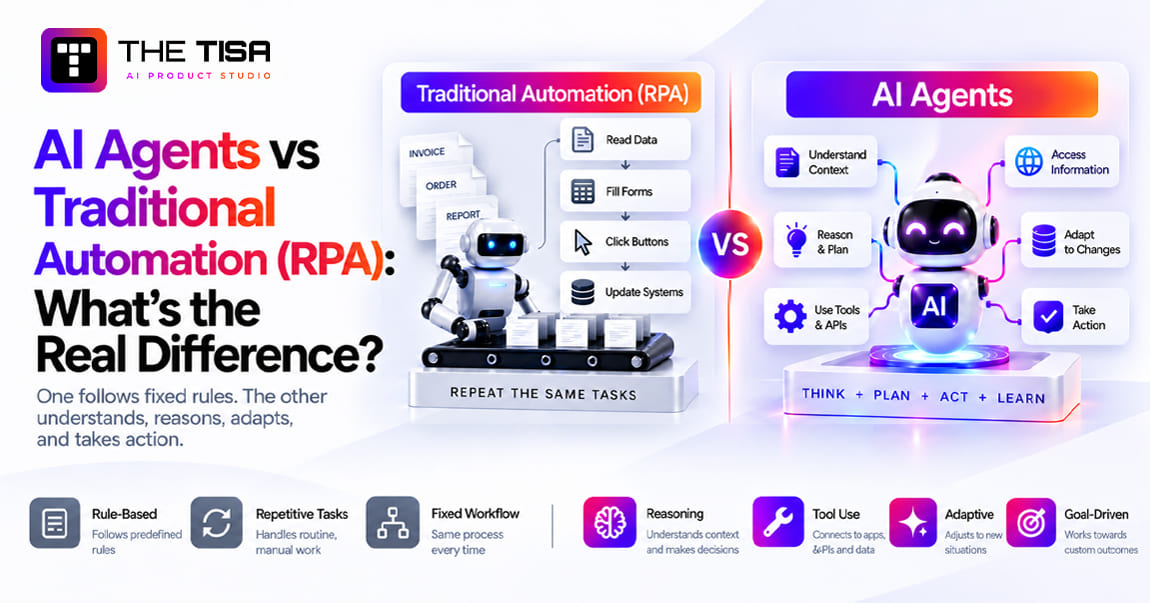
AI consulting vs AI development comparison showing business strategy, AI agents, custom AI solutions, and software integration

Quick Summary

Key highlights at a glance.

AI adoption across US businesses is growing quickly. A Federal Reserve analysis from April 2026 shows that about 18% of US firms had adopted AI by the end of 2025. More than 20% expected to use it in the first half of 2026. But adoption alone does not guarantee results.

A RAND study on the root causes of AI project failure notes that some estimates put AI project failure above 80%. That is roughly twice the rate of IT projects without AI. MIT’s NANDA initiative found a similar gap with generative AI. Its 2025 report, covered by Fortune, says about 95% of enterprise pilots showed little or no measurable impact on P&L.

RAND’s interviews with data scientists and engineers point to the same causes again and again. Teams misunderstood the business problem. They lacked usable data or skipped the infrastructure needed for deployment. These are planning gaps as much as engineering gaps.

This is where the AI consulting vs AI development question comes in. AI consulting helps you decide what to build and why. AI development builds the solution, connects it to your systems and keeps it running. Many CTOs and founders treat these as competing purchases. In practice, they can work as two parts of the same delivery cycle.

In this guide, you’ll learn what each service includes, how they differ, how they work together, what drives cost, and where projects usually go wrong. By the end, you’ll know whether your business needs strategy, a build team, or both.

Key Takeaways

  • AI consulting and AI development serve different purposes but work best together.
  • Consulting helps you choose the right problems, check data readiness, and plan for ROI and compliance.
  • Development turns that plan into secure, scalable software connected to your real systems.
  • In the AI Consulting vs AI Development decision, your current clarity matters more than your company size.
  • Budget for post-launch costs such as tokens, hosting, monitoring, and maintenance.
  • Start with one focused use case, measure its impact, and then scale.
WhatsApp
Get A Free Consultation
Chat Now

What is AI Consulting?

AI consulting helps you decide where AI belongs in your business, what it should achieve, and how to build it without wasting budget. It starts before the first line of code and continues to guide the project after development begins.

A useful consulting engagement usually covers four areas:

  • Finding the right use cases. Consultants map your workflows and rank AI opportunities by value, feasibility, and risk.
  • Creating an AI strategy. This defines goals, success metrics, build-vs-buy choices, and a phased roadmap.
  • Assessing data, architecture, and tools. The team checks whether your data is clean, accessible, and legally usable. It also reviews your current stack and integration points.
  • Planning ROI, risks, and compliance. This includes budget ranges, expected payback, security needs, and regulatory exposure.

The output should give the engineering team decisions they can act on. That means a ranked use-case list, a data readiness report, a reference architecture, and a scoped first release. If you only get a 60-slide deck, the consulting didn’t do its job.

Good AI strategy and consulting also tells you when “not” to use AI. Sometimes a rules engine, a better database query, or a simple workflow fix solves the problem faster and cheaper.

What is AI Development?

AI development is the actual building, integration, and deployment of AI features into your product or operations. It turns the strategy into working software that real users and systems depend on.

The work typically includes building AI models and applications, integrating them with your existing systems, developing custom features and workflows, and then testing, deploying, and scaling them. For most companies, this is full-stack software work with AI components inside it, not a research project.

The building blocks, in plain language

You’ll hear a lot of technical terms during development. Here’s what they mean and where they fit.

  1. LLMs (large language models) are trained on huge amounts of text. They can read, summarize, classify, and generate language. Most businesses use them through APIs from providers like OpenAI, Google, or Anthropic.
  2. RAG (retrieval-augmented generation) lets a model look up your own documents before answering. It helps ground responses in trusted, current data without retraining the model.
  3. Embeddings and vector databases support that lookup. Embeddings turn text into numbers that capture meaning, while vector databases store them to find similar content fast.
  4. AI agents go beyond answering questions. They plan steps and use tools such as APIs, databases, and internal apps to complete a task.
  5. MCP (Model Context Protocol) gives AI apps a common way to connect with tools and data sources, reducing one-off integration code.
  6. Fine-tuning means training a model on your own examples to change its behavior or style. Many teams don’t need it because good prompts plus RAG can often get most of the way at lower cost.

Here’s how that looks in real products. A customer support assistant may need an LLM plus RAG. A claims or invoice workflow may need an agent connected to your ERP and document storage. A product recommendation feature may rely more on classic machine learning than on an LLM. Serious enterprise AI development picks the simplest approach that meets the business goal.

AI Consulting vs AI Development: Key Differences

AI consulting decides what to build and why. AI development decides how to build it and then ships it. The table below breaks down the practical differences.

Aspect AI Consulting AI Development
Goal Strategy, planning, and guidance Building and deploying working solutions
Focus Business needs, use cases, ROI Technical implementation and integration
Output Roadmap, architecture, scoped requirements Working AI product, feature, or integration
Timeline Short-term, usually weeks Medium to long-term, usually months
Team AI strategists, domain experts, solution architects Engineers, data scientists, full-stack developers, QA
Pricing model Often fixed-fee discovery or advisory Often sprint-based or milestone-based
Success looks like Clear decisions and a realistic plan Reliable software running in production

The key point is the handoff. Consulting output becomes development input. When a strategy firm and a separate dev shop work in silos, assumptions can get lost, and the development team may have to redo discovery from scratch.

Why Do Most Businesses Need Both?

You need both because strategy without a build team produces shelfware, and a build without strategy produces expensive prototypes. Consulting defines the what, why, and how. Development turns it into a real solution.

The debate around AI Consulting vs AI Development often misses this point. The real question isn’t which one to buy. It’s how much of each you need at your current stage. Here’s what the combination gives you:

  • You start with the right problems. You put the budget behind high-impact use cases instead of the most exciting demo.
  • You avoid costly mistakes. Data gaps, compliance issues, and integration blockers surface in week two, not month five.
  • You reach the market faster. Engineers start with clear requirements, so fewer sprints go to rework.
  • You build in security and scale from day one. Access controls, audit logs, and cost limits become part of the design, not a patch.

Skipping strategy carries a real cost. Recent industry forecasts suggest that over 40% of agentic AI projects could be canceled by the end of 2027, mainly because of rising costs, unclear business value, and weak risk controls. None of these are coding problems. They’re planning problems that show up too late. 

The MIT NANDA research adds another useful signal. It found that companies buying specialized tools or working with external partners succeeded more often than those building purely in-house. For a US company with a lean engineering team, that’s a strong case for working with an AI-powered software development company that handles both planning and delivery.

How Do AI Consulting and AI Development Work Together?

AI consulting and AI development work as one continuous process with five stages. Consulting leads the first two, development leads the next two, and both share the last one.

Stage What happens Typical output
1. Discover business goals Interviews, workflow mapping, pain-point analysis Problem statement and success metrics
2. AI strategy consulting Use-case ranking, data audit, tech stack and roadmap Scoped first release and architecture
3. AI development Build, integrate, and customize the solution Working MVP connected to real systems
4. Testing and deployment Validate accuracy, security, and performance, then release Production deployment with monitoring
5. Scale and optimize Track usage and cost, improve quality, add use cases Ongoing improvements and new features

Timelines vary by scope. As a rough guide, discovery and strategy often take a few weeks. A focused MVP usually takes a few months. Scaling is ongoing.

What does testing look like for an AI product?

AI testing goes beyond normal QA. LLM outputs aren’t fully predictable, so your team needs evaluation sets that check answer quality against known correct responses. You also test for hallucinations, prompt injection, data leakage, latency under load, and cost per request. For sensitive workflows, keep a human reviewer in the loop at launch.

Which cloud and infrastructure decisions matter?

US teams typically deploy on AWS, Microsoft Azure, or Google Cloud. The bigger decisions are which model providers to use, where data lives, and how to avoid lock-in. A vendor-agnostic design lets you swap models as prices and capabilities change.

When Should You Choose AI Consulting, AI Development, or Both?

Choose consulting when the problem is unclear. Choose development when the problem and requirements are already clear. Choose both when you want to move from idea to production without losing context between teams.

Choose AI consulting when… Choose AI development when…
You are early in your AI journey You already have a clear use case and requirements
You’re not sure which use cases will create value You need a custom AI application or integration
You need a clear roadmap and ROI plan You want to add AI to an existing product
You face regulatory or compliance questions You are ready to build, test, and scale

Compliance often makes both consulting and development valuable. If you handle protected health information, assess applicable HIPAA requirements, including safeguards, access controls, and vendor responsibilities, before development begins. For B2B SaaS companies, enterprise buyers may ask for a SOC 2 report during procurement. Compliance planning should shape the architecture, development process, and ongoing operations from the start.

A simple test helps here. If your team can write a one-page spec with users, data sources, and a success metric, you’re ready for development. If that page is hard to write, start with consulting. This is the most practical way to settle the AI Consulting vs AI Development decision for your own roadmap.

What Drives the Cost and Timeline of an AI Project?

Scope, data readiness, and integrations drive most of the cost. The model itself is often the cheapest part. There’s no standard price list for AI work, so focus on the factors that move your budget up or down.

Cost factor Lower cost Higher cost
Data readiness Clean, structured, accessible data Scattered, unlabeled, or sensitive data
Integrations One or two modern APIs Legacy ERP, CRM, or on-premise systems
Model approach Hosted LLM APIs with prompts and RAG Custom training or fine-tuning
Compliance Internal tools with low-risk data HIPAA, financial, or government data
Product scope Single workflow or feature Multi-agent system or full AI SaaS product
Operations Low, predictable usage High volume with strict uptime needs

Don’t forget the costs that arrive after launch. These include API and token usage, cloud hosting, monitoring, model updates, and regular evaluation. Plan for maintenance as an ongoing line item, not a one-time project. AI agents add to these running costs, since multi-step reasoning and frequent tool calls raise the overall AI agent development cost. 

Security belongs in the budget too. IBM’s Cost of a Data Breach Report 2025 puts the average US breach cost above $10.22 million. It also flags weak access controls and missing AI governance as growing risk factors. Spending a little more on secure design is cheaper than fixing a breach later.

What Common Mistakes Stall AI Projects?

AI projects often stall because of the same avoidable mistakes, and almost none of them involve the algorithm.

  • Starting with the tool, not the problem. “We need a chatbot” is not a business goal. “Cut ticket resolution time by a set target” is.
  • Skipping the data audit. RAND’s research highlights poor data quality and availability as a leading cause of failure.
  • Treating the pilot as the product. A demo that works on 50 documents may break when you scale it to 50,000.
  • Leaving integration for later. AI that can’t read from or write to your core systems rarely gets adopted. See AI integration into legacy systems for safer approaches.
  • No evaluation plan. Without a way to measure output quality, you can’t tell if updates help or hurt.
  • No owner after launch. AI systems can drift as data, users, and models change. Someone has to monitor system performance and own ongoing improvements. 

Real-World Examples: How Consulting and Development Work Together

The pattern looks similar across industries. Consulting narrows the problem, and development builds the system that solves it. The scenarios below show typical engagements.

Industry Consulting work Development work
Ecommerce Identify personalization use cases with clear revenue impact Build a product recommendation engine tied to catalog and order data
Healthcare Map compliance needs and clinical or admin workflows Develop a HIPAA-aware AI assistant with access controls and audit logs
Finance Define a fraud detection strategy and risk thresholds Build a real-time transaction monitoring system with alerts
Enterprise Prioritize high-ROI internal use cases Build AI-powered internal tools and AI workflow automation

Healthcare shows why the two can’t be separated. The architecture choices, such as where data is stored and which vendors sign a business associate agreement, shape every line of code. 

What Business Impact Should You Expect?

When consulting and development run together, the impact shows up in four places: higher ROI, faster execution, better user adoption, and lower risk.

The payoff is real when AI is applied with focus. Google Cloud’s ROI of AI 2026 report, based on a survey of 2,403 executives, found that 84% are seeing growing financial returns from AI. The strongest gains show up in faster decision-making, greater workforce capacity, and higher customer lifetime value. Clear planning and solid execution help you reach those results sooner.

  • Higher ROI comes from funding the right use cases first.
  • Faster execution comes from a clear plan that engineers can build against.
  • Better adoption comes from designing around real workflows and real users.
  • Lower risk comes from planning for security and compliance early.

Stuck Between Strategy and Shipping? How THE TISA Closes the Gap

Teams that reach out to an AI partner rarely start from zero. They’re stuck somewhere in the middle, and each sticking point needs a different kind of help. Here’s how THE TISA approaches them.

“Our pilot works, but we can’t get it into production.” THE TISA’s engineers rebuild prototypes into production systems with proper APIs, evaluation, monitoring, and cloud deployment on AWS, Azure, or Google Cloud.

“Our data and systems are messy.” Before any build, the team audits data sources and maps integration points. It then connects AI to your CRM, ERP, and databases through AI integration services that don’t disrupt daily operations.

“We don’t have in-house AI engineers.” One team covers discovery, full-stack development, and AI engineering. That removes the handoff gap between a strategy firm and a separate dev shop.

“Our AI gives wrong or made-up answers.” Grounding responses in your own content through RAG development and adding evaluation tests helps keep outputs accurate and traceable.

“Compliance is slowing us down.” Access controls, audit logs, and data handling rules go into the architecture early, so security reviews don’t stall the launch.

Real project examples are available in the case studies, and the delivery process shows how each stage works.

Conclusion

AI success rarely depends on picking the smartest model. It depends on solving the right problem, with the right data, inside systems your team already uses. That’s why the AI Consulting vs AI Development question usually ends with “both,” in the right proportion for your stage.

Before you move forward, check a few things. Do you have a clearly defined use case and a measurable goal? Is your data accessible and legally usable? Do you know which systems the AI must connect to? Does someone own the system after launch?

If those answers are clear, you’re ready to build. If not, a short strategy phase will save you time and budget. Either way, choose a partner that can carry the work from idea to production without losing context.

Frequently Asked Questions

Q1. How much does AI consulting cost compared to AI development?
Ans. AI consulting generally costs less because it focuses on planning and takes a few weeks. AI development costs more because it involves building, integrating, testing, and deploying software. A fixed-price discovery phase can help define the scope and budget before development begins.

Q2. How long does it take to build an AI product?
Ans. A focused AI product typically takes a few months to build after the initial discovery phase. Clean data and modern APIs can speed up development, while legacy systems, compliance requirements, and complex AI workflows can extend the timeline.

Q3. Is AI consulting necessary if the engineering team is experienced?
Ans. AI consulting may not be necessary when the business has a validated use case, accessible data, and clear success metrics. However, an architecture review can help identify risks related to model selection, security, integration, and operating costs before development begins.

Q4. Is it better to build AI in-house or hire a development partner?
Ans. In-house development works well when AI is central to the product and the company has the required technical talent. A development partner can help when specialized skills, faster delivery, or additional engineering capacity are needed. A hybrid approach allows the partner to build the initial solution while the internal team develops the skills to maintain it.

Q5. How do you choose the right AI development partner?
Ans. Look for experience in production deployments, AI evaluation, data security, system integration, and post-launch support. A reliable partner explains technical trade-offs, challenges unclear requirements, and supports flexible model choices to reduce vendor lock-in.

Anuj Kumawat

"Anuj Kumawat is an AI/ML professional at THE TISA, with 5+ years of experience in Artificial Intelligence, Machine Learning, and data-driven solutions. He focuses on developing intelligent systems and practical AI/ML solutions for modern businesses."

Scroll to Top
The TISA
Hi there! 👋
How can we help you today?
now