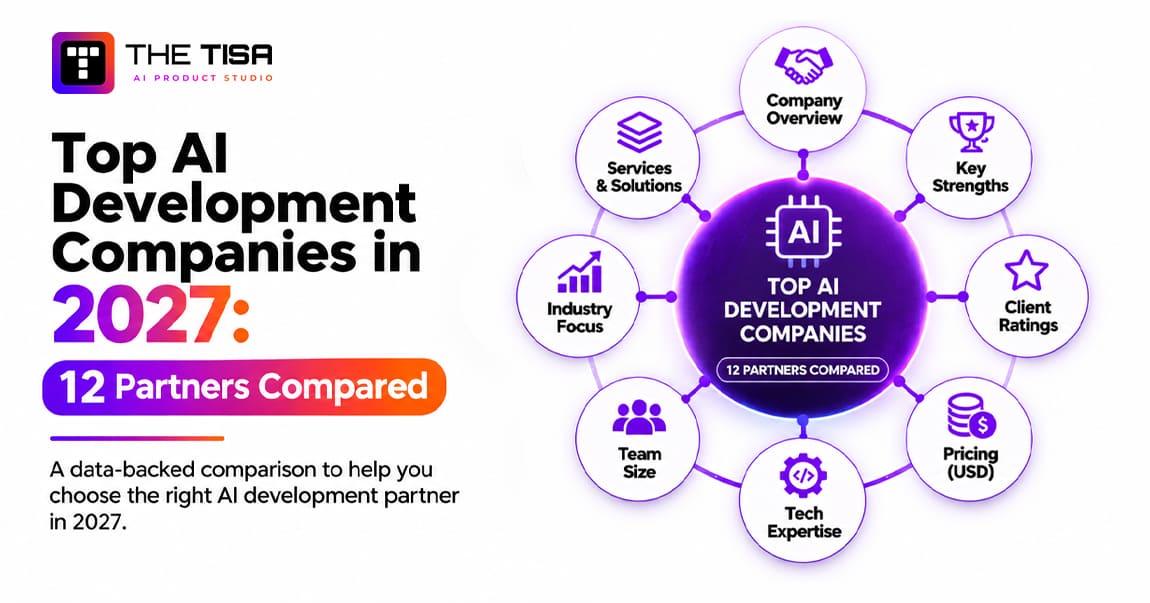
Picking an AI development company is harder than picking a normal software vendor. Every agency now says it builds AI, but far fewer have taken AI systems into production, measured their accuracy, and kept them running after launch.
We compared 12 AI development companies using public Clutch data, company disclosures and verified client reviews. Each profile covers what the company is best at, what it costs, and one honest watch-out from its reviews.
This guide is written for US founders, CTOs and product leaders. That’s why it covers rates in USD, time-zone overlap, and how US contracts and IP ownership work with offshore teams.
How to read this list: the companies are numbered for easy reference, not ranked. The order is an editorial grouping by buyer need, starting with smaller product-focused teams and moving to larger enterprise and talent-scale providers. No company is “number one” overall.

Quick Answer: The Best AI Development Companies by Need
- Best for startups and SMBs wanting a small senior team: THE TISA
- Best for enterprise AI programs and AI consulting: LeewayHertz
- Best for generative AI and computer vision for mid-market firms: Markovate
- Best for nearshore AI teams in US time zones: Azumo
- Best for regulated industries and a long track record: ScienceSoft
- Best for scaling large engineering teams fast: BairesDev
- Best for data science and ML-heavy products: InData Labs
- Best for Microsoft-centric enterprise AI: Itransition
- Best for AI-enabled MVPs and healthcare products: 10Pearls
- Best for AI inside large product engineering programs: Coherent Solutions
- Best for computer vision R&D: Abto Software
- Best for advanced LLM work and frontier-grade talent: Turing
How We Chose These AI Development Companies
We started from the AI software development companies that appear in Clutch’s AI categories, industry rankings and buyer shortlists, then selected 12 that together cover the main types of buyer need. This is a qualitative selection, not a scored ranking: we did not give each company a numeric score, because public evidence is not detailed enough to score every company fairly on every criterion. We used five selection criteria a buyer can check:
| Criterion | What we looked for | Evidence we accepted |
|---|---|---|
| Production AI track record | AI systems running for real users, not only prototypes | Client reviews, official case studies, official announcements |
| Verified client reviews | Rating, number of reviews, recurring praise and complaints | Clutch verified reviews and review summaries |
| AI depth | Work in AI agents, LLM apps, RAG, machine learning, computer vision or MLOps | Reviews and case studies first; service lists only as a weaker signal |
| Delivery and transparency | Published rates, minimum project size, clear process | Clutch pricing data, company pages |
| Security and ownership | Certifications, data handling, IP terms | Company statements; we note where a claim is self-reported |
Every profile follows the same format: what the company does, its AI services, notable work, rating and pricing, and one limitation taken from its reviews or its own positioning. We applied the same standard to THE TISA, including its limitations. The full method is explained in “How We Verify and Update This List” near the end.
Top AI Development Companies Compared
| Company | Best for | Founded | Headquarters | Team size | Delivery model | Engagement types | Clutch rating | Hourly rate (USD) | Min. project (USD) |
|---|---|---|---|---|---|---|---|---|---|
| THE TISA | Startups and SMBs | 2024 | Jaipur, India | 10-49 | Offshore with US overlap hours | End-to-end, dedicated pods, staff augmentation | 5.0/5 | $25-49 | $1,000+ |
| LeewayHertz | Enterprise AI and consulting | 2007 | Gurugram, India | 50-249 | Offshore | Consulting, end-to-end, team extension | 4.7/5 | $50-99 | $10,000+ |
| Markovate | Generative AI and computer vision | 2015 | San Francisco, US | 50-249 | Hybrid | Consulting, end-to-end | 5.0/5 | $50-99 | $50,000+ |
| Azumo | Nearshore AI teams | 2016 | San Francisco, US | 50-249 | Nearshore (Argentina) | End-to-end, dedicated AI pods | 4.9/5 | $25-49 | $10,000+ |
| ScienceSoft | AI solutions for regulated industries | 1989 | McKinney, Texas, US | 250-999 | Hybrid (US and global offices) | Consulting, end-to-end, staff augmentation | 4.8/5 | $50-99 | $5,000+ |
| BairesDev | Enterprise software and AI development | 2009 | San Francisco, US | 1,000-9,999 | Nearshore (Latin America) | Staff augmentation, end-to-end | 4.9/5 | $50-99 | $50,000+ |
| InData Labs | Data science and AI development | 2014 | Nicosia, Cyprus | 50-249 | Offshore (Europe and Miami) | End-to-end, dedicated teams | 4.9/5 | $50-99 | $10,000+ |
| Itransition | Enterprise software and AI solutions | 1998 | US / Global operations | 1,000-9,999 | Hybrid (global delivery) | End-to-end, dedicated teams | 4.9/5 | $25-49 | $25,000+ |
| 10Pearls | Enterprise digital transformation and AI | 2004 | Vienna, Virginia, US | 1,000-9,999 | Hybrid (US, Latin America & Pakistan) | End-to-end, staff augmentation | 4.9/5 | $25-49 | $50,000+ |
| Coherent Solutions | AI and product engineering | 1995 | Minneapolis, US | 1,000-9,999 | Hybrid (US and Europe) | End-to-end product engineering | 4.7/5 | $50-99 | $50,000+ |
| Abto Software | Custom AI and software development | 2007 | Lviv, Ukraine | 250-999 | Offshore (Europe) | End-to-end, staff augmentation | 4.9/5 | $25-49 | $10,000+ |
| Turing | Global AI talent and engineering teams | 2018 | Palo Alto, US | 250-999 | Remote global network | Staff augmentation, enterprise AI and data | 5.0/5 | Custom pricing | $50,000+ |
The 12 Best AI Development Companies for 2027
1. THE TISA — Best for startups and SMBs that want a small senior team
THE TISA is an AI software development company and custom AI development company founded in 2024, with its engineering team in Jaipur, India and clients in the US, UK, Canada and the UAE. It builds AI agents, AI-powered SaaS, RAG assistants and workflow automation, plus the web and mobile software around them.
- AI services: AI agent development services, generative AI, RAG, AI integration services for CRM/ERP, AI workflow automation, AI SaaS development
- Pricing: fixed-price discovery sprints and MVP builds; monthly dedicated pods; USD 25-49/hr
- Why it’s on the list: one senior team from discovery to post-launch support, evaluation sets on every AI feature, and full IP ownership for the client from day one
- Limitation: a young company (founded 2024) with a smaller team and fewer public reviews than the older firms on this list. Large multi-country programs will be better served by a bigger provider.
Project evidence:
| Project | Client and market | AI in production | Stack | Reported outcome (self-reported) |
|---|---|---|---|---|
| Narsik Logistics Control Hub | Multi-branch part-truck-load transport company, India | Logistics ERP plus six OpenAI features: booking drafts from WhatsApp text and voice notes, proof-of-delivery photo reading, payment matching, collection reminders, a manager Q&A assistant using 14 read-only tools, and a nightly exception digest | Next.js, NestJS, PostgreSQL, Redis/BullMQ, OpenAI Responses and Batch APIs | Over 12 weeks after go-live vs 12 weeks before: booking entry time per message-based booking fell from 4 min 10 s to 1 min 35 s; deliveries needing manual proof review fell from 100% to 19% |
| NovaMind AI | US founder; multilingual customer support assistant | Voice and text assistant answering from each business’s documents: GPT-4o replies, hybrid keyword and vector retrieval with source citations, LangGraph flows with human handoff, tool calls that need user confirmation | Next.js, Express, Python, LangChain, LangGraph, LlamaIndex, Elasticsearch | 2,000+ conversations; about half in non-English or mixed languages; about 99.5% uptime |
| Clove | US project management SaaS for startups and agencies | OpenAI structured outputs that draft sprint plans and suggest task owners and deadlines; a manager approves before anything is saved | React, TypeScript, Node.js, MySQL, Socket.IO | Platform-wide, not AI-specific: 1,850 monthly active users across 126 workspaces |
| OpsPilot | Multi-branch education institute, Singapore | Read-only OpenAI summaries of operational reports, shown beside the source report and limited by role and branch permissions | Next.js, Node.js, Express, MySQL, MongoDB | Platform-wide: 2,850 monthly active users, 6,400+ student records; no AI-specific metric measured yet |
Best for: founders building an AI MVP, SaaS teams adding AI features, and SMBs automating one high-value workflow. Talk to THE TISA
2. LeewayHertz — Best for enterprise AI programs and AI consulting
LeewayHertz is a Gurugram-based AI development company founded in 2007, with 50-249 employees and a minimum project size of USD 10,000+ on its Clutch profile. It is now part of The Hackett Group and pairs AI strategy with engineering and integration into existing enterprise systems.
- AI services: AI consulting, custom AI solution development, AI agents and multi-agent systems, generative AI, enterprise AI development; also runs its own ZBrain AI enablement platform
- Clutch rating: 4.7 from 9 reviews; most common project size USD 50,000-199,999
- Pricing: USD 50-99/hr
- Watch-out: Clutch’s review summary notes that some reviews mention project delays, often tied to communication gaps or scope changes. Lock scope and reporting cadence early.
Best for: enterprises that want strategy and build from one AI consulting and development partner.
3. Markovate — Best for generative AI and computer vision for mid-market firms
Markovate is a midsize generative AI company launched in 2015 and based in San Francisco (The Manifest, Clutch’s sister directory). Its services cover AI development, generative AI and agentic AI.
- AI services: enterprise AI development, AI POCs, computer vision, ML and MLOps consulting, LLM development, AI agents, copilots and chatbots
- Notable work: a real-time defect-detection computer vision system for a production line, and a generative AI proof of concept for a law firm.
- Clutch rating: 5.0 from 12 verified reviews
- Pricing: USD 50-99/hr; minimum project USD 50,000
- Watch-out: the most common reviewed project size is USD 10,000-49,999, so confirm the team has delivered at your scale if your program is larger.
Best for: mid-market companies in manufacturing, healthcare, construction and financial services that want generative AI or computer vision.
4. Azumo — Best for nearshore AI teams in US time zones
Azumo was founded in 2016 and is headquartered in San Francisco, with delivery from Rosario, Argentina. It works through nearshore engineering teams in US-friendly time zones and says it is SOC 2 certified and a member of the Claude Partner Network.
- AI services: agentic AI and AI agents, LLM and generative AI apps (RAG, fine-tuning), voice agents and chatbots, machine learning, data engineering
- Clutch rating: 4.9; most common project size USD 50,000-199,999
- Pricing: USD 25-49/hr; minimum project USD 10,000
- Watch-out: Clutch’s review summary mentions that some clients saw team turnover, which Azumo backfilled. Ask how they keep key engineers on your account.
Best for: US companies that want an AI team working their hours at nearshore rates.
5. ScienceSoft — Best for regulated industries and long track record
ScienceSoft is an IT consulting and software development company founded in 1989 and based in McKinney, Texas. It reports 750+ experts and 4,200+ projects for 1,400 clients across healthcare, insurance, investment, manufacturing, retail and telecom.
- AI services: HIPAA-compliant voice agents, intelligent document processing, predictive analytics, computer vision, automated trading platforms
- Pricing: USD 50-99/hr; minimum project USD 5,000+; most common reviewed project size USD 50,000-199,999
- Why it stands out: decades of compliance-heavy work in healthcare and finance, where AI must pass audits as well as accuracy tests.
- Watch-out: as a broad IT services firm, AI is one practice among many. Ask to meet the AI team that would staff your project.
Best for: healthcare, insurance and financial firms that need AI built inside strict compliance rules.
6. BairesDev — Best for scaling large engineering teams fast
BairesDev was founded in 2009, is headquartered in San Francisco and has offices across Argentina, Brazil, Mexico, Colombia and Spain, with 1,000-9,999 employees. About 10% of its service mix is AI development, with machine learning, conversational AI and computer vision as its main AI focus areas.
- Clutch rating: 4.9 from 63 reviews; most common project size USD 50,000-199,999
- Pricing: USD 50-99/hr; reported engagements range from USD 10,000 to over USD 5 million
- Why it stands out: fast access to engineers in similar time zones for US clients, and the capacity to staff large programs
- Watch-out: some reviewers say its pricing can be higher than other vendors, though they felt the quality justified it.
Best for: companies that need to add many AI and software engineers quickly, especially through staff augmentation.
7. InData Labs — Best for data science and ML-heavy products
InData Labs is a data science and AI company founded in 2014, headquartered in Nicosia, Cyprus, with offices in Vilnius and Miami and 50-249 employees. It lists AI agents, generative AI, custom LLM solutions, RAG pipelines and NLP among its core skills.
- Notable work: an AI-powered physical therapy platform with a provider web portal and patient iOS app; a multi-agent system that automates sales operations; predictive forecasting models for a manufacturer
- Clutch rating: 4.9 from 20 reviews
- Pricing: USD 50-99/hr; minimum project USD 10,000+
- Watch-out: Clutch’s review summary notes room to improve efficiency in proposals and planning calls. Ask for a written plan before kickoff.
Best for: companies whose product depends on strong ML models: forecasting, recommendations, anti-fraud or search.
8. Itransition — Best for Microsoft-centric enterprise AI
Itransition was founded in 1998 and is a global software development and IT consulting company with over 3,000 engineers across 40 countries. Its AI work sits alongside deep Microsoft expertise: Dynamics 365, Power Platform and AI solutions on Azure.
- AI services: artificial intelligence, generative AI and intelligent automation; Azure AI and machine learning; AWS machine learning
- Pricing: reviewed client investments range from about USD 33,000 to USD 5 million
- Why it stands out: long client relationships and the scale to run large, multi-year engagements
- Watch-out: at least one reviewer reported turnover in the project manager role. Agree on named leads in the contract.
Best for: enterprises already on Microsoft Dynamics and Azure that want AI built into those systems.
9. 10Pearls — Best for AI-enabled MVPs and healthcare products
10Pearls was founded in 2004 and is based in Vienna, Virginia, with offices across the US, Latin America, the UK and Pakistan and 1,000-9,999 employees. It describes itself as an AI-native technology partner for end-to-end digital transformation.
- AI services: generative AI, custom models, machine learning, computer vision, MLOps, LLMs and NLP; integrations with OpenAI, Google AI, Mistral, LangChain, LlamaIndex, Pinecone and Hugging Face
- Notable work: an MVP for AI-enhanced inspection software (web portal plus Android app) for ARInspect; healthcare apps where reviewers cite better patient engagement
- Pricing: USD 25-49/hr; minimum project USD 50,000+
- Watch-out: Clutch’s summary flags some challenges in the early phase of engagements. Plan a structured onboarding.
Best for: startups and healthcare organizations that want a validated, AI-enabled MVP built to scale.
10. Coherent Solutions — Best for AI inside large product engineering programs
Coherent Solutions is a global digital product engineering company founded in 1995 in Minneapolis, Minnesota. It won 2025 Spring Clutch Global Awards for Artificial Intelligence, Natural Language Processing and Robotics.
- AI services: AI and machine learning, applied generative AI, automation, data platforms and analytics
- Notable work: co-developed Spokn AI, a generative AI speech analytics platform for contact centers, with MaxContact
- Pricing: USD 50-99/hr; minimum project USD 50,000+
- Watch-out: with a minimum of USD 50,000 and many reviewed projects above USD 1 million, it suits larger budgets more than early-stage startups.
Best for: established companies that want AI added across a large, ongoing product roadmap.
11. Abto Software — Best for computer vision R&D
Abto Software is a full-cycle custom software engineering company founded in 2007 and based in Lviv, Ukraine, with 25-999 employees. It says it runs one of the largest computer vision AI departments in Eastern Europe.
- AI services: intelligent video analytics, data extraction, advanced driver assistance systems (ADAS), AI for healthcare, custom AI frameworks
- Notable work: an AI framework that generates 3D humanoid animations for a game-tools company; human-movement detection for remote physical therapy
- Pricing: USD 25-49/hr; minimum project USD 10,000+; reviewed projects range from USD 25,000 to over USD 1.25 million
- Watch-out: its strength is research-heavy AI. For a simple chatbot or workflow automation, a product-focused agency may move faster.
Best for: companies that need computer vision or other research-grade AI built from scratch.
12. Turing — Best for advanced LLM work and frontier-grade talent
Turing was founded in 2018 and is based in Palo Alto, California (Turing). It began as a platform for hiring remote engineers and now works with leading AI labs on model training data, while its Turing Intelligence unit builds custom AI models and systems for enterprises. Turing’s own company story says OpenAI engaged it in 2022 to provide coding data for ChatGPT (The Turing Story).
- What it offers: AI data and evaluation for frontier labs, custom enterprise AI systems, and vetted AI talent from a network of over four million engineers, data scientists and PhDs
- Notable work: provided coding data for OpenAI’s ChatGPT in 2022, according to Turing’s own company story
- Pricing: custom enterprise pricing
- Watch-out: Turing is built for large enterprises and AI labs. Smaller companies with a single product to build may find it more than they need.
Best for: enterprises working on advanced LLM, post-training or evaluation projects that need specialist AI talent at scale.
AI Development Companies Compared by Technology
Ratings and rates don’t tell you whether a company can build your kind of AI. This matrix shows the public evidence we found for each capability. It shows evidence, not ability: a dash means we found no public proof, not that the company can’t do it.
Legend: V = confirmed in a verified client review · S = shown in an official case study, portfolio item or announcement · L = listed as a service only · – = no public evidence found
| Company | Generative AI / LLM apps | AI agents | RAG | Machine learning | Computer vision | MLOps / monitoring |
|---|---|---|---|---|---|---|
| THE TISA | S | S | S | – | S | L |
| LeewayHertz | S | L | – | L | L | – |
| Markovate | V | L | – | L | V | L |
| Azumo | L | L | L | L | L | V |
| ScienceSoft | S | S | – | S | S | – |
| BairesDev | V | – | – | L | L | – |
| InData Labs | L | S | V | V | L | – |
| Itransition | L | – | – | L | – | – |
| 10Pearls | L | – | – | L | L | L |
| Coherent Solutions | S | – | – | L | – | – |
| Abto Software | V | – | – | L | S | – |
| Turing | S | – | – | L | – | – |
Evidence Note: V and S labels are based on publicly available client reviews, case studies, portfolios and company announcements. Supporting project examples are provided in the individual company profiles above.
What to check for each technology:
| Technology | What buyers should evaluate |
|---|---|
| Generative AI / LLM apps | Model choice, prompt and output testing, cost per request |
| AI agents | Tool calling, multi-step workflows, human approval for risky actions |
| RAG | Retrieval quality, embeddings and reranking, answers with sources |
| Machine learning | Training data quality, evaluation metrics, retraining plan |
| Computer vision | Accuracy on your real images or video, edge vs cloud processing |
| MLOps | Deployment pipeline, monitoring for drift, rollback |
AI Development Companies by Industry
Industry experience shortens discovery and reduces compliance risk. These pairings are based on public client reviews and official case studies, not on service lists.
| Industry | Companies with public evidence | Example evidence |
|---|---|---|
| Healthcare | ScienceSoft, InData Labs, Abto Software, 10Pearls | HIPAA-compliant solutions (ScienceSoft); AI physical therapy platform (InData Labs); computer vision for remote physical therapy (Abto) |
| Financial services | ScienceSoft, Markovate | Automated trading platforms (ScienceSoft); AI strategy and model work for a financial services firm (Markovate) |
| Manufacturing | Markovate, InData Labs | Real-time defect detection (Markovate); predictive forecasting for a manufacturer (InData Labs) |
| Logistics and transport | THE TISA | OpenAI-powered logistics ERP for Narsik Logistics |
| Education | THE TISA | Education admin platform with AI report summaries (OpsPilot) |
| Contact centers and customer support | Coherent Solutions, THE TISA | Spoken AI speech analytics (Coherent Solutions); multilingual RAG support assistant (NovaMind, THE TISA) |
| Legal | Markovate | Generative AI proof of concept for a law firm |
| Gaming and media | Abto Software | AI-generated 3D humanoid animation framework |
| Frontier and advanced LLM work | Turing | Training data and evaluation for AI labs |


US-Based vs Offshore AI Development Companies: Which Should You Choose?
The list includes US-headquartered firms (Markovate, Azumo, ScienceSoft, BairesDev, 10Pearls, Coherent Solutions, Turing) and companies headquartered outside the US (THE TISA, LeewayHertz, InData Labs, Abto Software). Many US-headquartered firms also deliver from Latin America or Europe.
| Factor | US-based delivery | Offshore delivery |
|---|---|---|
| Hourly rates | Usually higher | Usually lower |
| Time-zone coordination | Easier for US teams | Needs agreed overlap hours |
| Communication | Local business hours | Depends on the provider’s delivery model |
| Technical ability | Varies by provider | Varies by provider |
| Data compliance | Must be set out in the contract | Must be set out in the contract |
| IP ownership | Depends on the contract | Depends on the contract |
| Legal recourse | US courts and law | Choose US governing law in the contract where possible |
Why US Companies Work With Offshore AI Engineering Teams
- Access to AI specialists who are scarce and expensive to hire locally
- Flexible capacity that grows or shrinks with the roadmap
- Lower engineering cost for the same scope, when quality controls are in place
- Dedicated teams that work only on one product
- Planned overlap hours for daily stand-ups and fast decisions
- End-to-end delivery, from design to support, without building a large internal team
The deciding factor is rarely location. It is whether the team has shipped AI like yours and whether the contract protects your IP and data. THE TISA, for example, works from India with 3-4 hours of daily overlap with US time zones and contracts that assign all IP to the client.
AI Development Company vs AI Consulting Company vs AI Staff Augmentation
| Model | What you get | Choose it when |
|---|---|---|
| AI consulting company | Strategy, use-case selection, roadmaps, vendor advice | You don’t yet know what to build or whether your data supports it |
| AI development company | Design, build, launch and support of a working AI product | You know the problem and need a team to deliver it end to end |
| AI product engineering partner | A long-term dedicated team owning a product roadmap | AI is central to your product and the work is ongoing |
| AI staff augmentation | Individual engineers who join your team and process | You have strong product and engineering leadership and need more hands |
Many companies on this list offer several of these models. LeewayHertz and Markovate lead with consulting; BairesDev and Turing are strong in staff augmentation; THE TISA, InData Labs and 10Pearls focus on end-to-end builds.
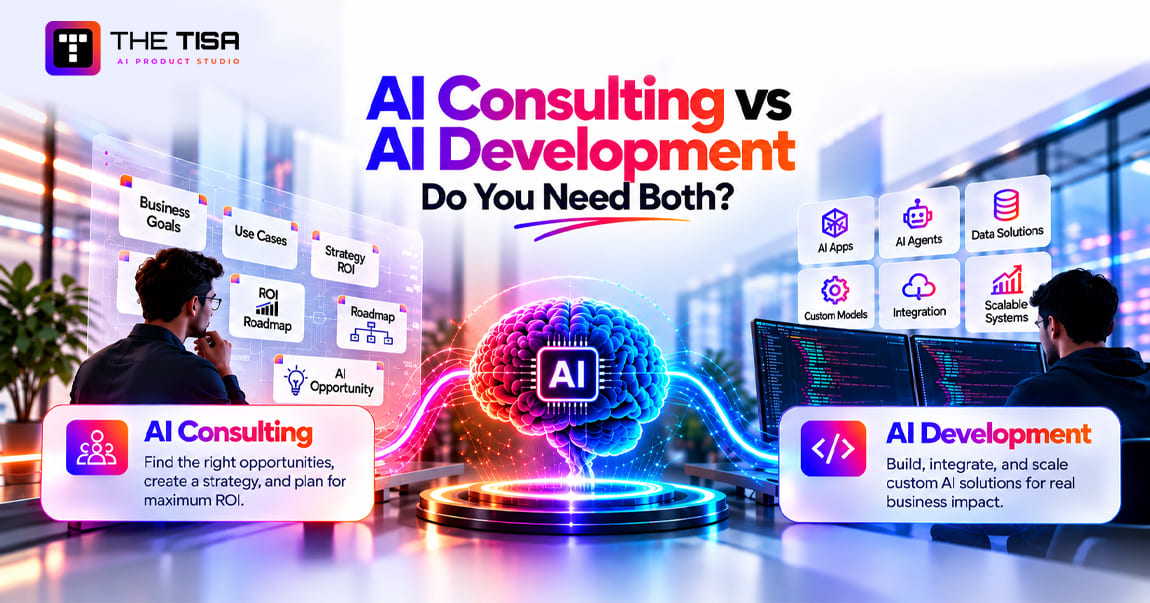
For a deeper look, read AI Consulting vs AI Development: Do You Need Both? and IT Staff Augmentation vs Outsourcing vs In-House Hiring for AI Projects.
What Does an AI Development Engagement Include?
- Discovery: business goal, success metric, data check, risks and a scoped estimate.
- Architecture: model choice, data flow, integrations, security and cost plan.
- Prototype: a working version on real data to prove the approach.
- Development: the full product in short sprints with regular demos.
- Evaluation: accuracy, hallucination and safety testing against agreed thresholds.
- Deployment: release to users with access controls and rollback.
- Monitoring: tracking accuracy, latency, cost and model drift.
- Maintenance: model and prompt updates, fixes and new features under a support plan.
Ask every vendor which of these eight stages their quote covers. Quotes that skip evaluation, monitoring or maintenance often look cheaper but cost more later.
How to Choose the Right AI Development Company
Start with your situation, not the ranking. Then test every shortlisted company with the same questions.
Match the company to your stage
| Your situation | Look for | Companies on this list that fit |
|---|---|---|
| Seed or Series A startup building an AI MVP | Fixed-scope pricing, senior people, fast start | THE TISA, 10Pearls, Markovate |
| SaaS company adding AI features | Experience inside existing codebases, agent and RAG work | THE TISA, Azumo, InData Labs |
| Mid-market firm automating operations | Integration with CRM/ERP, workflow automation | THE TISA, Markovate, LeewayHertz |
| Enterprise AI program | Governance, security certifications, scale | LeewayHertz, ScienceSoft, Coherent Solutions, Itransition |
| Need many engineers fast | Large bench, staff augmentation | BairesDev, Turing, Azumo |
| Research-heavy AI (vision, custom models) | R&D depth, ML specialists | Abto Software, InData Labs, Turing |
Six questions to ask before you sign
- Can you show AI you’ve taken to production? Ask for a live system, its users and a measured result.
- How do you measure accuracy before launch? A good answer names a test set built from your real cases and a pass threshold.
- Who owns the code, prompts, models and data? It should be you, in writing.
- Who will actually work on our project? Meet the named leads before signing.
- What happens after launch? Look for monitoring, model updates and a support plan.
- How do you control AI running costs? Caching, model routing and usage limits should be designed in.
We go deeper in our buyer’s checklist for choosing an AI development company.
Hiring specifically for AI agents? Use this vendor checklist for choosing an AI agent development company.
How to evaluate an AI development company’s technical capabilities
| Question | What a good answer includes |
|---|---|
| Have you deployed production AI? | Live systems, real users and a measured outcome you can verify |
| How do you evaluate accuracy? | Test datasets from real cases, defined metrics and a pass threshold |
| How do you handle hallucinations? | Grounding in your data (RAG), output validation, fallbacks and human review |
| How do you test retrieval quality in RAG? | Retrieval metrics, reranking, and answers that cite their sources |
| How is data protected? | Access controls, encryption, audit logs and data kept in your cloud where possible |
| How do you control AI costs? | Token budgets, caching and routing simple requests to cheaper models |
| How do you monitor after launch? | Dashboards for accuracy, latency, cost and errors, with alerts |
| Can the system scale? | Architecture review and load-testing evidence |
Questions to ask before signing an AI development contract
- IP and source code: Does the contract assign all code, prompts, configurations and documentation to you on payment?
- Model ownership: Who owns fine-tuned model weights and training datasets?
- API and infrastructure costs: Who pays for model APIs and cloud, and is there a monthly cap?
- Service levels: What uptime, response and fix times apply after launch?
- Data retention: What data does the vendor keep, where, and for how long? How is it deleted at the end?
- Warranty: How long are defects fixed free of charge after delivery?
- Maintenance: What does ongoing support cost, and what does it include?
- Exit terms: How is the handover done if you move to another team?
Download: Get the AI Development Partner Evaluation Checklist (PDF) — every question above in one scorecard you can use on vendor calls.
Red flags
- Only demos and slide decks, no production systems
- No talk of evaluation, accuracy or failure cases
- Vague answers on IP ownership or data handling
- A different team after signing than the one you met
- Fixed prices offered before anyone has seen your data
How Much Does It Cost to Hire an AI Development Company?
Hourly rates on this list fall into two main bands. Nearshore and offshore teams in Latin America, Eastern Europe and India, such as Azumo, 10Pearls, Abto Software and THE TISA, mostly charge USD 25-49 per hour. Firms like LeewayHertz, Markovate, ScienceSoft, BairesDev, InData Labs and Coherent Solutions sit at USD 50-99 per hour.
A note on these rates: Clutch hourly rates are ranges that companies report about themselves in the directory. They are not quotes. Your actual rate depends on seniority, team size, contract length and scope, and is set in negotiation. Use the published bands to build a shortlist, then compare written proposals.
For budget ranges by project type, see our guides to AI agent development cost, generative AI development cost and AI SaaS development cost.
Project size matters more than the hourly rate. For most companies here, the most common reviewed project on Clutch falls between USD 50,000 and 199,999. A focused proof of concept costs less; a multi-system enterprise platform costs far more.
Hourly rate vs total project cost
A low hourly rate does not always mean a lower total cost. The total depends on how many hours the work takes, what the quote leaves out, and what it costs to run the system after launch.
| Cost component | What it covers | Often missing from quotes? |
|---|---|---|
| Build | Design, engineering, integrations and project management | No |
| Evaluation and QA | Test sets, accuracy and hallucination testing, security testing | Yes |
| AI usage | Model API fees or GPU hosting, charged per use | Yes |
| Infrastructure | Cloud hosting, vector database, monitoring tools | Sometimes |
| Maintenance | Model and prompt updates, fixes, new features | Yes |
Ask every vendor to price all five, and to estimate monthly running costs at your expected usage.
How We Verify and Update This List
- Research date: company data was last checked in November 2026. Each update changes the date at the top.
- Source hierarchy: we use official company pages, announcements and case studies first, then Clutch profiles and verified reviews, then other directories. We do not use unverified blog claims for company facts.
- Reviews: we use Clutch because it verifies reviewer identity. We quote patterns from review summaries, not single outlier reviews.
- Missing information: if we can’t find a fact, we say so rather than estimate it. A missing capability in the technology matrix means “no public evidence found”, not “can’t do it”.
- Self-listing: THE TISA is held to the same evidence standard as every other company, and its limitations are stated.
- Updates: we re-check every company each quarter, and sooner if a company asks us to correct a fact. Send corrections to info@thetisa.com.
How to Compare AI Development Proposals: A Practical Example
Illustrative scenario, not actual vendor quotations.
A US logistics company wants an AI-powered document processing platform that reads bills of lading and invoices, pulls out key fields, and answers staff questions about shipments. It gets three proposals for the same scope:
| Cost Component | Vendor A | Vendor B | Vendor C |
|---|---|---|---|
| Quoted price | USD 25,000 | USD 45,000 | USD 65,000 |
| Scope | Basic development | Build plus evaluation | Full lifecycle |
| RAG implementation | Basic | Yes | Yes |
| Evaluation framework | No | Yes | Yes |
| Security testing | Limited | Yes | Yes |
| Monitoring | No | Limited | Yes |
| Post-launch support | Extra | Limited | Included |
| Likely extra cost after launch | High | Medium | Low |
Vendor A looks cheapest, but the buyer would pay later to add accuracy testing, monitoring and support, and would carry the risk of errors in production. Vendor C costs the most up front but includes everything needed to run the system safely. Vendor B can work if the buyer has an internal team to handle monitoring.
Lesson: the lowest quote is not always the lowest total cost of ownership. Compare proposals line by line against the eight engagement stages above, and ask each vendor to price what it left out.
Final Word
The AI development companies on this list are all credible; they are not interchangeable. Shortlist two or three that match your stage, ask each of the six questions above, and choose the one that gives the most specific answers.
If you’re a startup or SMB with one AI product to take from idea to production, book a free 30-minute AI scoping call with THE TISA. You’ll talk to a senior engineer and get a written summary afterwards: the recommended approach, the main risks, and a budget range.
Frequently Asked Questions
Q1. What does an AI development company do?
Ans. An AI development company designs, builds and maintains software that uses artificial intelligence, such as machine learning, large language models, computer vision or AI agents, to solve a business problem. The work covers use-case selection, data preparation, model choice, integration, testing, deployment and monitoring.
Q2. Which is the best AI development company?
Ans. There is no single best AI development company. The best choice depends on your stage, budget and use case. Startups usually do best with small senior teams on fixed scopes; enterprises need governance and scale; research-heavy projects need ML specialists. Use the “best for” labels above to shortlist two or three.
Q3. How can businesses choose between an AI development company in the USA and an offshore one?
Ans. US-based companies offer the advantage of working in the same time zone and having local contracts, but typically charge higher rates. Nearshore and offshore companies cost less per hour; the main trade-offs are time-zone overlap and communication. Many buyers choose a US-headquartered firm with offshore delivery or an offshore team with guaranteed overlap hours.
Q4. How long does it take to build an AI solution?
Ans. A proof of concept usually takes 4-8 weeks, an AI MVP or single automated workflow 2–3 months, and an enterprise AI platform 6 months or more. Data readiness and the number of system integrations are the biggest factors.
Q5. Should a business build AI in-house or hire an AI development company?
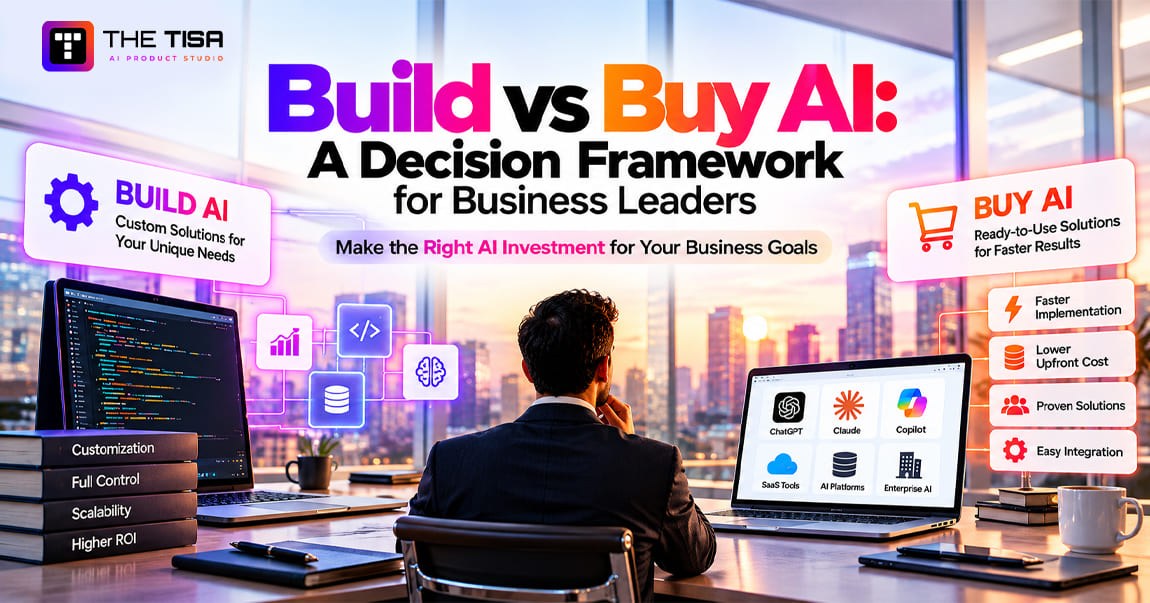
Ans. Building AI in-house makes sense when AI is a long-term core product and the business can hire specialists. Hiring an AI development company is a better option when results are needed within months, internal AI expertise is limited, or the business wants to prove value first. Many companies use a hybrid approach: a development partner builds the first version and trains the internal team.
Q6. What are the best AI development companies for startups?
Ans. Startups usually do best with a company that offers fixed-scope MVP builds, keeps senior engineers on the project and hands over full IP. On this list, THE TISA, 10Pearls and Markovate are the closest fits; check each one’s minimum project size first. For SaaS products, see our page on working with an AI SaaS development company.
Q7. How much does it cost to hire an AI development company in the USA?
Ans. Among the US-headquartered companies here, published rates run from USD 25–49 per hour for firms with nearshore or offshore delivery (Azumo, 10Pearls) to USD 50–99 per hour (Markovate, ScienceSoft, BairesDev, Coherent Solutions). Fully onshore US teams usually charge more. Compare total project cost, not just the rate.
Q8. Are offshore AI development companies reliable?
Ans. Reliability depends on the company, not the country. Check verified reviews, ask for production AI work, meet the actual team, and agree on overlap hours, US governing law and IP assignment in the contract.
Q9. What is the difference between AI development and generative AI development?
Ans. AI development is a broad field: machine learning, computer vision, predictive models and more. Generative AI development is one part of it, focused on systems that create text, images, code or audio, usually built on large language models.
Q10. How can an AI development company’s experience be verified?
Ans. Buyers should request a live demo of a production system, a client reference they can contact, and evaluation results from a previous project. They should also check the company’s Clutch reviews for AI-specific projects, not just general software development work.
Q11. What industries benefit most from custom AI development?
Ans. Industries with lots of documents, repeat decisions or visual inspection gain the most: healthcare, financial services, insurance, manufacturing, logistics, e-commerce and customer support. The industry table above shows which companies have public evidence in each.
Q12. What should an AI development agreement include?
Ans. IP and code assignment, model and data ownership, API and infrastructure cost responsibility, service levels, data retention and deletion, a defect warranty, maintenance terms and an exit plan. See the contract checklist above.
Looking for the Right AI Development Partner in 2027?
Choosing an AI development company involves more than comparing prices and service lists. Talk to THE TISA about your AI project, technical requirements, integrations, and development goals to understand the right approach for building and launching your AI solution.
Discuss Your AI Development Project →