


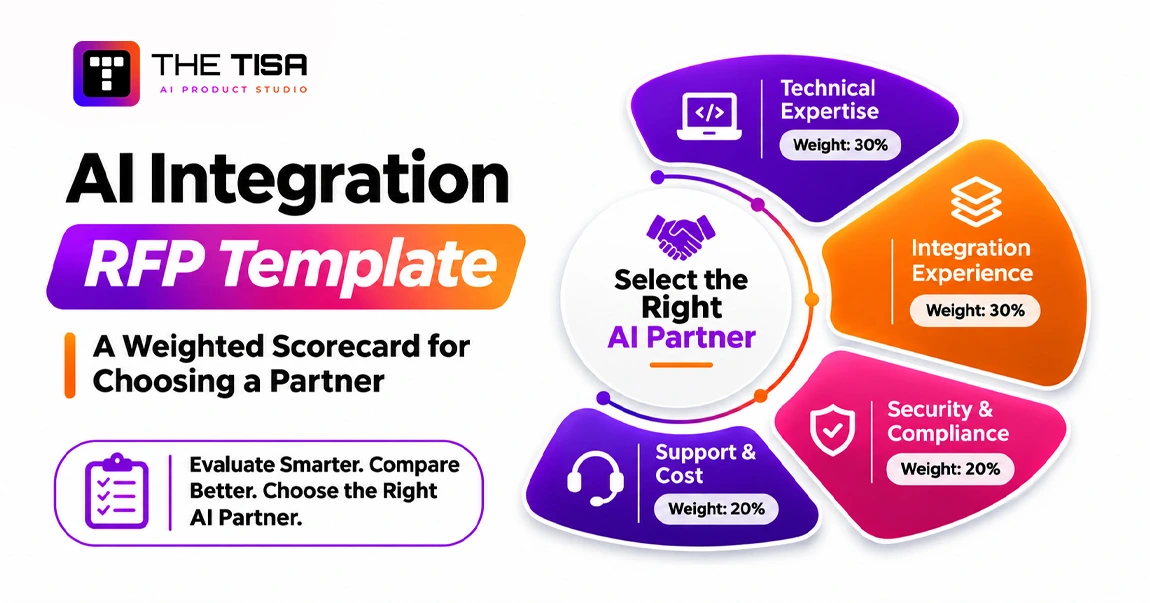
Selecting an AI integration partner can be difficult when vendors propose different technologies, development approaches, timelines, and pricing models for the same project. Without clear requirements, businesses may struggle to identify which partner can meet their needs.
An AI integration RFP template helps businesses prepare a Request for Proposal (RFP) that outlines their objectives, existing software infrastructure, technical requirements, security expectations, and budget. It ensures that vendors receive the same information, making their proposals easier to compare.
The US Federal Acquisition Regulation (FAR) emphasizes evaluating both cost and non-cost factors, including technical capabilities, past performance, and personnel qualifications. Private businesses can follow similar principles when assessing AI integration service providers.
A weighted scorecard helps businesses prioritize vendor selection criteria according to project needs. For example, a healthcare company may prioritize data security, while a SaaS business may place greater importance on integration capabilities and scalability.
This guide provides an editable RFP template and explains how to assess vendor capabilities and compare proposals using a weighted scorecard.

What Is an AI Integration RFP and When Do You Need One?
An AI integration request for proposal (RFP) is a document that businesses send to potential development partners to communicate project requirements and request technical and commercial proposals.
Unlike a general AI development RFP, an integration-focused document explains how new AI capabilities must work with existing applications, databases, APIs, and business workflows.
However, not every AI project requires a formal RFP.
| Business Situation | Recommended Approach |
|---|---|
| Unclear business or technical requirements | Discovery brief |
| Exploring available AI solutions | Request for Information (RFI) |
| Small integration with a fixed scope | Request for Quotation (RFQ) |
| AI integration across multiple business systems | Request for Proposal (RFP) |
| Complex enterprise AI implementation | RFP with technical and security assessment |
An RFP becomes particularly useful when businesses need to compare multiple vendors, manage significant investments, or protect sensitive information.
If your team has not established clear project requirements, complete an initial discovery phase before requesting detailed implementation proposals.
AI Integration RFP Template: 12 Sections to Include
A practical RFP communicates what your business needs, which technical constraints vendors must address, and how you will evaluate their proposals.
Use the following AI integration requirements checklist to structure your document.
| RFP Section | Information to Include |
|---|---|
| Company overview | Industry, business operations, company size |
| Business objectives | Existing problems, expected outcomes, success metrics |
| Project scope | Required AI features, workflows, deliverables, exclusions |
| Existing software infrastructure | CRM, ERP, databases, APIs, cloud environment |
| Data requirements | Data sources, formats, quality, volume, accessibility |
| Technical requirements | Performance, system compatibility, scalability |
| Security and compliance | Access controls, data privacy, regulatory requirements |
| Budget and timeline | Investment range, milestones, expected launch date |
| Testing and acceptance criteria | Quality benchmarks, test scenarios, approval process |
| Maintenance and support | Monitoring, updates, incident response |
| Ownership and handover | Source code, configurations, documentation, exit terms |
| Proposal submission requirements | Response format, deadlines, evaluation criteria |
Distinguish mandatory requirements from optional features. Where technical details remain uncertain, identify them openly and ask vendors to explain how they would resolve those uncertainties.
Define project requirements and compare AI integration partners using an editable RFP template and weighted scorecard.
How to Write an AI Integration RFP: A Practical Example
Start by describing the business problem, the systems involved, and the expected outcome. Avoid prescribing a particular AI model unless your organization has a specific technical or compliance requirement.
The following example illustrates how a SaaS company could prepare an RFP for an AI-powered customer support integration.
| RFP Requirement | Example Project Details |
|---|---|
| Business problem | Support teams spend excessive time answering repetitive questions |
| Project objective | Reduce average ticket-handling time by 30% |
| Existing systems | Salesforce, Zendesk, internal knowledge base |
| Expected workload | 20,000 support tickets per month |
| Required AI capabilities | Ticket classification, information retrieval, response drafting |
| Security requirements | Role-based access and restricted customer data |
| Human oversight | Staff approval for refunds and account changes |
| Acceptance criteria | Representative test cases, accurate responses, reliable system integration |
| Expected deliverables | Working integration, source code, documentation, training |
These figures represent illustrative project requirements, not actual client results.
Assign a business owner, technical lead, and security reviewer to approve the RFP. Their involvement helps establish realistic requirements and identify dependencies that could affect implementation.
Ask every vendor to respond using the same document structure, including proposed architecture, assumptions, exclusions, costs, and delivery milestones.
AI Vendor Evaluation Scorecard: A Weighted RFP Matrix
A weighted scorecard helps businesses evaluate AI integration partners against consistent criteria. Instead of treating every requirement equally, it assigns greater importance to capabilities that directly affect project success.
The following recommended AI vendor selection criteria provide a 100-point evaluation framework.
| Evaluation Criteria | Weight | Evaluation Focus | Evidence to Request |
|---|---|---|---|
| Technical expertise | 20% | Architecture, AI engineering, scalability | Architecture diagrams |
| Integration capabilities | 20% | APIs, connectors, software compatibility | Working integrations |
| Security and compliance | 15% | Data protection, governance | Security reports |
| Relevant experience | 10% | Comparable business projects | Case studies, references |
| Delivery approach | 10% | Milestones, testing, development process | Project plans |
| Pricing transparency | 10% | Development and operational costs | Itemized estimates |
| Maintenance and support | 10% | Monitoring, updates, troubleshooting | Support agreements |
| Ownership and handover | 5% | Source code, documentation, exit terms | Contract terms |
| Total | 100% |
Adjust these weights to reflect your business priorities. Establish the final criteria before distributing your AI integration RFP template so that every vendor understands how you will assess its proposal.
How to Score AI Vendor Proposals
Assign each vendor a rating between one and five for every criterion.
| Rating | Meaning |
|---|---|
| 1 | Does not meet requirements |
| 2 | Partially meets requirements |
| 3 | Meets requirements |
| 4 | Exceeds requirements with evidence |
| 5 | Substantially exceeds requirements with strong evidence |
Calculate each weighted score using the following formula:
Weighted score = (Vendor rating ÷ 5) × Criterion weight
For example, a vendor with a technical expertise rating of four receives 16 out of the available 20 points.
Example of a Completed Vendor Evaluation Scorecard
| Evaluation Criteria | Weight | Vendor A | Vendor B | Vendor C |
|---|---|---|---|---|
| Technical expertise | 20% | 20 | 16 | 12 |
| Integration capabilities | 20% | 16 | 20 | 12 |
| Security and compliance | 15% | 15 | 9 | 12 |
| Relevant experience | 10% | 8 | 8 | 6 |
| Delivery approach | 10% | 8 | 10 | 6 |
| Pricing transparency | 10% | 6 | 8 | 10 |
| Maintenance and support | 10% | 8 | 6 | 4 |
| Ownership and handover | 5% | 5 | 4 | 3 |
| Final score | 100% | 86 | 81 | 65 |
In this hypothetical example, Vendor A achieves the highest overall score due to stronger technical, security, and maintenance capabilities.
However, vendors must also meet mandatory requirements. A high overall score should never compensate for failure to meet essential security or regulatory obligations.
How to Assess an AI Vendor’s Technical and Security Capabilities
Technical evaluation should establish whether a vendor can deliver a reliable AI integration within your existing software environment. Review the proposed architecture, integration methods, testing approach, and security controls.
Architecture and Integration Capabilities
Ask vendors to explain how their solution will connect AI models with existing applications, databases, and business workflows.
Assess their approach to API authentication, data synchronization, system failures, scalability, and infrastructure requirements.
A vendor-agnostic AI architecture can also provide greater flexibility when businesses need to change model providers due to pricing, performance, or operational requirements.
AI Testing and Performance
Request an evaluation plan that measures AI output accuracy, response time, task completion, and system reliability.
Vendors should demonstrate how they handle incorrect responses, unavailable data, and external API failures. Use representative business scenarios during technical demonstrations rather than relying exclusively on prepared examples.
Security and Compliance
Your AI integration RFP template should require vendors to explain:
- How they protect sensitive information and manage user permissions.
- Whether model providers retain business data or use it for training.
- How they prevent unauthorized AI actions and data exposure.
- How they manage audit logs, security incidents, and regulatory obligations.
The NIST AI Risk Management Framework provides voluntary guidance for managing AI risks, while the OWASP Top 10 for LLM Applications identifies application-level security risks.
Use these resources to establish relevant security requirements and request evidence of implemented controls.
How to Compare AI Integration Proposals by Cost and Timeline
Compare the total cost of ownership rather than the initial development quotation. Vendors may offer similar functionality but recommend different infrastructure, model providers, and maintenance arrangements.
The following hypothetical example compares two proposals with equivalent project scope and workload assumptions.
| Cost Component | Vendor A | Vendor B |
|---|---|---|
| Discovery and architecture | $5,000 | $3,000 |
| Development and integration | $35,000 | $25,000 |
| Testing and deployment | $8,000 | $5,000 |
| Monthly AI usage and infrastructure | $800 | $1,800 |
| Monthly maintenance | $1,200 | $2,000 |
| Build cost + 12 months of operations | $72,000 | $78,600 |
Although Vendor B offers a lower development quotation, Vendor A has a lower overall cost.
When comparing timelines, ask vendors to identify development milestones, API dependencies, data preparation requirements, and testing periods. Treat proposed timelines as indicative estimates until vendors validate these dependencies.
Your RFP should also clarify software maintenance and support responsibilities, including model updates, performance monitoring, integration troubleshooting, and production incidents.


What Questions Should You Ask an AI Integration Partner?
Vendor interviews help businesses clarify proposal details and verify capabilities that written responses may not demonstrate.
Ask shortlisted vendors the following questions:
- What similar AI integration projects has your team completed?
- Why does your proposed architecture suit our business requirements?
- Which technical dependencies could increase costs or delay implementation?
- How will your team measure AI accuracy and business performance?
- Who will own the source code, configurations, and integration components?
- How will your team handle system failures and security incidents?
- Who will maintain the solution after deployment?
- Can our internal engineering team manage or extend the solution independently?
Request written clarification for commitments that influence project costs, technical responsibilities, or delivery schedules. Include these commitments in the final statement of work.
How to Choose the Right AI Integration Partner
Use the completed RFP and vendor evaluation scorecard to establish a shortlist. Then validate the highest-scoring proposals through technical and commercial discussions.
- Screen proposals: Confirm that vendors meet mandatory project and security requirements.
- Score independently: Ask business, engineering, and security stakeholders to evaluate proposals using the same criteria.
- Conduct technical workshops: Review proposed architecture, implementation risks, and integration dependencies with the assigned engineering team.
- Validate uncertain requirements: Use a focused, paid proof of concept when the proposed solution involves significant technical uncertainty.
- Finalize the agreement: Confirm deliverables, acceptance criteria, payment milestones, ownership rights, and support obligations.
Review each vendor’s software development process to understand how its team manages discovery, development, testing, and production deployment.
Avoid selecting a partner based solely on pricing, technology preferences, or sales presentations. The final decision should reflect verified capabilities, business requirements, and long-term operational costs.
How THE TISA Approaches AI Integration Requirements
A strong AI integration proposal needs to account for more than model selection. Existing software architecture, data availability, business rules, and operational dependencies influence implementation feasibility.
As an AI software development company, THE TISA assesses these requirements when defining project scope and recommending technical approaches.
During the development of Narsik Logistics Control Hub, our team built an ERP foundation and subsequently integrated OpenAI to support booking data extraction, delivery document processing, and payment matching.
The AI integration phase took six weeks and used a shared server-side AI service, structured output validation, permission controls, and human review for selected workflows.
This project illustrates why businesses should evaluate both AI expertise and full-stack engineering capabilities when reviewing vendor proposals.
Through our AI integration services, businesses can validate technical requirements, identify integration dependencies, and establish a practical implementation scope based on their existing infrastructure.
Conclusion
Selecting an AI integration partner requires a clear understanding of business requirements, technical capabilities, implementation risks, and long-term costs. Comparing development quotations alone cannot establish whether a vendor can deliver and maintain a reliable solution.
A well-prepared AI integration RFP template helps vendors understand the project scope, while a weighted evaluation scorecard gives businesses a consistent method for comparing proposals.
Establish mandatory requirements, request evidence of vendor capabilities, and assess the proposed solution against your existing software environment. Where technical uncertainty remains, consider a focused discovery phase or proof of concept. These steps help businesses make informed investment decisions and select a partner that can support both immediate project objectives and future development requirements.
Frequently Asked Questions
Q1. How much does an AI integration project cost?
Ans. Simple AI integrations can cost 5,000–30,000, while complex enterprise implementations may range from $150,000 to $500,000 or more. The actual AI integration cost depends on project scope, data readiness, integration complexity, and security requirements. Businesses should also budget for ongoing AI usage, infrastructure, and maintenance costs.
Q2. How long does an AI integration RFP process take?
Ans. Businesses can allow two to six weeks as an initial planning estimate for a standard RFP process. Complex enterprise procurement may take several months, depending on project requirements, proposal evaluation, security assessments, and internal approvals.
Q3. How many AI integration vendors should a business shortlist?
Ans. Three to five qualified vendors provide a practical starting point for comparing technical capabilities, pricing, and project delivery approaches without creating excessive evaluation work.
Q4. Can small businesses use an AI integration RFP template?
Ans. Yes. Small businesses can simplify the template by focusing on business objectives, required integrations, budget, security, delivery expectations, and ongoing support.
Q5. Should businesses share confidential data during the RFP process?
Ans. Businesses should initially share sanitized or synthetic data. If vendors require sensitive information for technical validation, establish confidentiality agreements and appropriate access controls.
Q6. Should businesses choose a fixed-price or time-and-materials AI integration contract?
Ans. Fixed-price contracts suit clearly defined requirements. Time-and-materials contracts offer greater flexibility when technical dependencies or project requirements remain uncertain.
Planning an AI Integration Project?
Choosing the right AI development partner requires more than comparing project quotes. Talk to THE TISA about your AI integration requirements, technical evaluation criteria, system compatibility, security expectations, and project scope to understand the right approach for your business.
Discuss Your AI Integration Project →